A collection call is worth about €104 for every €1 you spend making it. Everyone in collections already believes a phone call beats another silent reminder. What I rarely see anyone put on paper is how much better, in actual euros — which matters, because chasing late payments already costs European businesses €275bn and 74 working days a year, about €9,194 per company (Intrum European Payment Report 2025). So I ran the numbers on Sono’s own calling data, step by step, from the moment we reach someone to the moment the money lands. Below is the whole chain: the conversion funnel, the cost side, how fast the cash arrives, and the one lever that nearly doubles all of it.
Here it is, per 1,000 reached contacts — meaning people who actually picked up. We only pay for calls that connect, so this is exactly the group the economics run on.
From a conversation to a payment
Out of 1,000 real conversations, 165 turn into payments. Reaching someone is just the start. To turn that call into cash, two more things have to happen: they have to agree to pay, and then they have to actually do it. Each step loses a share of the group.
| Step | Conversion | Contacts remaining |
|---|---|---|
| Reached (answered the call) | — | 1,000 |
| Promised to pay | 23.5% | 235 |
| Actually paid | 70% of promises | 165 |
The drop-off, drawn out:
That already sounds decent. It gets a lot more interesting once you put money on it.
The economics: €553 in, €57,750 out
Our average overdue balance is €350 (principal plus accrued interest and fees). So those 165 payments bring in:
165 × €350 = €57,750 recovered per 1,000 reached contacts.
The cost side has only two line items, and both are tiny:
- The calls: €0.50 per reached contact → €500.
- SMS confirmations: €0.15–€0.30, sent only to the 235 who promise to pay → about €53.
Total cost ≈ €553.
Line them up:
| Metric | Value |
|---|---|
| Recovered | €57,750 |
| Cost | €553 |
| Net recovered | €57,197 |
| Recovered per €1 spent | ≈ €104 |
| Cost to recover €1 | ≈ 0.96 cents |
| Cost per collected account | ≈ €3.35 |
A hundred and four euros back for every euro in. And that’s not the optimistic case — even if every SMS came in at the top of its price range, you’d still be looking at about €101 per €1. The cost is basically a rounding error against what it brings back. If you want the per-contact arithmetic behind that €0.50, we broke it down in AI versus human customer service: the real cost per contact.
The part that matters as much as the amount: speed
The people who paid did so 14 days after the call — 23 days before their final due date. Return isn’t only about how much; it’s about when.
For a lender, pulling cash in 23 days early across a whole book is real money. It shrinks days-sales-outstanding, frees up working capital, and — this is the part I care about most — it catches accounts before they slide into deeper delinquency, where recovery rates fall off a cliff and the cost of collecting climbs. Across Western Europe 47% of B2B invoices are already overdue and 6% end up as bad debt (Atradius Payment Practices Barometer 2025), so the accounts you catch early are the ones you don’t write off later. The call doesn’t just recover more. It recovers it sooner, which quietly prevents the expensive problems later. If you want the metrics to track that shift, DSO and the four numbers that prove call ROI covers the dashboard side.
The biggest lever isn’t the call — it’s how fast you make it
Here’s what convinced me this is a timing game, not just a channel game. The conversion rates aren’t flat across the book. The fresher the debt, the more people pick up, and the more of those who pick up agree to pay. Both curves point the same way, and they compound.
Take a pool of 10,000 overdue accounts and look at what happens depending on how quickly you get on the phone:
| Called at | Reach rate | Promise (of reached) | Accounts that pay | Recovered |
|---|---|---|---|---|
| 3 days past due | 53.0% | 30.4% | 1,128 | €394,800 |
| 10 days | 47.9% | 23.6% | 791 | €276,850 |
| 35 days | 46.7% | 20.5% | 670 | €234,500 |
| 65 days | 45.1% | 18.4% | 581 | €203,350 |
Same 10,000 accounts. Same overdue balances. The only thing that changed is how long we waited to call. Calling at day 3 instead of day 65 recovers €394,800 versus €203,350 — nearly double, about €191,450 more — off the exact same book. Per account, that’s €39 recovered instead of €20. And because the cost of a call doesn’t change with timing, the return per euro spent climbs too: roughly €131 back per €1 at three days, versus €83 at sixty-five (Sono calling data, 2026).
This is the part I’d underline for anyone running an overdue book: the single most valuable thing you can do is call immediately, every time, on every late account — and keep doing it at the scale of the whole portfolio. Waiting a few weeks doesn’t just delay the money; it quietly halves it. A person can’t call every account the day it goes late. Voice AI can, and that’s exactly where the extra €191,450 comes from. That’s the whole design premise behind Sono’s outbound collection calls, and it’s why the lenders and insurers we work with start the sequence on day one rather than day thirty.
Why a call beats a letter or a text
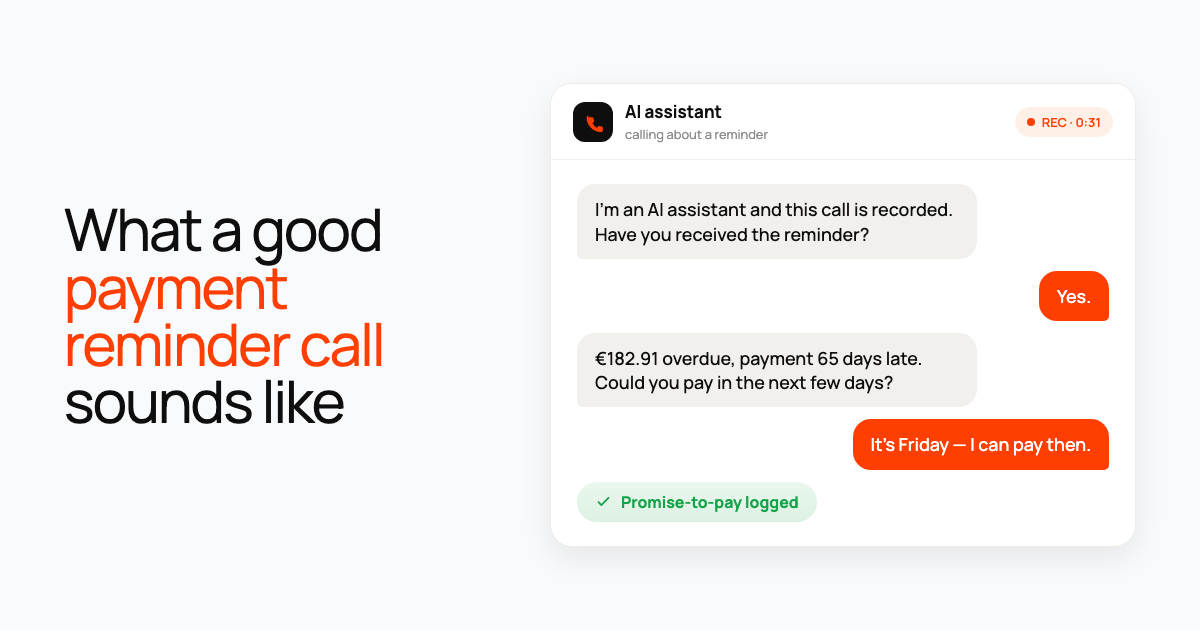
None of this is magic. A real conversation does three things a letter or a silent text can’t: it reaches the person in the moment, it gets a verbal commitment, and it makes paying feel like the obvious next step — reinforced by a text with the details the second the call ends. The middle one is doing more work than it looks: asking someone to promise out loud measurably lifts follow-through, an effect documented well outside collections — Kulik and Carlino found that simply asking parents to verbally commit significantly improved medication compliance (Journal of Behavioral Medicine, 1987). Voice AI just lets you have that conversation with your entire book, at €0.50 a call, without staffing a phone room to do it. We compared the channels head to head in payment reminder call vs text or email, and walked through what one of these calls actually sounds like in how an AI voice agent handles collection calls.
One honest caveat
These are gross recoveries. Some of these people would have paid eventually anyway — I’m not going to pretend otherwise. The real value of the call is the mix of three things: it lifts how many people pay at all, it pulls forward the ones who’d have paid later, and it does both at a cost so low the math works under almost any assumption you want to throw at it. Even if you wrote off a big chunk of these as “would’ve come in eventually,” the return still clears the bar comfortably — and you’d still be collecting them three weeks sooner. What that delay costs you while you wait is the subject of what unpaid invoices really cost.
Bottom line
Per 1,000 conversations, one round of Voice AI collection calls turned €553 into €57,750 — roughly €104 back for every €1 spent — and brought the money in 23 days early. That’s the whole case for putting a voice on your overdue book.
If you want to see what those numbers look like against your own portfolio — your balances, your ageing buckets, your reach rates — book a 20-minute walkthrough with us and we’ll model it with you before you commit to anything.
Figures are from Sono’s own calling data (2026), rounded for clarity. Answer, promise, and payment rates vary by portfolio, segment, and timing.
Sources
- Intrum — Chasing late payments costs European businesses €275bn a year
- Intrum European Payment Report 2025
- Atradius Payment Practices Barometer — Western Europe 2025
- European Commission — Late payment in commercial transactions
- Kulik & Carlino (1987) — The effect of verbal commitment on medication compliance