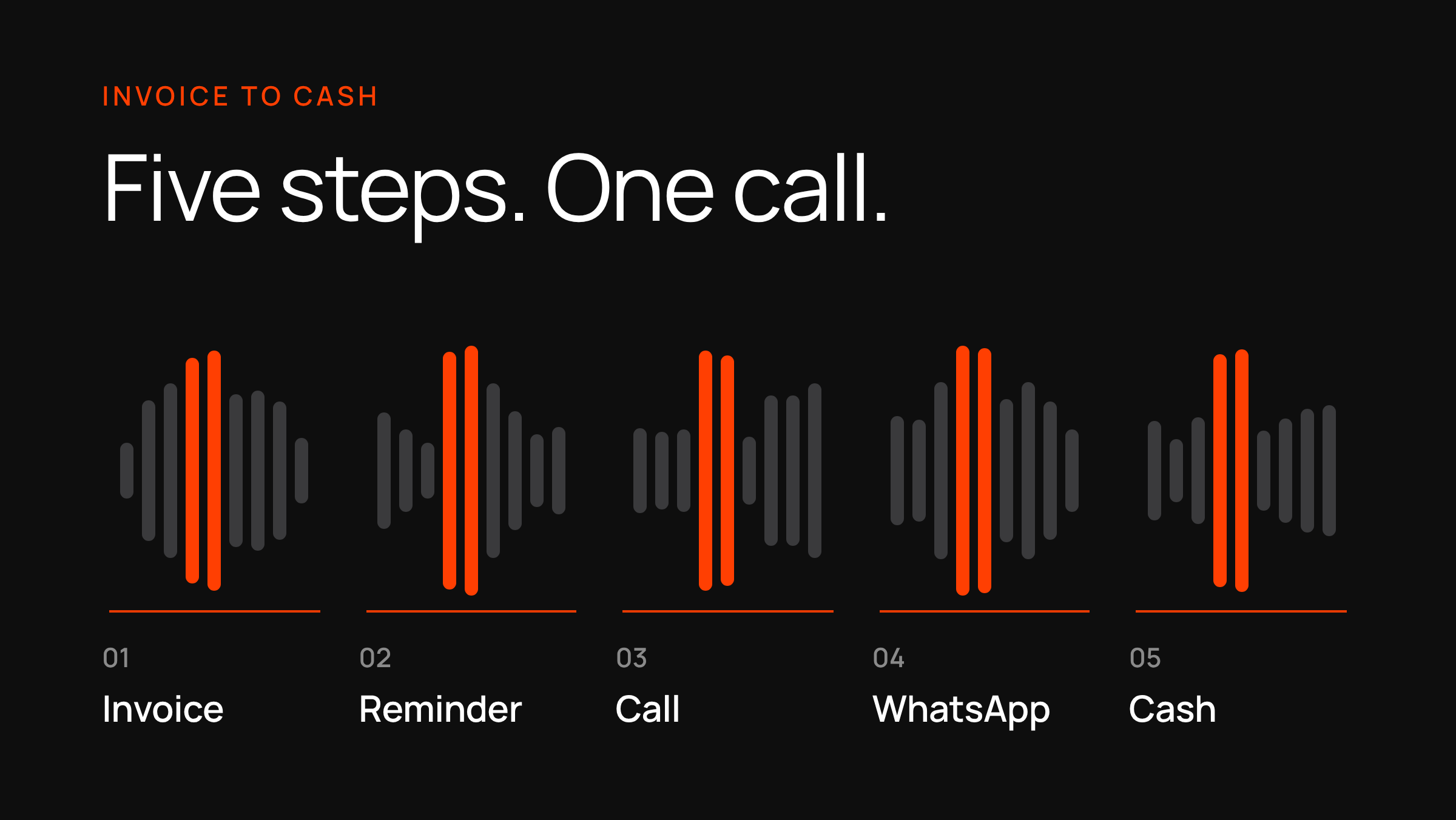

AI debt collection is the use of software agents — including voice agents that make and take phone calls — to handle routine collections work such as payment reminders, arrangement-to-pay conversations and overdue-invoice follow-ups. In the UK and Ireland, this work sits under strict fair-treatment rules, so the goal is not to replace your collectors but to hand them a tireless assistant for the repetitive calls. UK businesses lose the equivalent of 73 working days a year chasing late payments, according to Intrum’s European Payment Report 2025. This guide shows how to introduce a voice AI agent gradually, keep humans in control, and avoid disrupting the team you already have.
Most collections leaders don’t fear the technology — they fear the rollout. A tool that mishandles a vulnerable customer, breaks a compliance rule, or lands on the team as a surprise can cost more than it saves. A phased approach removes that risk.
What does a voice AI agent actually do in collections?
A voice AI agent is software that holds a natural spoken conversation over the phone: it calls a customer, confirms identity, states the reason for the call, answers common questions, and either takes a payment commitment or routes the call to a person. It works from the same scripts and rules your team already follows. For a fuller walkthrough of how these calls are structured, see how an AI voice agent handles overdue-payment calls.
In practice it is best suited to the high-volume, low-complexity end of your workload:
- Pre-due and early-stage reminders. Friendly nudges before or just after a due date, where no negotiation is needed.
- Broken-promise follow-ups. Chasing a payment the customer already agreed to, on a fixed cadence.
- Simple arrangement confirmations. Recording a customer’s intent to pay and passing anything unusual to a human.
The complex, sensitive cases — genuine hardship, disputes, vulnerable customers — stay with your people. That division of labor is the whole point.
Why introduce it in phases rather than all at once?
Because a big-bang switch-on maximizes exactly the risks you’re trying to avoid: compliance gaps, team anxiety and customer complaints all arrive at once, with no time to learn. A phased rollout lets you prove the agent on a narrow slice of collection calls, measure results, and widen scope only when the evidence supports it.
Late payment is a large enough problem to justify the care. Chasing overdue invoices costs European businesses an estimated €275 billion a year (Intrum, 2025), and under the EU Late Payment Directive (2011/7/EU) B2B terms can run to 60 days — so the reminders pile up fast. A phased pilot captures some of that value early without betting the whole operation on an unproven setup.
How do you run a low-risk pilot?
Start with one call type, a capped volume, and a human reviewing every outcome. A workable four-step sequence:
- Pick the narrowest useful use case. One segment, one stage — for example, first reminders on invoices 1–14 days overdue. Nothing sensitive.
- Shadow first, act second. Run the agent in parallel with your team, or on a small sample, and compare transcripts against how a person would have handled the call before it touches your wider book.
- Set hard guardrails. Calling only within permitted hours, a clear disclosure that the caller is an automated system, and an instant hand-off to a human on any sign of dispute or distress.
- Review daily, then weekly. A named person listens to recordings, checks payment outcomes and complaint rates, and signs off before scope expands.
Keep the pilot small enough that a single supervisor can genuinely oversee it. The reassurance comes from evidence you gathered yourself, not vendor claims.
How do you keep the team on side?
Tell them early, and frame the agent as workload relief rather than a headcount threat. Collectors spend a large share of their day on repetitive dialing that rarely needs human judgment; moving that to an agent frees them for the negotiations and hardship cases where they add real value.
- Involve collectors in the script. They know the objections and the phrasing that works — build the agent from their expertise, not around it.
- Give them the review role. The people who once made the calls become the people who quality-check them, an upskilling step rather than a demotion.
- Be specific about what changes. Name which call types move to the agent and which stay human, so no one is guessing about their own job.
How do you stay compliant in the UK and Ireland?
Automating a call does not lower the regulatory bar — it raises the need for control. In the UK, firms collecting consumer debt must follow the FCA’s rules in CONC 7.3, treating customers in arrears “with forbearance and due consideration”, and the Consumer Duty requires that support be as accessible in difficulty as it was at sale. Crucially, the FCA is clear that engaging a third party or a tool does not shed your responsibility for how customers are treated.
Three controls make automation defensible:
- Vulnerability detection and hand-off. The agent must recognize signs of distress or confusion and pass the call to a trained person immediately, not push on.
- Contact rules by design. No calls outside reasonable hours, and respect for a customer’s stated contact preferences — configured once, applied every time.
- Full auditability. Every call recorded, transcribed and logged, so you can show a regulator exactly what was said. Data handling must meet UK GDPR (and, in Ireland, the EU GDPR overseen by the Data Protection Commission).
Consistency is actually where automation helps: a well-configured agent never has a bad day, never skips the disclosure and never calls at the wrong time.
When should you expand — and how far?
Expand only when your pilot metrics clear a bar you set in advance: payment or promise-to-pay rates at least as good as your team’s, complaint rates flat or lower, and clean compliance logs. Then widen one dimension at a time — more volume, or the next call type, but not both at once — so you can always tell what caused a change.
A realistic path is reminders first, then broken-promise follow-ups, then simple inbound queries, with sensitive and legal-stage cases remaining human indefinitely. Many operations find the right long-term split is an agent handling the routine majority while the team concentrates on the cases that genuinely need a person.
If chasing overdue invoices is eating your team’s week, a voice AI agent introduced this way — one call type, tight guardrails, humans in control — lets you recover time and cash without a disruptive overhaul. The safest rollout is the boring one: small, measured and reversible. Talk to us about piloting it for your team, and let the results decide the pace.