A dunning process is the series of reminders a business sends to get an overdue invoice paid before the debt goes to a collection agency. It usually starts with an email or text, moves on to a phone call and ends with a final notice. Late payment is expensive in Europe: chasing it costs European businesses an estimated €275 billion and 74 working days a year (Intrum European Payment Report 2025), and 47% of B2B invoices are already overdue (Atradius Payment Practices Barometer 2025). Below you’ll find the stages of dunning, where the reminder call fits, and how recorded calls compare with AI voice agents.
Most teams put their effort into the written reminders, but the call is usually the step that decides whether an invoice gets paid or heads to collections. That makes the kind of call you use worth a closer look.
What is a dunning process?
The word comes from the verb “dun”, to demand payment of a debt, and it is now the standard English term finance teams use across Europe. It covers the same process as Mahnwesen in Germany, maksumuistutus and perintä in Finland, betalningspåminnelse in Sweden and aanmaning in the Netherlands.
A typical dunning process has five stages:
- A courtesy reminder a few days before the due date, usually by email or SMS.
- A first reminder shortly after the due date, often with a payment link.
- A reminder call in the first week or two past due.
- A final notice that explains what happens next, including any fees local law allows.
- A handover to a collection agency or a legal process.
The written stages are cheap and easy to automate. The call costs more per contact, and it is often the first time anyone actually talks to the customer about the invoice, so it is where most invoices either get sorted out or start moving towards collections.
What is a dunning strategy?
A dunning strategy decides who gets contacted, through which channel and when. Most teams segment customers by overdue amount, days past due and payment history, then set a cadence for each segment.
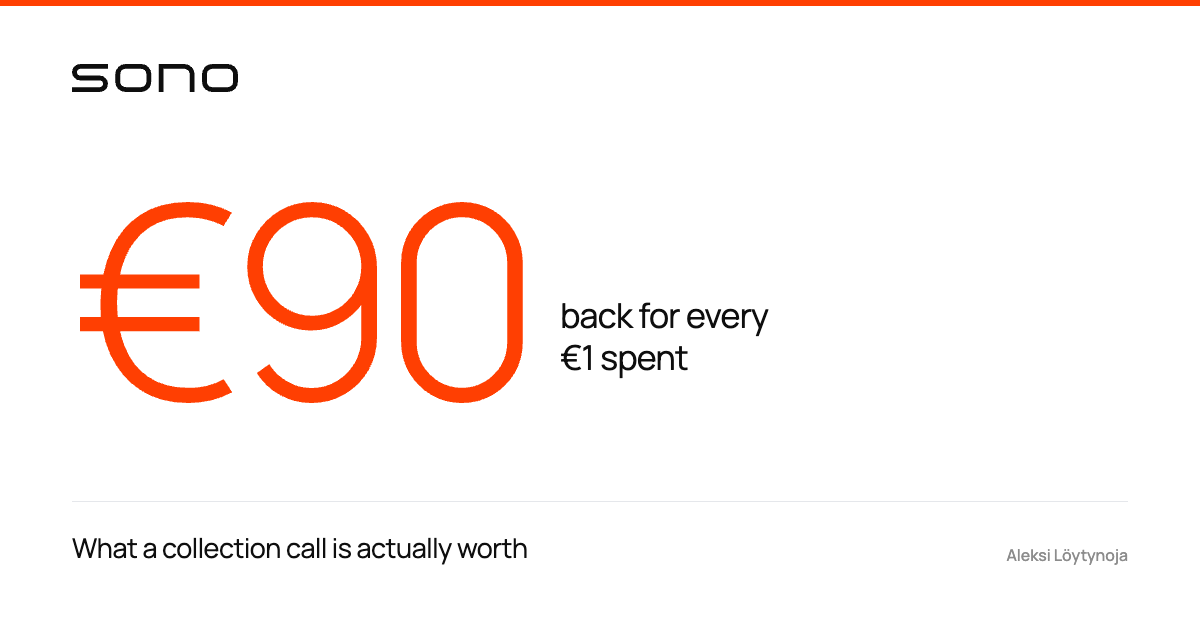
Timing matters most. In Sono’s collection data, calls made on day 3 past due recovered 1.94 times more than calls made on day 65 (what a collection call is worth). An early call only pays off if it can settle something, and that is where the type of call comes in. A recording in that slot is cheap per dial, but it wastes the window when the customer is still easy to reach and usually willing to pay.
Recorded calls vs AI voice agents in the call step
There are two ways to automate the call stage. The first is voice broadcasting, also called outbound IVR: a dialler plays the same pre-recorded or text-to-speech message to everyone on the list, sometimes with a “press 1” option. The second is an AI voice agent, which holds a two-way conversation with the customer and can agree a payment date within rules you set.
| Recorded call (voice broadcast / outbound IVR) | AI voice agent | |
|---|---|---|
| Conversation | One-way message, optional keypress | Two-way, natural speech |
| Identity check before mentioning the debt | Not possible | Built into the call |
| Handles “I’ve already paid” | No, the message plays anyway | Yes, logs it and pauses reminders |
| Agrees a payment date | No | Yes, within your policy |
| Outcome in your system | Delivered / not delivered | Promise date, amount, reason code |
| Languages | One recording per language | Switches language on the call |
| Handover to a person | Keypress to a queue | Warm transfer with a summary |
| Cost per dial | Lowest | Higher |
| Cost per collected invoice | Often high | Usually lower |
Recorded calls are cheaper per dial, and that is usually the figure that ends up in the budget. The more useful number is what it costs to get one invoice paid. Recorded calls often lose on that measure, because so few of them end with a payment date agreed.
What happens when the customer answers back?
Three replies come up on almost every reminder list.
“I paid it yesterday.” A recording plays the demand anyway, and the same call often goes out again the next day, which is a common source of complaints. An AI agent notes the date the customer gives and pauses the sequence until the payment shows up.
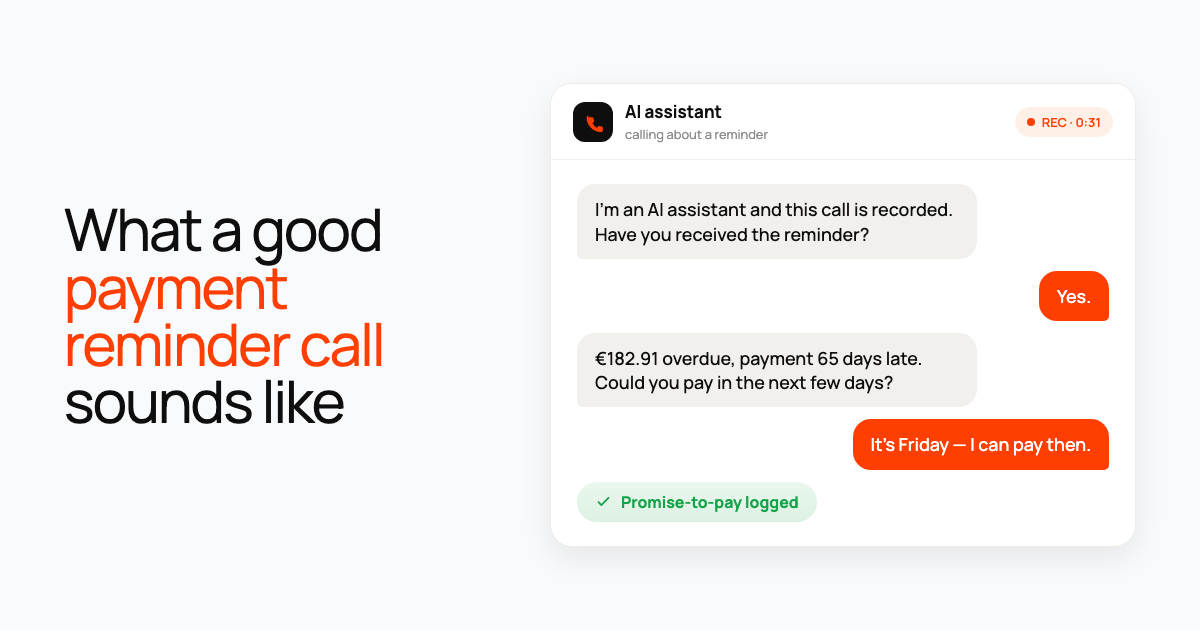
“Can I pay on the 15th, when my salary comes in?” A recording cannot agree to that, so the customer has to call your team, and many never do. An AI agent checks the date against your policy, confirms it, texts a payment link and only follows up if the money does not arrive.
The customer’s flatmate picks up. A recording that states the balance to whoever answers may disclose personal data to a third party. An AI agent checks who it is speaking to before mentioning the invoice and, if it is the wrong person, only asks when to call back.
There is a full example in our transcript of an AI payment reminder call.
Which dunning metrics show the difference?
If you test both approaches, count outcomes rather than dials:
- How many calls reach the actual account holder.
- How many of those customers agree a payment date.
- How many of those promises turn into payments.
- How much each paying account cost you in calls and SMS.
- How many complaints or disputes come in.
In Sono’s data, 235 of every 1,000 reached contacts promised to pay, and 70% of them kept the promise. That is a 16.5% call-to-cash rate and roughly €104 recovered for every €1 spent on calls and SMS. Recorded-call platforms usually report only delivery and keypress rates, so many teams have never seen their promise-to-pay rate. It is worth asking your current provider for it.
When is a recorded message enough?
A recording works when the customer does not need to decide anything, for example a courtesy reminder before the due date or a notice about a changed bank account. For very small balances, the cheapest channel may also be the sensible choice.
Once the invoice is overdue, the customer usually wants to pick a date or raise a problem, and a conversation handles that much better. A common setup is an SMS or recorded nudge before the due date, an AI voice agent from the first days past due, and your own team for disputes and vulnerable customers.
What EU rules apply to automated dunning calls?
Automated reminder calls are legal across the EU, but a few rules shape how you run them.
- Since 2 August 2026, the EU AI Act has required that people are told when they are talking to an AI system (Article 50, AI Act Service Desk). A compliant agent says it is an AI at the start of the call.
- The ePrivacy Directive requires prior consent for automated calls used for direct marketing (Directive 2002/58/EC, Article 13). A genuine payment reminder is a service message, so keep promotions out of the call.
- Under the GDPR, the debt should only be discussed with the person who owes it, which is why the identity check matters (Regulation (EU) 2016/679).
- For B2B invoices, the Late Payment Directive sets maximum payment terms and a fixed minimum of €40 compensation for recovery costs (Directive 2011/7/EU).
National rules add detail. Finland’s Debt Collection Act (513/1999) requires good collection practice, the Netherlands requires a 14-day notice before collection costs can be charged to consumers, and UK lenders follow the FCA’s forbearance rules in CONC 7. Check the rules in each market you call into before you start.
How do you test this in your own dunning process?
Pick one customer segment, keep the list and timing you already use, and replace the recorded call with an AI voice agent for a few weeks. Sono runs AI payment reminder calls in English and most European languages and reports promise-to-pay and call-to-cash from the first week, so you can compare the two with your own numbers.
Useful links and sources
- EU AI Act Service Desk: Article 50 transparency obligations
- Directive 2002/58/EC (ePrivacy)
- Regulation (EU) 2016/679 (GDPR)
- Directive 2011/7/EU on combating late payment
- Finland: Laki saatavien perinnästä 513/1999
- Intrum, European Payment Report 2025
- Atradius, Payment Practices Barometer 2025