An AI payment reminder call is an automated voice agent phoning a customer about an overdue invoice — the friendly nudge that happens before an account is passed to formal debt collection. That distinction matters: reminders sit under lighter, different rules than statutory collection, but firms still have to treat customers fairly. In the UK, the Financial Conduct Authority expects firms to treat people in or approaching arrears “with forbearance and due consideration” (FCA Consumer Duty). Most people assume an automated caller would ignore all that and just push for money. This guide walks through a real, anonymised reminder call, line by line, so you can hear what “good” sounds like.
Unlike a recorded reminder call, the agent listens and answers back. For where this call sits among the other reminders, see our guide to the stages of a dunning process.
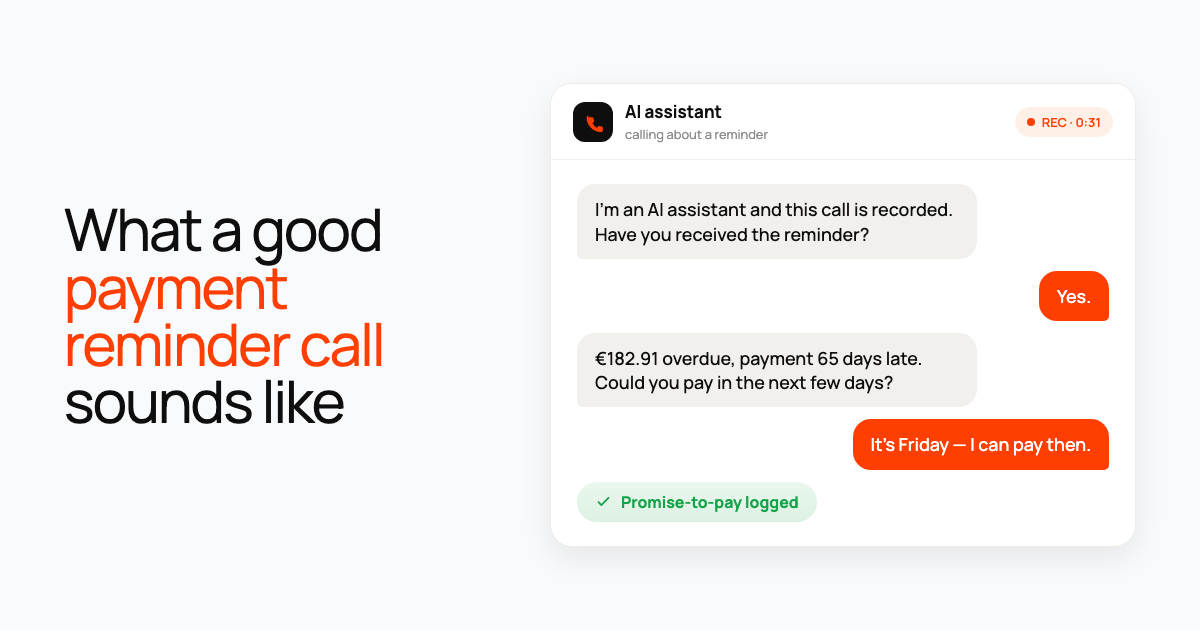
The call below is a genuine transcript from a consumer lender, lightly anonymized. The invoice is well overdue — late enough that the tone could easily turn hard. Watch how it doesn’t.
The transcript
AI: Hi, we’re calling about your overdue invoice. I’m an AI assistant and this call is being recorded. Have you received the reminder about the invoice? Customer: Yes. AI: Okay. You have an overdue balance of €182.91, and the payment is now 65 days late. The account is currently in an elevated credit-risk state, so arranging more time gets harder by the day. Would you be able to pay the full amount in the next few days? Customer: It’s Friday — I can pay then. AI: Alright. Let’s agree that you’ll pay the full amount on Friday. Does that work for you? Customer: Works. (system sends SMS with payment details) AI: Great — I’ve just sent you a text with the payment details. Did you get it? Customer: Yes, got it. AI: Good. Is there anything else I can help you with? Customer: No. AI: Alright, thank you for your time and have a good day.
Forty seconds, one resolved account, no raised voice. Now here’s why each move matters.
Why does the call open by admitting it’s an AI?
The very first thing the agent does is disclose two things: that it’s an AI, and that the call is recorded. This isn’t only good manners — it’s becoming law. Under the EU AI Act, from 2 August 2026 anyone deploying an AI system that interacts with people must clearly tell them they’re talking to a machine (EU AI Act, Article 50). That applies across the EU, including Ireland; in the UK it’s fast becoming best practice. A customer who knows what they’re dealing with can make informed choices about what they say.
- Disclosure builds trust, not suspicion. People forgive an honest robot far faster than a human agent who dodges the “are you a real person?” question.
- The recording notice is a data-protection baseline. UK and EU firms handling personal data on calls operate under GDPR; a clear notice up front keeps the call clean.
- The opening question is low-stakes. “Have you received the reminder?” lets the customer orient themselves before any number is mentioned.
Does it state the facts without shaming the customer?
Yes — and this is the part people don’t expect. The agent gives the exact balance (€182.91), the exact lateness (65 days), and the one real consequence that matters (the account is in an elevated credit-risk state). Then it stops and asks an open question.
There’s no moralizing, no “you should have paid this,” no threat dressed up as concern. A reminder is meant to prompt payment, not to punish — and because it comes before formal collection, its job is simply to give the customer the facts and a clear way forward. Stating a fact plainly and then listening is textbook good practice, and it’s easier for a machine to do consistently than a human having a bad afternoon.
How does it handle the customer’s own proposal?
The customer doesn’t say yes to “pay in the next few days.” They counter: “It’s Friday, I can pay then.” A poorly built agent would miss that or bulldoze past it. This one catches it, accepts it, and repeats it back as a firm agreement: “Let’s agree that you’ll pay the full amount on Friday. Does that work?”
That single exchange does three things well:
- It respects the customer’s autonomy. The customer set the date; the agent confirmed it. That’s a promise-to-pay they actually own.
- It confirms explicitly. Restating the amount and the date, then asking “does that work?”, removes ambiguity.
- It de-escalates by agreeing. The fastest way to lower the temperature of any money call is to reach an arrangement, and the agent does exactly that.
Roughly eight in ten people in problem debt say anxiety and stress are among the biggest effects on their lives, according to the debt charity StepChange — which is why a reminder that hands the customer a manageable next step, rather than a fight, does more for recovery than intimidation ever will.
What happens after the agreement?
The agent removes friction immediately. It sends an SMS with the payment details while still on the line, then checks the customer actually received it. Only after that confirmation does it move to close.
This matters because most “broken promises” aren’t refusals — they’re people who genuinely meant to pay and then couldn’t find the reference number or the link. By putting the payment details in the customer’s hand during the call and verifying receipt, the agent closes the gap between intention and action. It’s a small operational detail that quietly lifts the payment rate.
How does the agent get better after every call?
Here’s an advantage a human phone team simply can’t match. Because every call is transcribed and structured, you can review real completed calls and adjust the agent in minutes — tweak a line, soften a phrase, change when it escalates to a human — without scheduling training sessions or re-briefing staff.
- Tuning is fast and grounded in reality. You’re editing the agent based on how actual conversations went, not on assumptions about how they might go.
- Advanced Gen AI systems keep learning. Platforms like Sono continuously improve their agents from every customer call, so handling gets measurably better over time — the version running next month is sharper than today’s, tuned on real conversations.
- Improvements apply to every call at once. Fix one awkward moment and it’s fixed for all future calls, instantly and consistently.
Does it close the call with dignity?
The ending is almost anticlimactic, and that’s the point: “Is there anything else I can help you with?” — “No.” — “Thank you for your time, have a good day.” No parting warning, no guilt, no upsell. The customer leaves having been treated like an adult who hit a rough patch, which is precisely how the FCA’s vulnerability guidance (FG21/1) expects people in financial difficulty to be treated.
If your payment reminder calls are inconsistent, hard to staff, or difficult to evidence, a voice agent that sounds like the transcript above is worth hearing for yourself. The technology isn’t the surprising part — the surprising part is how calm and fair a good reminder call can be.