Collection-call ROI is the measurable return on every outbound call that chases an overdue invoice: the cash recovered set against the cost of making the call. Four numbers capture almost all of it — days sales outstanding (DSO), contact rate, promise-to-pay rate, and recovery per hour. Across the UK and the EU, roughly half of B2B invoices are paid late, and suppliers now wait an average of 61.8 days to be paid, more than five days longer than in 2022 (Intrum European Payment Report 2025).
That delay is expensive, and calling is one of the few levers that shortens it. This guide shows how to measure each metric, what “good” looks like, and how automated voice calls change the maths.
The four metrics that decide collection-call ROI
Most collections dashboards drown in numbers. For proving the return on calling specifically, four do the heavy lifting:
- Days sales outstanding (DSO) — the outcome metric. It tells you how fast cash comes back.
- Contact rate — the input metric. If you don’t reach the customer, nothing else happens.
- Promise-to-pay rate — the conversion metric. It shows how often a conversation turns into a commitment.
- Recovery per hour — the efficiency metric. It reveals what an hour of calling is actually worth.
Track these together and you can attribute cash movements to calling effort, rather than guessing.
What is a good DSO, and how do you calculate it?
DSO measures the average number of days it takes to collect payment after a sale. The formula is straightforward: (accounts receivable ÷ total credit sales) × number of days in the period. A company with £500,000 in receivables and £3m in quarterly credit sales has a DSO of about 15 days.
The global average DSO reached roughly 59 days in 2023 — the steepest single-year rise since the 2008 financial crisis. What counts as “good” is relative to your payment terms: a DSO close to your agreed terms is healthy, while a DSO running 30% or more above them signals a collection problem. Every day you cut from DSO frees working capital you can redeploy instead of borrow.
Calling drives DSO down by moving the payment date forward. In one anonymized deployment for a European consumer-finance lender, borrowers who committed on an automated call promised to pay in an average of 14.1 days — about 23 days sooner than the longest term an agent could have offered.
Why contact rate is the metric everything else depends on
Contact rate — often called right-party-contact (RPC) rate in collections — is the share of attempts that actually reach the person who can pay. It’s the ceiling on everything downstream: no contact, no promise, no payment.
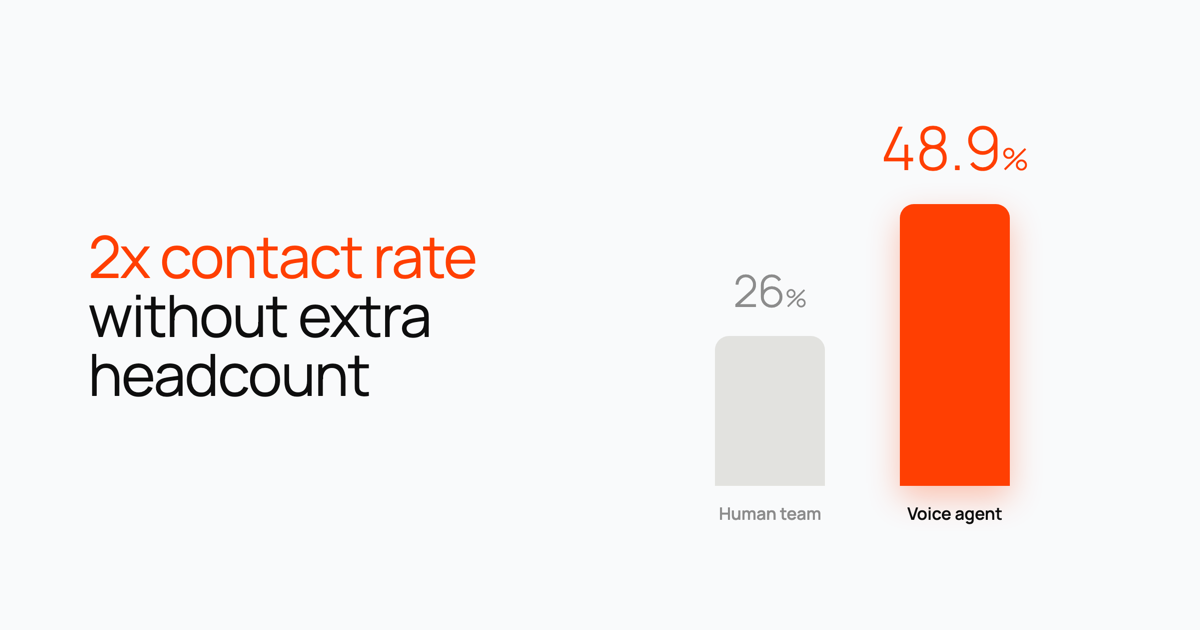
Human calling teams struggle here because they work fixed hours and can’t dial every account. The industry-average RPC rate sits near 26%, and many call centers fall below 20%. Automated voice agents lift this by calling every account, retrying at the times people actually answer, and working evenings and weekends. In the anonymized lender case above, the automated agent reached 48.9% of borrowers — well above the human benchmark — simply because it called them all, tirelessly. For a fuller look at how these calls are structured, see how an AI voice agent handles overdue-payment calls.
How much does a payment promise actually recover?
The promise-to-pay (PTP) rate is the share of contacted customers who commit to a specific payment date. It’s your truest leading indicator of recovery, because a dated commitment converts to cash far more often than a vague “I’ll sort it out”.
- What good looks like: a common target is to secure a promise from a large majority of the customers you actually reach; the anonymized lender converted 23.5% of all answered calls into a dated promise.
- What it costs: in the same deployment, the average cost per promise was €2.35 — and each promise protected roughly €115 of at-risk balance, a return of about 49× on outreach spend.
- Why it beats letters: a reminder letter or the statutory €40 recovery fee under the EU Late Payment Directive documents the debt; a phone promise commits the person to a date.
Multiply PTP rate by your average balance and kept-promise rate, and you get a defensible forecast of recovered cash per calling campaign.
What is recovery per hour, and why does it favor automation?
Recovery per hour is the cash collected divided by the calling hours spent to collect it. It’s the metric that exposes the real cost difference between human and automated calling.
A human agent handles a limited number of conversations per hour and only during office hours. An automated voice agent runs hundreds of calls in parallel at any hour, so its recovery-per-hour ceiling is far higher — and its cost per contact keeps falling as volume rises. The practical effect: you can call the whole book at every stage of delinquency, not just the largest balances, and still keep cost per promise low.
This is where late payment’s scale matters. Businesses across Europe spend the equivalent of 73 working days a year chasing overdue invoices (Intrum, 2025); shifting the routine chase to an automated agent returns most of that time to your team.
Does reaching borrowers earlier change the maths?
Yes — dramatically. The earlier you reach someone, the more willing they are to commit, and the cheaper each promise becomes.
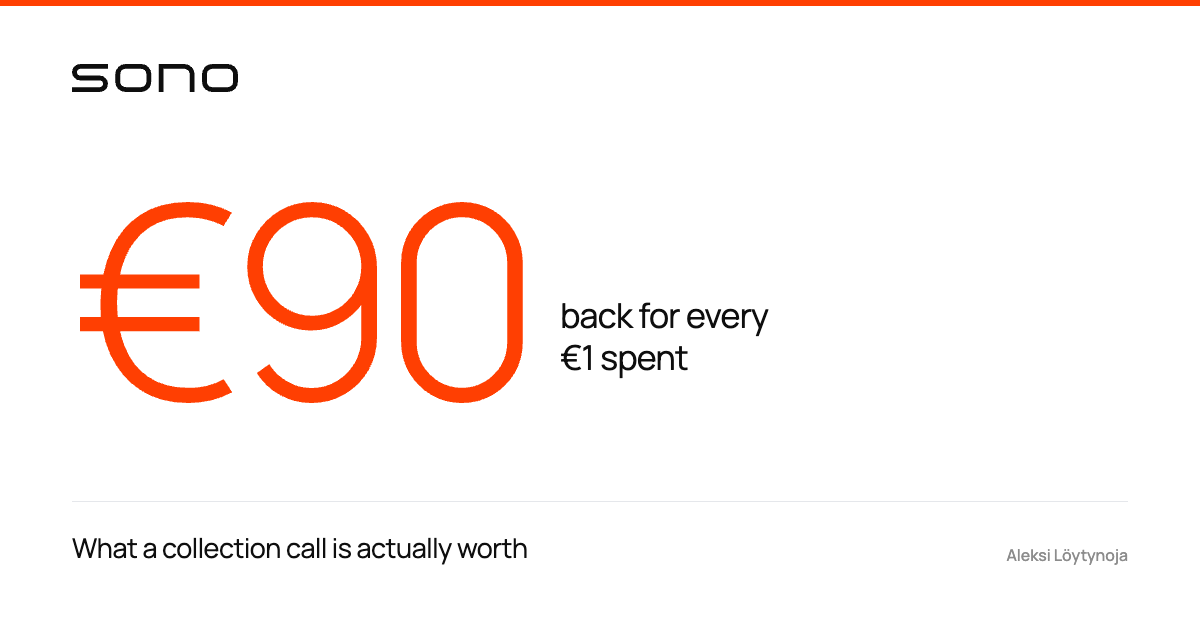
In the anonymised lender data, a borrower reached at 3 days past due promised to pay 32.5% of the time, at a cost of just €2.08 per promise. By 65 days past due, the promise rate had fallen to 11.69% and the cost per promise had risen to €5.02 — more than double. Carried across a whole book, that gradient is worth roughly twice the cash: we walked the full arithmetic through in what a collection call is actually worth, where calling at day 3 rather than day 65 recovered €347,900 instead of €178,850 off the same 10,000 accounts. Early, automated outreach is therefore not just faster; it is structurally cheaper per euro recovered, because it catches accounts before they harden into write-offs. Around 8% of B2B invoices become bad debt in some European markets (Atradius Payment Practices Barometer), and most of that is preventable with timely contact.
How to build a collection-call ROI dashboard
You can stand up a working view with the four metrics and a handful of supporting fields:
- Track DSO monthly against your payment terms, and annotate the chart when you change calling cadence.
- Log contact rate and PTP rate per campaign, split by days-past-due bucket, so you can see the early-vs-late gradient in your own book.
- Attribute recovered cash to promises kept, not just calls made, to get a true cost per euro recovered.
- Compare recovery per hour across human and automated channels to decide where each belongs.
If your current DSO sits well above your terms and your contact rate is stuck in the twenties, automated voice calls are the fastest lever to test. Sono’s voice agent calls every overdue account at the right moment and hands the complex cases to your team, so you can measure the four numbers above from day one. Talk to us about piloting it for your collections process.
Late payment is not going away, but it is measurable — and what you can measure, you can improve.