
An AI voice agent is software that holds a natural spoken phone conversation to complete a routine task — such as reminding a customer about an overdue invoice. In collections, it places the call, confirms who it’s speaking to, states the amount owed, and helps the person pay or set up a plan, with no human on the line. Think of it as a chatbot built for the phone, which is still where overdue balances get resolved fastest.
This guide covers how an AI voice agent works, where it sits within UK and Irish rules, and what in-house finance teams can realistically expect. The focus is the early, friendly reminder call — the one that stops an account ever becoming a formal collection case.
What an AI voice agent actually is
Three technologies now run fast enough to feel like a real conversation: speech-to-text turns what the customer says into words, a language model decides the reply within limits you set, and text-to-speech voices it back. The loop takes under a second, which is why a good agent no longer sounds like the old “press 1 for balance” menus.
For finance teams, the line that matters is routine versus complex. An AI voice agent handles the repetitive 90% of reminder calls — confirming a balance, taking a reference, booking a callback — and hands anything disputed or sensitive to a human. It doesn’t replace your collections specialists; it stops them spending the day on calls that never needed one.
How an AI collection call works, step by step
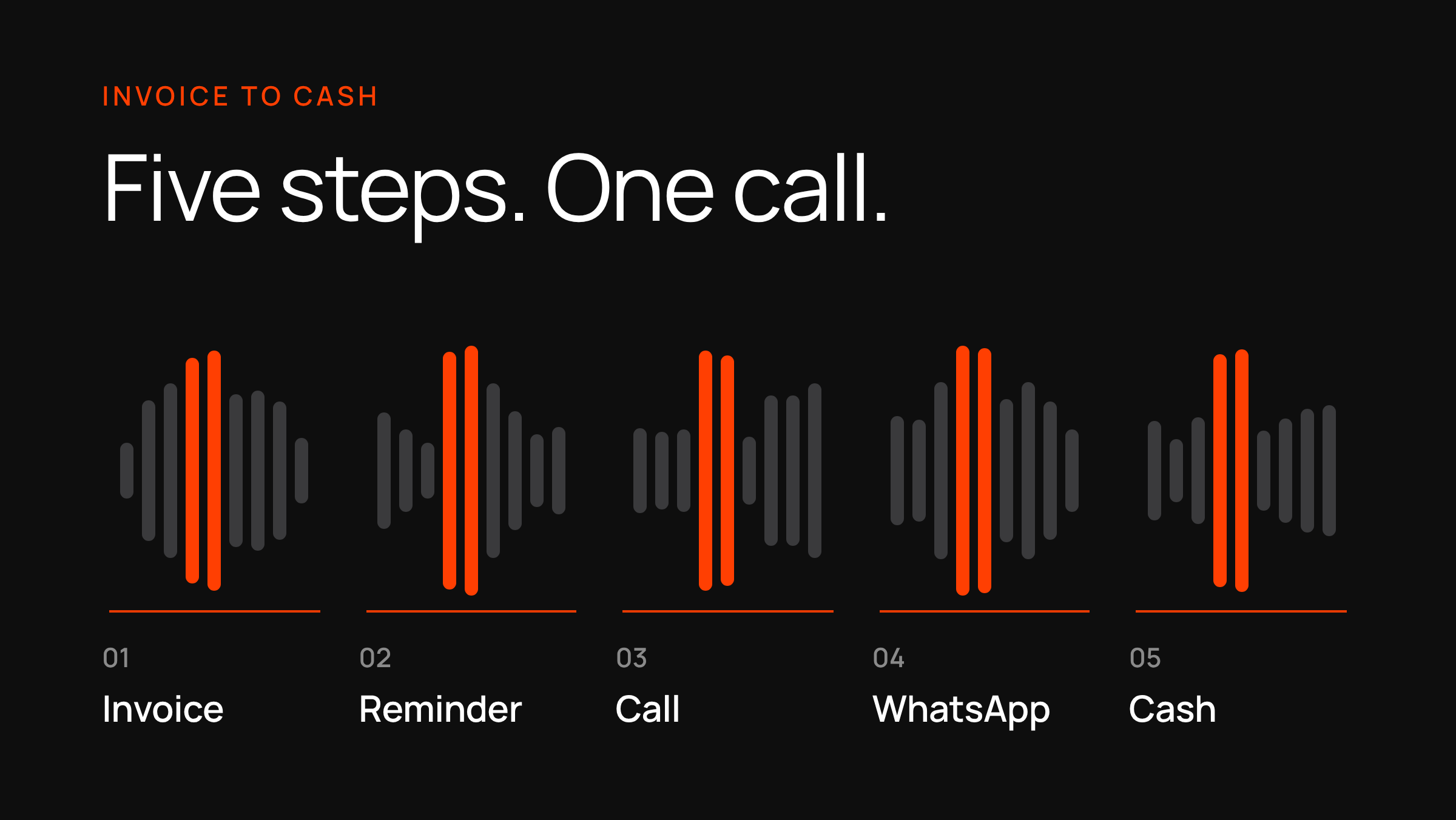
A typical outbound reminder follows a fixed, auditable flow:
- Identity and consent first. It confirms the right person and states who’s calling and why, before sharing any account detail.
- The facts of the invoice. Invoice number, amount, original due date — no pressure, no spin.
- A path to pay. Take payment, send a secure payment link by SMS, or set up an instalment plan within your rules.
- A clean handoff. Disputes, distress, or anything out of scope goes straight to a person.
- A full record. Every call is transcribed and logged automatically.
Because the script and its limits are fixed in advance, the agent behaves the same on call 5 and call 5,000.
Where it fits UK and Irish rules
Chasing your own overdue invoices is ordinary business, but it’s regulated. In the UK, statutory interest and compensation on late commercial payments come from the Late Payment of Commercial Debts (Interest) Act 1998, and consumer collections must follow the FCA’s rules against harassment. In Ireland and the wider EU, the Late Payment Directive (2011/7/EU) gives a business creditor at least €40 in fixed recovery costs plus interest at the ECB rate + 8 points.
An AI voice agent supports compliance rather than threatening it: it can’t call outside permitted hours, can’t apply pressure it was never given, and produces a verbatim record of every word. In a regulated function, that audit trail is often the strongest argument for automation. For the data-protection side, see our guide to secure, GDPR-compliant voice AI.
Reminder vs. collection: why timing matters
A reminder and a formal collection demand aren’t the same, and the agent’s best moment is the reminder stage — before things escalate. A prompt, polite call a few days after the due date clears most late payments without fees, interest, or damage to the relationship. Wait until 90 days overdue and a two-minute chat becomes a costly, adversarial process.
This is where automation changes the maths. Human teams triage — they call the biggest accounts and let the rest slide. An AI voice agent calls every overdue account on day one, at the early stage where recovery is highest and relationships stay intact.
What it can do — and what it can’t
It handles volume, consistency, and coverage. It calls in the customer’s language at the best time, never tires or snaps, and scales from hundreds to tens of thousands of calls without new hires. For neo-banks and financial-services firms with large B2C portfolios, that coverage is the whole point.
What it shouldn’t do: improvise on a disputed debt, negotiate beyond its limits, or handle a vulnerable customer alone. Treat it as the first, widest layer of contact and route the exceptions to people. Judge a vendor less on how human the voice sounds and more on how cleanly it hands off and how completely it logs.
Sources
- Late Payment of Commercial Debts (Interest) Act 1998: legislation.gov.uk
- EU Late Payment Directive 2011/7/EU (Ireland): EUR-Lex
- Financial Conduct Authority — Consumer Duty: fca.org.uk
If overdue invoices are quietly draining your team, an AI voice agent like Sono is worth a look for the early reminder stage, where a quick, consistent call does most of the work. You don’t have to automate everything at once — start with the routine reminders, keep your specialists for the cases that need them, and book a demo to hear a live reminder call.