A payment reminder call is an automated or human phone contact that prompts a customer to pay an overdue invoice, confirms they intend to, and captures a payment commitment in one conversation. In the UK and Ireland, most businesses lead with email and SMS because they are cheap and easy to automate — but for certain overdue accounts, a call recovers the money faster. Late payment affects around 60% of B2B transactions across the EU, and roughly half of all invoices are paid late or not at all (European Commission). This guide explains which channel to use for which account, and where a voice call earns its higher cost.
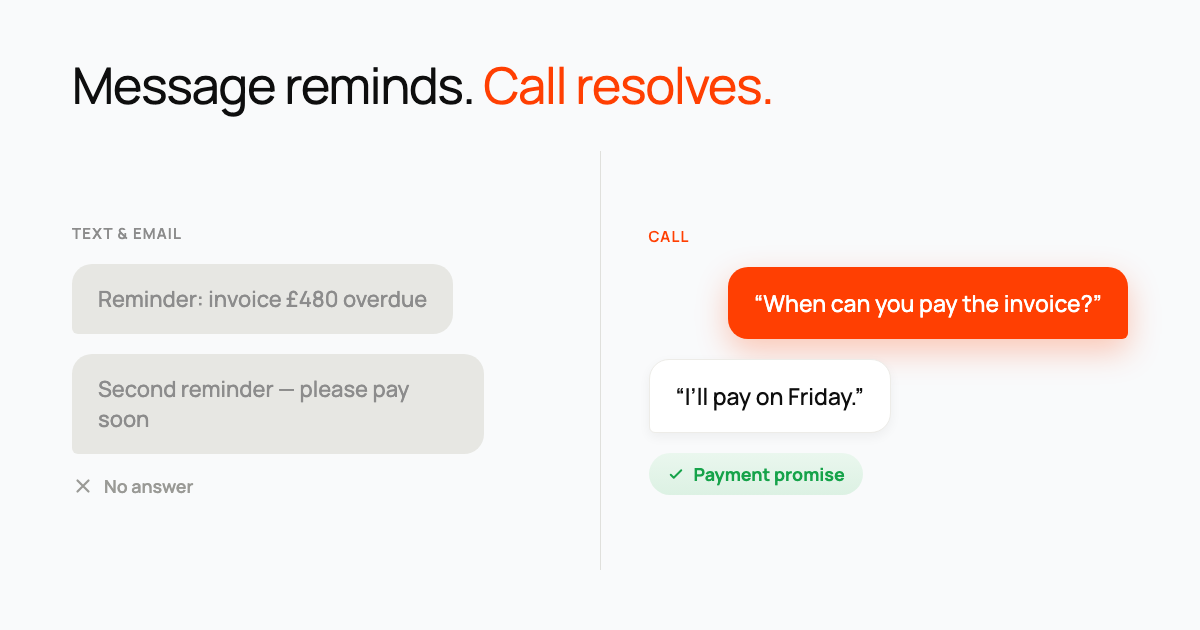
Text and email are not failing you everywhere. They clear the easy accounts — customers who simply forgot. The problem is the segment left behind after two or three ignored messages, and that is exactly where a call changes the outcome.
What does a payment reminder actually do?
A reminder has one job: move a specific invoice from “unpaid” to “paid” with the least friction and the least damage to the relationship. Every channel does this differently.
- Email carries detail — the invoice, a payment link, a full breakdown — but competes with a crowded inbox. Marketing email open rates sit around 20%, and a reminder buried at message three or four rarely gets opened at all.
- SMS is seen fast. Around 98% of texts are opened and 90% are read within three minutes (industry benchmarks, 2026), which is why it beats email for a gentle nudge before the due date.
- A call is the only channel that holds a two-way conversation — it answers “why haven’t I paid” in real time, handles the excuse, and ends with a commitment or a payment then and there.
The right question is not “which channel is best” but “which channel fits this account, at this stage, for this amount.”
When does a call beat a text or email?
A call is worth its cost when the message alone cannot resolve why the customer hasn’t paid. In practice, phone the account when:
- The invoice is high-value. The recovery justifies the per-contact cost. A £50 invoice does not need a call; a £5,000 one does.
- Two or more digital reminders have been ignored. Silence after email and SMS is a signal, not an accident. A call breaks the pattern.
- The account is aging past 30 days. Under the EU Late Payment Directive, 30 days is the default term for many transactions; every week beyond it lowers the odds of full recovery.
- There is likely a dispute or a genuine problem. A call surfaces “the goods arrived damaged” or “we never got the invoice” instantly, instead of trading one-line emails for a fortnight.
- You want a firm promise-to-pay. People honor a commitment made out loud in conversation far more than a link they close.
Which overdue segments respond to voice?
Not every debtor is the same, and channel choice should follow the segment rather than a fixed schedule.
- Forgetful payers: clear on SMS. A single pre-due-date text usually does it — no call needed.
- Chronically slow payers: respond to voice. They have learned to filter reminder emails; a call resets the priority.
- Silent non-responders: only a call confirms whether the contact details still work and whether the customer intends to pay at all.
- Disputed accounts: need a conversation, full stop. Text and email prolong the dispute; a call resolves or escalates it in minutes.
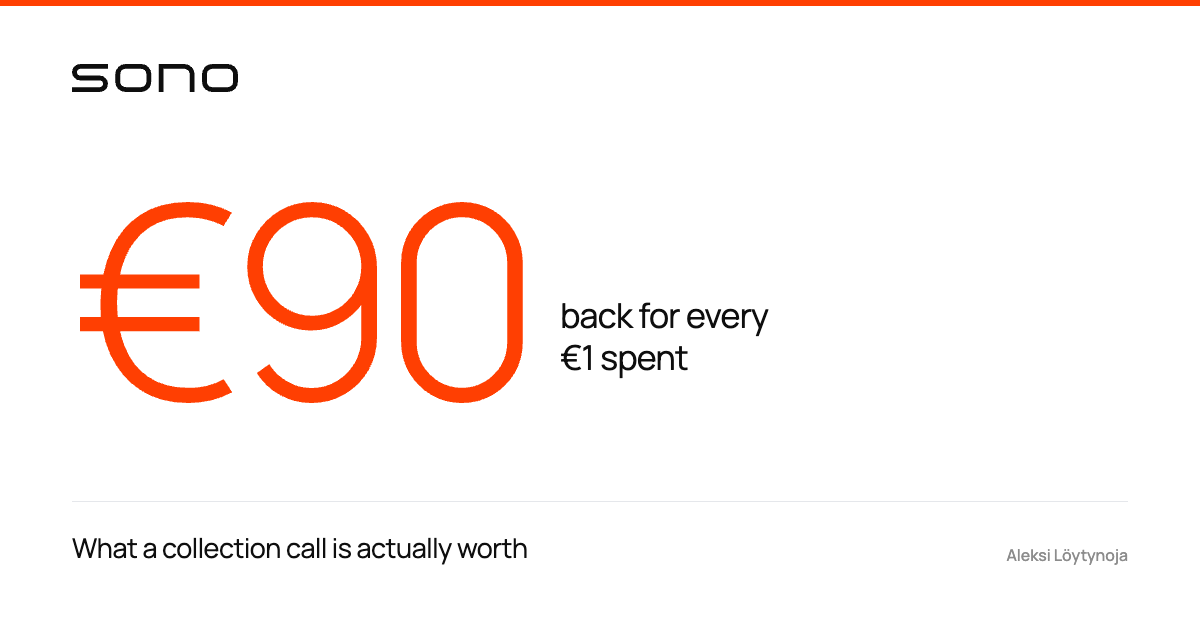
An automated voice agent lets you apply this logic at scale — calling hundreds of the right accounts a day, in a consistent, compliant tone, and passing only the genuinely complex cases to a human. See how the same calls also move DSO and collection-call ROI once you’re running them at volume. An agent like this is not the same as a recorded robocall; our guide to the dunning process compares the two in the call step.
How should the channels work together?
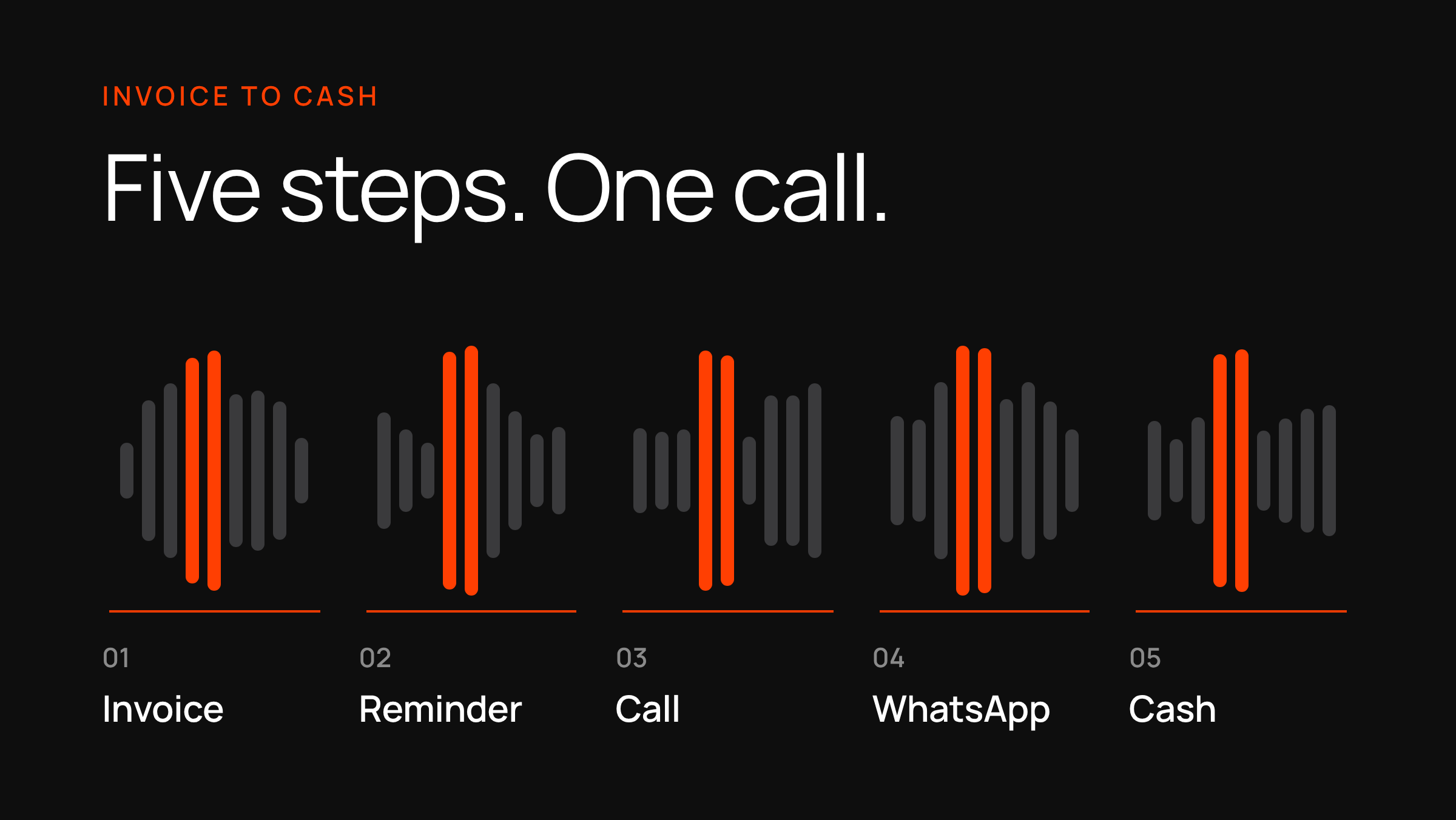
The strongest results come from a sequence, not a single channel. A practical ladder for the UK and Ireland looks like this:
- Before due date: a friendly SMS or email reminder with a payment link.
- Day 1–7 overdue: a second reminder by email, restating the amount and the link.
- Day 8–14 overdue: a voice call to any account that hasn’t paid — automated first, human for the exceptions.
- Beyond 14 days: escalate accounts that broke a promise, with the call log as your record.
Voice sits deliberately in the middle: after cheap digital nudges have done their work, and before formal collection. That placement is where it recovers the most for the least cost. For where this ladder sits in the wider receivables process, see accounts receivable automation and the call step.
Is an automated call compliant and appropriate?
Yes, when it is done properly. Reminder calls must be honest about who is calling, avoid harassment, and respect reasonable contact hours — the same standards that apply to any pre-collection contact. Keeping a clear record of each call, what was said, and any promise made protects you if an account later escalates. A well-designed automated agent logs all of this by default, which is often cleaner than ad-hoc manual calling.
Choosing the right channel, in one line
If a customer simply forgot, a text will do. If a customer is avoiding, disputing, or sitting on a large overdue balance, pick up the phone — or let an automated voice AI agent do it for you. Sono builds Voice AI agents that make those reminder calls automatically, so your team spends time only on the accounts that genuinely need a person. Getting the channel right for each account is the difference between chasing invoices and getting paid — book a short demo to see it on your own overdue accounts.