Cost per contact is what one customer interaction costs you end to end — labour, overhead and the queue included. In Europe, a human voice contact costs roughly €2.00 in Latvia and €6.26 in Norway, driven almost entirely by local labour cost. An AI voice contact costs €0.90–1.20 almost anywhere, because a minute of compute is priced the same in Riga and Oslo.
That single fact explains why this decision looks completely different depending on where you operate. This article builds the model from public sources, runs it at a deliberately conservative automation rate, and shows you the three places the argument falls apart.
Your numbers are almost certainly different from the illustrative ones — so start with yours. The calculator runs the same model this article does; the rest of the piece explains how every figure in it is built.
Model it on your own numbers
Change any assumption and the whole model updates. Nothing is hidden and nothing is gated — the results are yours.
We'll rebuild this on your numbers — including the calls you're currently losing to the queue.
Two things the model does on purpose. AI minutes are charged on every call, including escalated ones — that's the honest construction, so the triage minute is in the total. And human cost scales linearly here while real headcount does not: savings are realised by absorbing volume growth and redeploying people, not by a day-one headcount cut. There is no implementation cost in the model.
Labour cost: Eurostat lc_lci_lev, NACE Section N, per hour worked, EUR, 2025 (retrieved 2026-08-04). AI price is Sono's published €0.30–0.40/min managed range; the €0.35 default and 3-minute resolved handle time are our operating data, not a market benchmark.
What does a human customer service contact actually cost?
Start with the mistake most models make: using gross salary. Salary is maybe two-thirds of the answer.
Rather than stack assumptions, use the figure that already contains them. Eurostat publishes hourly labour cost per hour actually worked — employer contributions, holiday and sickness absence already netted out. For contact centre work, the relevant series is NACE Section N, administrative and support service activities.
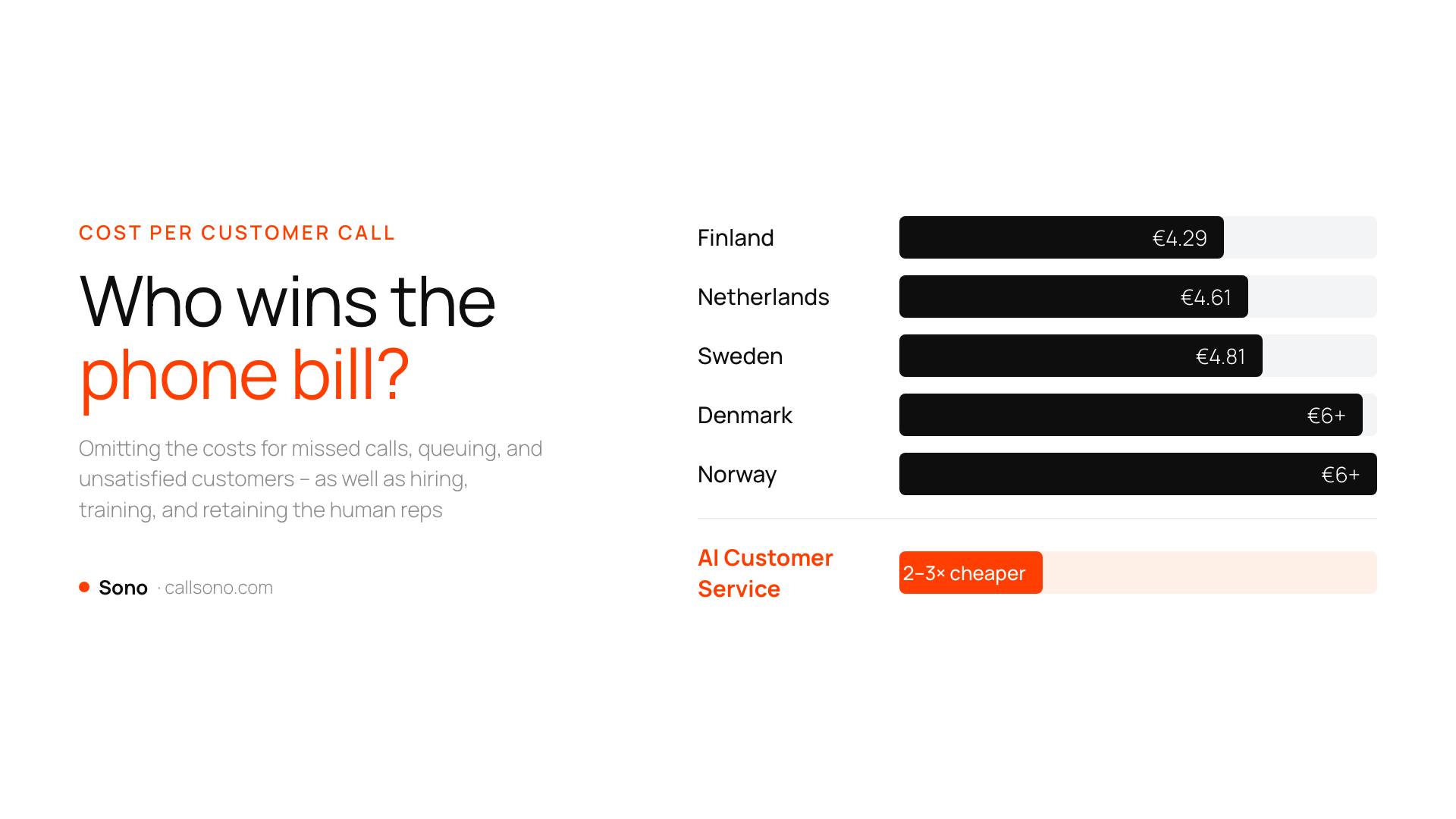
| Market | Labour cost €/hour worked (2025) | Cost per 7-min contact |
|---|---|---|
| Norway | 44.50 | €6.26 |
| Denmark | 44.40 | €6.24 |
| Sweden | 34.20 | €4.81 |
| Germany | 33.20 | €4.67 |
| Netherlands | 32.80 (2024; 2025 confidential) | €4.61 |
| Finland | 30.50 | €4.29 |
| EU-27 average | 26.40 | €3.71 |
| Estonia | 16.30 | €2.29 |
| Poland | 15.60 | €2.19 |
| Lithuania | 14.40 | €2.02 |
| Latvia | 14.20 | €2.00 |
Source: Eurostat lc_lci_lev, NACE N, EUR, enterprises with 10+ employees.
Two more steps get you from an hourly rate to a per-contact cost.
Occupancy. An agent isn’t handling contacts every hour they’re at work. The benchmark for maximum sustainable occupancy — share of logged-in time on talk plus after-call work — is around 83%, from more than 190,000 entries into Call Centre Helper’s Erlang calculator. Dividing by occupancy alone is conservative: training, coaching and team meetings sit outside logged-in time entirely, so real cost per handling hour is higher.
Handle time. ContactBabel’s UK benchmark (survey fielded late 2023) puts median service call duration at 360 seconds, mean at 421, with post-call wrap adding another 12% of agent time. Median talk plus wrap ≈ 7 minutes of handled time.
So: labour cost per hour ÷ 0.83 × (7 ÷ 60). For a Finnish operation that’s €30.50 ÷ 0.83 × 7/60 = €4.29.
That is labour only. It excludes team leaders, WFM, QA, telephony, licences, real estate, recruitment and attrition — which ran at 35–38% a year in North American contact centres in 2021–22, with each new hire costing an estimated $10,000–20,000 in recruiting, training and ramp-up (SQM Group; McKinsey, 2018). ContactBabel’s UK respondents report an all-in inbound call cost of £5.58 mean / £4.18 median — roughly €6.50 and €4.90.
Does outsourcing change it? Not as much as you’d hope. There is no citable per-ticket price list; publicly advertised BPO rates run $40–50 per agent-hour in Western Europe and $12–25 nearshore in Eastern Europe (CloudTalk — vendor-published, not research). The figure we hear quoted for a fully managed outsourced ticket in Northern Europe is around €4, which lands on the bottom-up in-house calculation. That isn’t coincidence: the BPO is solving the same labour equation you are, with better occupancy and thinner margins.
Working figure for the rest of this article: €4.00 per human voice contact. Conservative for Northern and Western Europe, generous for Central and Eastern Europe — we’ll come back to what that does to the answer.
What does an AI voice contact cost?
AI voice is priced per minute. Self-serve platform rates look very low: ElevenLabs Agents lists $0.080/minute for additional calls, Vapi $0.05/minute for hosting, Bland $0.11–0.14 all-in, Retell a published all-in range of $0.07–0.31.
Take those numbers for what they are. A platform rate buys you inference and a telephone line. It does not buy you a working customer service agent. It includes no discovery of what your customers actually call about, no integration into the systems where the answers live, no prompt and flow engineering, no test calls before go-live, no listening to recordings afterwards, no support when something breaks on a Monday morning, and no one accountable for the containment rate. All of that is real work, and if you don’t buy it you do it yourself — usually with engineers who cost more per hour than the agents you were trying to free up.
The difference with an enterprise-grade provider is not a better model. Everyone rents broadly the same models. The difference is that the product keeps getting better after go-live: every call is a data point, and reviewing them surfaces the intents the agent mishandled, the phrasings it didn’t recognise, the transfers it should have made and the ones it shouldn’t. That feedback loop is why a well-run deployment climbs from a decent containment rate to a high one over months instead of plateauing on day one. A self-serve platform has no mechanism for that. It ships you a rate card.
For a fully managed European deployment — telephony, models, integration into your CRM, ERP, booking or dispatch system, EU data handling, monitoring, QA on real recordings and continuous tuning — a realistic all-in range is €0.30–0.40 per minute. That’s a real premium over the platform rate, and it should be. Enterprise vendors typically publish no rate at all, so treat this as an indicative planning range rather than a quote.
At a three-minute average for a resolved call — our observed handle time, not a published benchmark:
€0.90–€1.20 per handled contact. Midpoint €1.05.
Against €4.00, that’s 74% cheaper, or 3.8×.
Is 3 minutes vs 7 minutes a fair comparison?
Partly, and it’s worth being precise because this ratio does a lot of work.
Seven minutes is a blended benchmark across all inbound service calls, easy and hard together. The routine subset AI resolves would take a human less than that average — call it four to five minutes. On a strict like-for-like basis, comparing the same simple contact, the handle-time advantage is nearer 1.5× and the total gap nearer 2.2–2.7×, not 3.8×.
Both numbers are true, and they answer different questions. Use ~2.5× if you want the narrowest claim that survives a hostile reading. Use 3.8× when you’re comparing against the cost base you actually carry — because you staff, pay and lose calls against your full mix, not against the easy subset. Your budget is blended, so the comparison to your budget is blended too.
Where the gap actually comes from
Per minute rather than per call, the picture is more sober. A €4.00 seven-minute contact is €0.57 per minute of handling. AI at €0.35 is only 1.6× cheaper per minute. The 3.8× factors cleanly into two things:
- Cost per minute: 1.6×. Not the dramatic part.
- Handle time: 2.3× (7 minutes vs 3). AI doesn’t small-talk, doesn’t put you on hold to check a system, and looks up your booking while you’re still describing it.
1.6 × 2.3 ≈ 3.8. That’s the whole per-contact gap — which means anyone claiming AI voice is “10× cheaper than a human agent” is comparing against offshore labour or not counting their own infrastructure.
And if you operate in Poland or the Baltics, read this twice
At €15.60/hour in Poland or €14.20 in Latvia, a human contact costs €2.00–2.20. Against €1.05 for AI that’s 1.9–2.1×, and at the top of that range (€1.20 per call) it’s 1.7–1.8×. Run the savings model there at 50% automation and you save 15–18%; at €0.40/minute in Latvia it drops to about 10%.
We’d rather say that plainly than sell you a Nordic business case in Vilnius. In lower-labour-cost markets the honest argument for voice AI is not cost per contact — it’s answering calls you currently miss, covering hours you currently don’t, and absorbing peaks without hiring. Those are worth real money too, but they’re a different case and they need a different model. Cost arbitrage is a Nordic and Western European story.
The cost that never appears in the budget: your queue
Cost per contact only measures contacts you answered. The larger number is usually in the ones you didn’t.
Human capacity forces a trade-off, and both sides are expensive.
Staff for the peak, and you pay for waiting. That waiting doesn’t appear as its own line — it appears as a worse cost per contact. Chasing a very high service level pushes occupancy down hard; Call Centre Helper describes an operation running a 99% service level in 5 seconds at just 45% occupancy (on a one-minute AHT). Here’s what falling occupancy does to the model, everything else constant:
| Occupancy | Cost per 7-min contact |
|---|---|
| 83% (benchmark max) | €4.00 |
| 65% | €5.11 |
| 45% | €7.38 |
Same work, same people, up to 84% more per contact. That’s a sensitivity on our own model rather than a measured case, but the mechanic is why “just add headcount for the peak” quietly destroys unit economics.
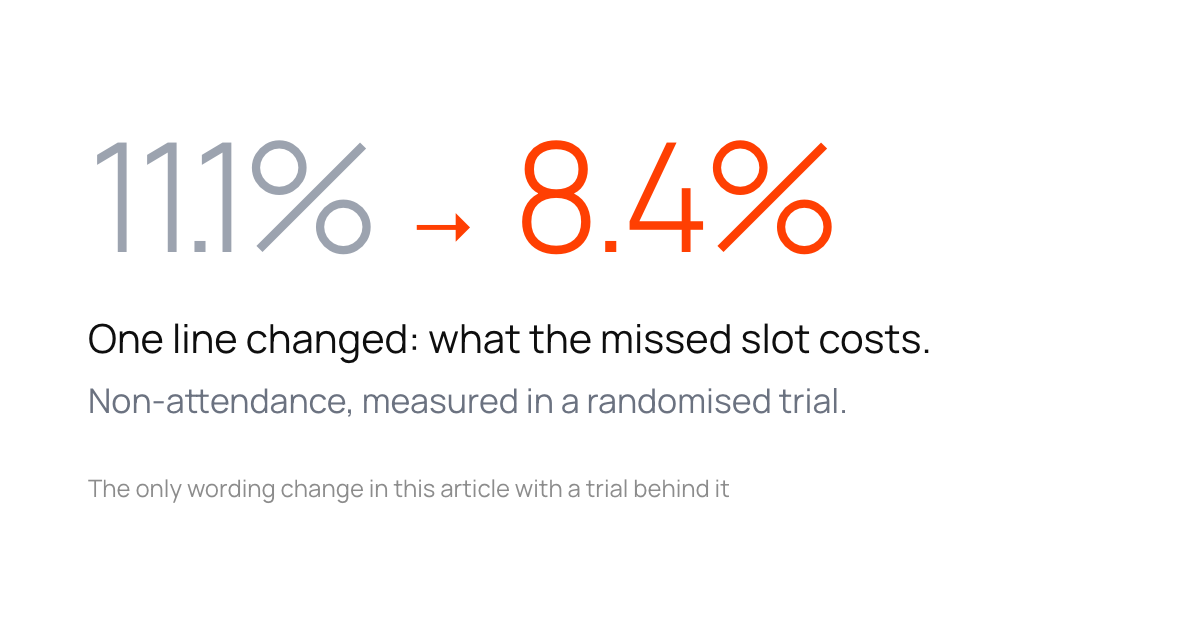
Staff for the average, and your customers pay in the queue. ContactBabel’s data has average speed to answer at 116 seconds mean / 48 seconds median — the mean is its second-highest level in twenty years — and abandonment at 8.4% mean / 6.0% median, roughly 90% higher than a decade earlier. Practitioner-reported cases show over half of callers hanging up after 45 seconds in sales and 95 seconds in technical support.
Abandoned calls are not neutral. 63% of consumers say they’d switch to a competitor after one bad experience, which Zendesk reports as up 9% year on year. Qualtrics puts global spending at risk from poor experiences at nearly $3 trillion for 2026, with 47% of bad experiences leading customers to cut spending.
Put numbers on it. Answer 5,000 calls a month at an 8.4% abandonment rate and roughly 460 more were offered and lost — over 5,500 a year nobody spoke to. They cost nothing in the P&L, which is exactly why they never get fixed. They show up in churn and in sales you never knew you had.
In the model below, the blended cost of a call is €2.70. Answering all 460 of those abandoned calls costs about €1,240 a month. Whether that’s a good trade depends on your average order value — for most of our customers, a handful of recovered jobs pays for it.
Why elasticity matters more than the hourly rate
Human capacity is a step function with a long lead time. You hire in whole FTEs, recruiting takes weeks, and reaching proficiency takes months — SQM Group puts it at six months or more. You cannot un-hire for a quiet Tuesday. McKinsey found 57% of care leaders expect call volumes to rise by up to a fifth over the next one to two years, and seasonal spikes are real: Zendesk measured ticket volume rising 42% between Q3 and Q4 of 2013, with retail CSAT falling six points.
AI capacity is a variable cost with no notice period. Monday-morning spike, campaign launch, product recall, snowstorm, end-of-month invoicing wave: the twentieth simultaneous call costs the same as the first, and a quiet week costs nothing. You buy minutes, not seats.
There’s a second-order effect worth naming: AI absorbs the variance, so your humans can run at healthy occupancy. You stop paying the low-occupancy premium from the table above, because the overflow no longer has to sit in a human queue.
What automation rate is realistic?
Everything above depends on how many contacts AI resolves end to end. Be sceptical of the numbers vendors quote here, ours included.
What we see in practice: first implementations typically reach a 60–70% automation rate, rising to 80–90% with continuous development as we widen intent coverage, deepen integrations and tune against real recordings. That’s Sono’s operating data, not third-party research.
It’s consistent with the independent picture:
- McKinsey, analysing 30+ organisations, finds 50–60% of customer interactions remain transactional — around 50% of call volume at a European bank, 40% of call reasons at a North American telco. That’s the addressable pool.
- Gartner predicts that by 2029, agentic AI will autonomously resolve 80% of common customer service issues, with a 30% cut in operational costs.
- Salesforce’s 2025 survey has 6,500 service professionals self-reporting that AI already handles 30% of cases, projected to reach 50% by 2027.
The counterweight matters: Gartner’s survey data shows traditional self-service fully resolves only 14% of issues. Automation rate is not a property of the technology — it’s a property of how well the thing is scoped, integrated and maintained. A voice agent with no access to your booking system will contain almost nothing, at any price per minute.
The model: savings at a conservative 50%
Let’s model 50% — below what we typically reach on day one, well below where deployments end up.
Scenario. 5,000 answered inbound calls a month. Human handled time 7 minutes at €4.00. AI at €0.35/minute — the midpoint of that range — 3 minutes for a resolved call, 1 minute of triage before escalation. AI minutes are paid on every call, including escalated ones — that’s the honest way to model it.
Baseline: 5,000 × €4.00 = €20,000/month (€240,000/year). That’s about 5.3 FTE at 37.5 hours a week and a 82.3% worked-hours ratio (EK, 2024) — roughly 950 calls per agent per month, ~45 a day. Real staffing runs higher once training and meetings are added, which again favours the AI case.
| Automation rate | AI minutes | AI cost | Human cost | Total/month | Saving/month | Saving % | Saving/year |
|---|---|---|---|---|---|---|---|
| 50% | 10,000 | €3,500 | €10,000 | €13,500 | €6,500 | 33% | €78,000 |
| 60% | 11,000 | €3,850 | €8,000 | €11,850 | €8,150 | 41% | €97,800 |
| 70% | 12,000 | €4,200 | €6,000 | €10,200 | €9,800 | 49% | €117,600 |
| 85% | 13,500 | €4,725 | €3,000 | €7,725 | €12,275 | 61% | €147,300 |
Stress-test it. Push every assumption against us at once — 50% automation, AI at the top of the range (€0.40/min), and a human contact at only €3.50 — and you still save 27%. At €0.30/minute and 50% automation you save 35% (€84,000/year).
The biggest lever isn’t the AI price, it’s human handle time. Use ContactBabel’s median talk time without wrap — 6 minutes instead of 7 — and the human contact costs €3.43, the headline becomes 69% cheaper / 3.3×, and the 50% case saves 30% instead of 33%. Check your own AHT before you believe anyone’s model, including this one.
What this table leaves out, in both directions
Against the AI case: there’s no implementation cost here. A real deployment has integration work, scoping and internal ownership — budget for it and calculate a payback period rather than annualising month one. And the table scales human cost linearly, which reality does not: you can’t shed 2.65 FTE in a straight line. In practice the saving is realised by absorbing volume growth without hiring, not backfilling attrition, and moving people onto higher-return work — not a headcount cut on day 30.
For the AI case, none of this is counted: the ~460 abandoned calls a month you now answer; falling wait times for calls that do reach a human, and the low-occupancy premium you stop paying; 24/7 coverage without night premiums; reduced attrition pressure once agents stop spending their day on “what time do you close?”; and every escalated call arriving with the customer identified and the reason already captured.
Where does this argument break?
If we only gave you the bull case you’d be right not to trust the model. Three things genuinely cut against it.
The per-minute price may not keep falling. Gartner’s January 2026 forecast is blunt: GenAI cost per resolution will exceed $3 by 2030, above what many offshore human agents cost, as data centre costs rise and AI vendors pivot from subsidised growth to profitability. Their analyst’s conclusion: “Full automation will be prohibitively expensive for most organizations; instead, leading organizations will use AI to drive customer engagement rather than to cut costs.” Build your case on today’s prices, not a hoped-for collapse.
Regulation is moving toward guaranteed human access. Gartner expects rules mandating easy access to a human agent to increase assisted-service volume by 30% by 2028. If your model depends on customers being unable to reach a person, it has a legal expiry date. And this is no longer forward-looking in Europe: the EU AI Act’s Article 50 transparency obligation — you must tell people they are interacting with an AI system — has applied since 2 August 2026. Design for disclosing it, not for hiding it. In our experience disclosure costs you almost nothing anyway, as long as the agent then resolves the call.
Companies that over-automated are walking it back. Gartner predicts that by 2027, 50% of organisations that expected to significantly cut their service workforce will abandon those plans, and half of those who did cut will rehire — noting only 20% ever actually reduced headcount. Klarna is the reference case: an AI assistant doing the work of 700 agents in 2024, then a public reversal — “I just think it’s so critical that you are clear to your customer that there will be always a human if you want” — and rehiring, while the AI still handles about two-thirds of inquiries. Qualtrics found AI customer service fails at roughly four times the rate of AI on other tasks, with half of consumers worried it will block them from reaching a human.
None of that argues against automating. It argues against automating everything.
The best customer service is hybrid — and so is the cheapest
We will never fully replace humans, and we don’t try to. Your best people should spend their time on your most valuable customers and your hardest cases — the angry ones, the complex ones, the ones where a good conversation saves a contract. That work is worth far more than €4 a contact.
But most customers, most of the time, aren’t looking for a relationship. They want to know whether the part arrived, move an appointment to Thursday, or reach the right person. For that, the fastest and by a wide margin the cheapest route is AI — and speed is what they actually care about. Five9 found 73% of US consumers accept AI handling their issue as long as they can escalate to a human if needed. That’s the design brief in one sentence.
So it isn’t humans or AI. Route the routine to an AI receptionist, route the valuable and the difficult to people, and give every customer a clean path from one to the other. That configuration produces the best quality — and it happens to optimise cost per contact and ROI too.
The right question isn’t “how much can we automate?” It’s “what is the cheapest way to give every customer the outcome they came for?” For most of your volume the answer is now obvious. For the rest it’s still a person — and you can finally afford to give them the time.
Send us your call volume, your average handle time and your country, and we’ll build this model on your numbers — including the calls you’re currently losing to the queue.
Assumptions used in this article
| Input | Value | Source |
|---|---|---|
| Labour cost per hour worked | €14.20–44.50 by market; €4.00/contact working figure | Eurostat lc_lci_lev, NACE N, 2025 |
| Occupancy | 83% | Call Centre Helper Erlang dataset |
| Human handled time per contact | 7 min (median talk 360 s + wrap) | ContactBabel, survey late 2023 |
| AI handled time / triage before escalation | 3 min / 1 min | Sono operating data |
| Automation rate | 50% modelled; 60–70% typical first implementation | Sono operating data |
| Call abandonment rate | 8.4% mean | ContactBabel, survey late 2023 |
| Monthly answered volume | 5,000 calls | Illustrative |
Excluded from the human cost: supervision, WFM, QA, training, telephony, licences, facilities, recruitment and attrition — including them improves the AI case. Excluded from the AI cost: implementation, integration and internal ownership — including them worsens it in year one. AHT, abandonment and cost-per-call benchmarks are UK data, the best available public series, applied to European cost bases.
Sources and useful links
- Eurostat, hourly labour cost
lc_lci_levand 2025 news release - ContactBabel, UK Contact Centre Decision-Makers’ Guide 2024 (survey fielded Oct–Nov 2023)
- Call Centre Helper, industry standards for contact centre metrics · occupancy · acceptable waiting time
- McKinsey, The contact center crossroads (2025) · Where is customer care in 2024? · Employee engagement (2018)
- Gartner: 80% by 2029 · 14% self-service resolution · cost per resolution above offshore by 2030 (coverage) · workforce-reduction plans abandoned · rehiring by 2027
- Zendesk CX Trends 2025 · Salesforce State of Service 2025
- Qualtrics, $3 trillion at risk · AI service failure rate
- SQM Group, call centre attrition · CloudTalk, outsourced pricing
- EU AI Act · Klarna reversal coverage
- Vendor pricing: ElevenLabs · Vapi · Bland · Retell