
An unpaid invoice is money you have already earned but cannot use: a receivable your customer has not settled by the due date. The fastest way to get one paid is to phone the customer on day one — because until you know why it is unpaid, every reminder you send is a guess.
That is not how most guides to this problem are written. Search for help with an unpaid invoice and you will be handed statutory interest rates, letter templates, and the number of a debt-recovery solicitor. All of that has its place, at step four or five. None of it tells you whether the invoice ever reached the right inbox.
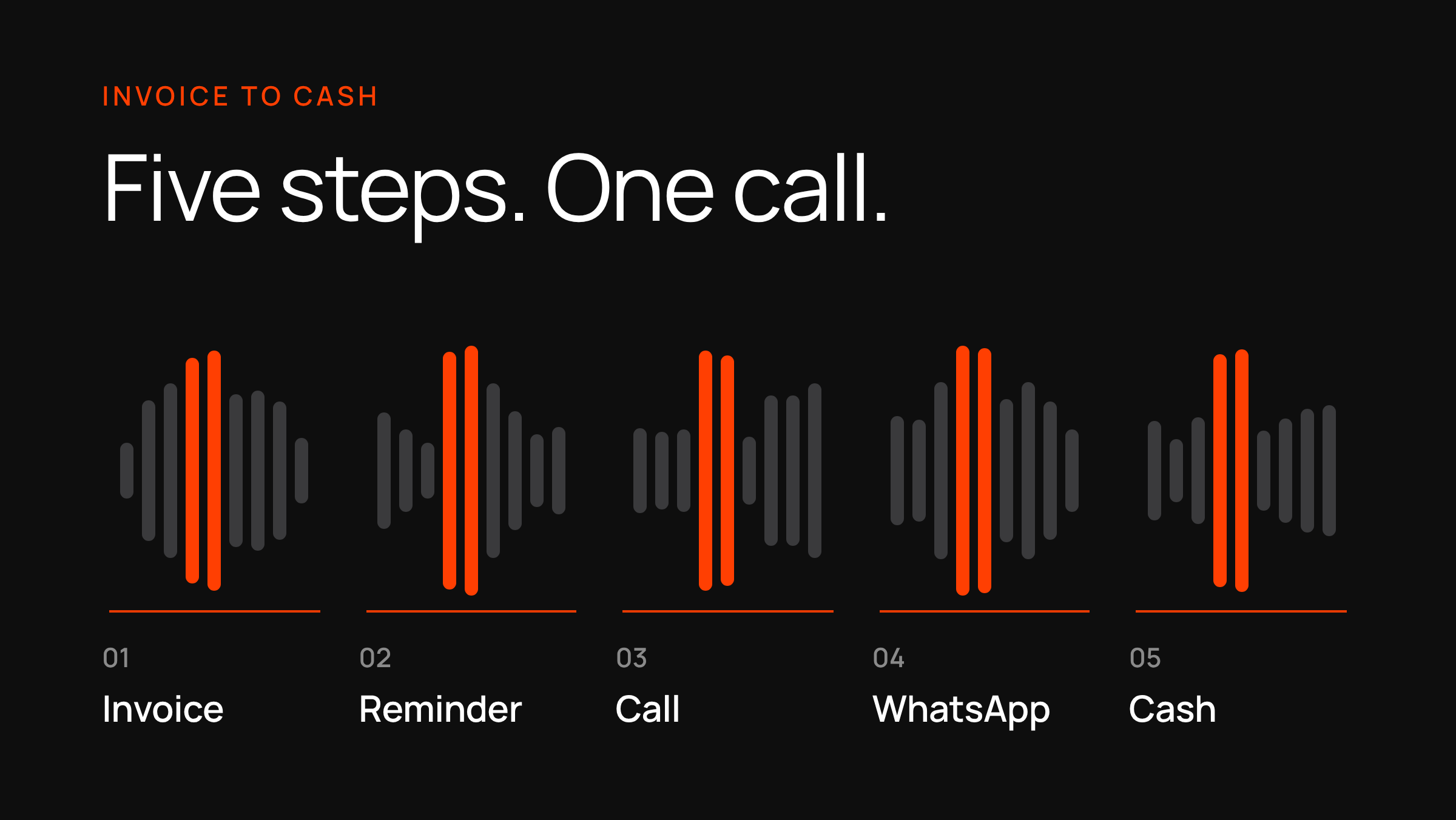
Here are five steps, in the order that actually works.
How common are unpaid invoices?
Common enough to be a planning assumption rather than an exception. Nearly four in five companies in Western Europe report that their B2B customers pay invoices late, and across the region about one quarter of all invoices are paid after the due date, according to the Atradius Payment Practices Barometer 2026, published in May 2026.
Two figures from the same survey matter more than the headline:
- Once an invoice does go overdue, it is settled around one month beyond the due date on average. The problem is usually frequency, not permanence.
- Credit losses average 1.6 % of B2B invoiced turnover — and nearly one in four firms report losses of up to 5 %.
And the reason is rarely bad faith. More than half of the businesses surveyed said liquidity pressure was the main cause of their customers paying late. Ireland, notably, is the region’s main exception, with more positive payment experiences than the Western European benchmark.
In the UK the cumulative effect is severe. The Small Business Commissioner counts roughly 14,000 business closures a year — 38 a day — attributable to late payment, at a cost of almost £11 billion to the economy.
Step 1 — Call on day one
Not day seven. Day one.
A two-minute call answers the question no reminder can: why is this invoice unpaid? In practice it is almost always one of four things — the invoice never arrived, it went to the wrong person, a PO or reference number is missing, or there is a genuine cash-flow problem and the customer is embarrassed to say so. Each of those needs a completely different response, and you cannot pick the right one from silence.
A call also gets you the single most useful artefact in collections: a specific date, said out loud by the person who controls the payment.
Here is a script that works. Keep it short and stay on the customer’s side of the table.
"Hi — this is [name] from [company]. I’m calling about invoice [number] for [amount], which was due on [date]. I wanted to check it reached you and that there’s nothing holding it up on your end?
[listen — then, whatever the answer:]
That’s helpful, thank you. What date should I expect the payment to land? … [date]. Great, I’ll note that down and I won’t chase you before then. If anything changes, just let me know."
The last sentence matters. Promising not to chase before the agreed date is what makes the agreed date real.
Step 2 — WhatsApp on day three
If the call went to voicemail, or you agreed a date and want it in writing without escalating the tone, WhatsApp is the next step. For a lot of customers it is read faster than email, and it does not carry email’s implicit filing-and-forgetting behavior.
Keep it factual, short, and free of pressure:
Hi [name] — [your name] from [company]. Following up on invoice [number], £[amount], due [date]. Could you confirm it’s in the payment run? Happy to resend a copy if it’s easier. Thanks!
And if you agreed a date on the call:
Thanks for the call, [name] — noting payment for invoice [number] on [date] as agreed. I’ll leave it with you until then.
One rule: WhatsApp is a follow-up channel, not a substitute for the call. It confirms; it does not diagnose.
Step 3 — SMS on day seven
Short, unavoidable, and useful precisely because there is no room to explain anything:
[Company]: invoice [number] for £[amount] was due [date] and is still showing as unpaid. Reply here or call [number] and we’ll sort it.
Step 4 — A written notice on day fourteen, with your rights stated
This is where the letter-and-statute advice that dominates every other guide finally belongs. By day fourteen you have called, messaged, and texted, and you have either a broken promise or silence. Now put it in writing, and reference what the law gives you.
In England and Wales you can claim statutory interest of 8 % plus the Bank of England base rate, plus a fixed sum for recovery costs, under the late payment legislation summarised by GOV.UK:
| Amount of debt | Fixed sum you can charge |
|---|---|
| Up to £999.99 | £40 |
| £1,000 to £9,999.99 | £70 |
| £10,000 or more | £100 |
You can charge that fixed sum once per payment. In Ireland, EU late payment rules provide equivalent interest and a minimum €40 recovery-cost compensation.
Two practical notes. If you did not agree a payment date in the contract, the law treats payment as late 30 days after the customer receives the invoice or you deliver the goods, whichever is later — you do not need a clause to have a right. And most small firms never actually invoke statutory interest against a customer they want to keep; naming it in a written notice is usually the point, not charging it.
Step 5 — Escalate on day thirty, deliberately
If day fourteen produced nothing, the invoice moves out of customer service and into recovery: a final notice, then a collections partner or a court claim. Legally you have a long time — the limitation period for a simple contract debt in England and Wales is six years.
Commercially you do not. Every week the invoice ages, the person who could have fixed it in two minutes on day one is further from the problem, and the relationship is worth less than the money. The escalation decision should weigh the invoice size, the customer’s lifetime value, and the cost of recovery — not just the calendar.
Which channel should you use, and when?
| Channel | What it’s good for | Where it fails | Use it |
|---|---|---|---|
| Phone | Finds the actual reason; gets a spoken payment date; resolves disputes on the spot | Labour-intensive; people hesitate to call a regular customer about money | Day 1 — always first |
| Read fast; confirms in writing without escalating tone; easy to reply to | Needs a number and a business profile | Day 3 — confirming the call | |
| SMS | Almost always read; cheap; impossible to file and forget | No room to resolve anything | Day 7 — a nudge |
| Carries the invoice copy, the audit trail, and the statutory language | Sinks; no read receipt; easiest to ignore | Day 14 — the formal notice |
Notice which two rows the rest of the internet leaves out.
What does chasing invoices manually cost you?
Enough that most businesses quietly stop doing it. US research by Intuit QuickBooks, covering firms with 25 or more employees, found 65 % of mid-sized businesses spend around 14 hours a week on payment-collection admin.
That is the real cost of the missed follow-up, and it is worth being precise about it: nobody decides not to chase an invoice. The call on day one simply loses to whatever else was urgent that morning, and then the invoice is eleven days old and the conversation is harder. Manual chasing does not fail because people are careless. It fails because it competes with everything else and always loses.
Can AI make the follow-up calls for you?
Increasingly, that is how the day-one call gets made at all. Per the Intrum European Payment Report 2026 — 8,385 businesses across 20 European countries — 66 % now use AI somewhere in payments, up from 59 % a year earlier, and reported time savings in the payments function imply AI can cut the cost of chasing late payments by around 20 %. The same report is candid about the constraint: 55 % say they lack the skills to unlock its potential.
What that looks like in practice is narrow and unglamorous. A voice AI agent calls every invoice the day it falls overdue, asks the four questions above, captures the promised date, and routes anything disputed or emotional to a person. It does not negotiate and it does not chase twice. It just ensures that step one always happens.
Sono builds voice AI agents that make exactly these calls — in your customer’s language, in your company’s voice, logged — and sends the WhatsApp follow-up in step 2. Our guide to AI voice agents for debt collection covers how the call itself is structured. If you want to see what it looks like against your own invoice volume, get in touch.
Unpaid invoices are not a fact of business life. They are a follow-up problem with a first step almost nobody takes.
Useful links and sources
- Atradius Payment Practices Barometer — Western Europe 2026
- Intrum European Payment Report 2026
- GOV.UK — late commercial payments: interest and debt recovery
- GOV.UK — claim debt recovery costs on late payments
- Small Business Commissioner — late payments research
- Intuit QuickBooks — mid-size payments research
- Enterprise Ireland / DETE — late payments