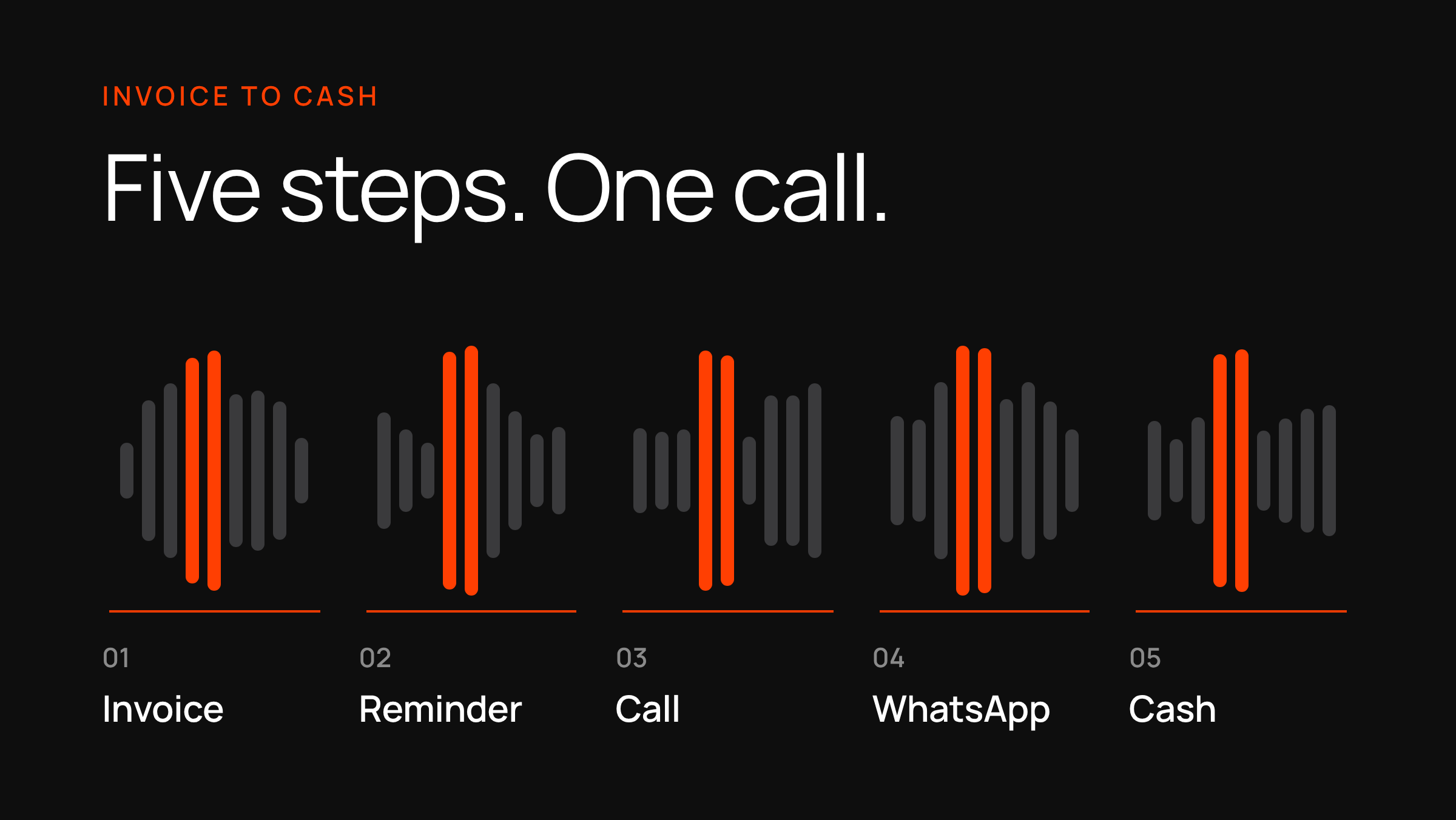

AI debt collection is the use of software voice agents that call overdue customers, hold a natural conversation, take payment or set a promise-to-pay, and log the outcome — without a human on the line. In the UK and Ireland, these agents work inside the same rules a human collector must follow, including the FCA’s Consumer Credit sourcebook (CONC) on fair treatment of customers in arrears. Deploying advanced generative AI in customer assistance can lift recoveries by around 10% and cut collections operating costs by up to 40% (McKinsey, 2024). This guide compares voice AI against a traditional collections call centre on the three things a buyer actually weighs: cost, coverage, and recovery rate.
Most finance and operations leaders aren’t choosing between “AI” and “people” in the abstract. They’re deciding how to work a growing book of overdue invoices without tripling headcount. The honest answer is that each model wins on different metrics.
How does AI debt collection actually work?
A voice AI agent places or receives the call, understands what the customer says in real time, and responds conversationally rather than reading a rigid IVR menu. It can verify identity, explain the balance, offer a payment link or installment plan, handle common objections, and escalate edge cases to a human.
The practical difference from an old-school dialer is comprehension. A modern agent handles interruptions, accents, and unexpected replies, then writes a structured outcome back to your collections system.
- Conversation, not script-reading. The agent adapts to what the customer says instead of forcing a menu tree.
- Structured outcomes. Every call ends with a logged result — paid, promise-to-pay, dispute, or callback — ready for your CRM.
- Human handoff. Vulnerable-customer signals or complex disputes route to a trained person.
What does each model cost?
Cost is where the gap is widest. A traditional operation carries salaries, recruitment, training, attrition, floor space, and management overhead. The average contact-center cost per call sits near $6.47, and a UK agent typically costs £25,000–£32,000 a year loaded, before you add supervisors and shrinkage.
Voice AI shifts the model from headcount to usage. You pay per minute or per resolved conversation, and capacity scales instantly during a month-end spike without a hiring cycle.
- Call center: fixed and semi-fixed costs; every extra hour of coverage means another paid agent.
- Voice AI: variable cost per call; the marginal cost of the 10,000th reminder call is near-zero.
- Blended reality: most teams keep humans for hard conversations and let AI clear the routine, high-volume reminders.
Which model reaches more customers?
Coverage is the quiet driver of recovery. Debt gets easier to collect the earlier and more consistently you make contact, and human teams are capped by working hours and dialing speed.
Voice AI removes the ceiling. It can attempt thousands of calls in parallel, retry at the times a customer is most likely to answer, and operate outside 9-to-5 within permitted contact hours. McKinsey’s collections work attributes double-digit recovery gains partly to contact-strategy optimization — picking the right channel, timing, and frequency per customer rather than one dunning script for everyone.
Does voice AI recover as much as human agents?
For routine early-stage arrears, well-designed voice AI matches or beats human recovery on the metrics that count, largely because it contacts more people, faster, and more consistently. A common benchmark is securing a promise-to-pay from at least 80% of contacted debtors, and coverage is the biggest lever on that number.
Humans still win on complex, sensitive, or high-value accounts where empathy, negotiation, and judgement decide the outcome. The strongest results come from a split: AI handles volume and first contact; people handle escalations and vulnerable customers. Analytics- and AI-led collections have shown recovery-rate improvements of 10–15% when contact strategy is optimised this way (McKinsey, 2024).
Is automated collection compliant in the UK and Ireland?
Yes, when it’s built for it. In the UK, the FCA’s CONC rules require fair treatment of customers in financial difficulty, clear disclosure, and appropriate handling of vulnerable customers — obligations that apply regardless of whether a human or an agent makes the call. In Ireland, firms fall under the Central Bank of Ireland consumer protection framework.
A compliant voice AI setup records and transcribes every call, applies consistent disclosures, respects permitted contact windows, and routes vulnerability signals to a human. In practice, consistency is an advantage: an AI agent never skips a required disclosure or loses its temper on the phone.
Cost, coverage, recovery: which should you choose?
Choose based on your book. If most of your overdue value sits in high volumes of low-to-mid-value invoices, voice AI will cut cost per recovery and widen coverage fast. If your book is concentrated in a few large, disputed, or sensitive accounts, keep experienced humans on those and use AI to clear everything else.
If you’re weighing this decision, Sono builds voice AI agents that handle reminder and collection calls end to end, then hand the hard cases to your team — so you widen coverage without widening headcount. The safest first step is small: automate one segment of routine reminders, measure recovery and cost against your current baseline, and expand from what the numbers show.