Conversational IVR is a phone-handling system that understands natural speech to identify a caller’s intent, rather than routing them through numbered menus. Instead of “press 1 for sales, press 2 for support,” a caller says “I want to reschedule my appointment” and the system understands, retrieves the relevant data, and responds — without menus, transfers, or hold time. According to a 2026 NICE Customer Experience report, 67% of consumers abandon calls during traditional IVR navigation. This guide breaks down why that happens, what conversational IVR does differently, and what the performance gap looks like in real deployments.
What is conversational IVR, and how does it differ from traditional IVR?
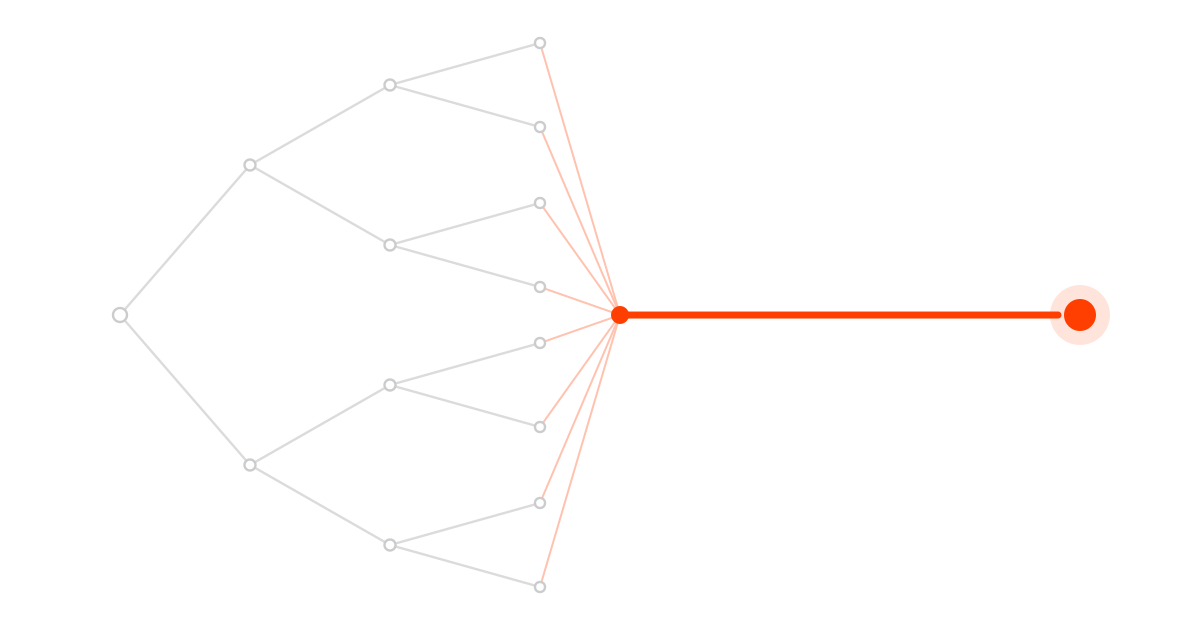
Traditional IVR is a decision-tree system. It plays a recorded menu, waits for a keypress, plays another menu, and repeats. The caller navigates toward a pre-mapped outcome — or gives up. The system only works if the caller’s need maps cleanly onto one of the pre-defined branches.
Conversational IVR replaces the tree with intent recognition. The caller speaks freely. The system uses automatic speech recognition (ASR) to transcribe the audio in real time, then a language model to classify the intent — “booking change”, “status check”, “billing dispute” — and routes or resolves accordingly. In more capable deployments — closer to a full AI receptionist — the system also pulls live data from integrated back-end systems (CRM, ERP, booking platform) and completes the transaction without transferring to a human.
The technical shift is from rule-following to intent-matching. The practical difference shows up in three key metrics.
Why do callers abandon traditional IVR systems?
Abandonment in traditional IVR is structural, not incidental. NICE’s 2026 CX research found that systems with more than ten menu levels see abandonment rates between 30% and 50%. The reasons are consistent across industries:
- Menu mismatch. The caller’s actual need doesn’t fit any listed option. They pick the closest one, get routed to the wrong team, and have to start over — or hang up.
- Time cost. Each menu level adds seconds. Multiply across three or four levels and the caller is 45–90 seconds in before they’ve spoken to anyone or resolved anything.
- Perceived disrespect. A rigid automated menu signals that the company has not invested in the caller’s experience. Research consistently shows this correlates with lower post-interaction CSAT regardless of whether the call is eventually resolved.
Conversational IVR removes all three. The caller speaks once. The system responds to what they actually said — much like an AI answering service does for missed calls outside an IVR context.
How conversational IVR works: from speech to resolution
When a caller speaks, a modern conversational IVR system runs four steps in sequence:
- Speech-to-text (STT) transcribes the audio in under 300 milliseconds.
- Intent classification maps the transcript to a known intent category using a language model fine-tuned on the company’s call types.
- Data retrieval queries integrated systems — the booking platform, CRM, or order management system — for the caller’s relevant context.
- Resolution or transfer — the system either handles the request fully, or transfers to a human agent with the intent and context pre-loaded, so the agent doesn’t have to re-ask what the call is about.
A live example of exactly this swap: Käyttöauto replaced a multi-level keypad menu with a single spoken question across six dealership locations, and now routes 92%+ of callers correctly on the first attempt — see the Käyttöauto case study.
Well-configured deployments consistently achieve 60–80% containment rates on defined call types — meaning that share of calls is resolved entirely without a human (VoiceSpin, 2025). Traditional IVR self-service resolution tops out at 14–40% for most deployments.
The three metrics where conversational IVR outperforms
Three measurable shifts show up after the switch: lower abandonment, higher first-call resolution, and lower cost per resolved call. Each is sourced and quantified below.
Call abandonment rate
This is where the gap is most immediate. Organizations switching from traditional to conversational IVR report abandonment dropping from around 35% to 5–10% — a reduction of over 60% — typically within the first month of deployment (Retell AI, 2025). For a contact center handling 200,000 calls per month, that is tens of thousands of additional calls that reach resolution rather than dead air.
First-call resolution (FCR)
AI-powered conversational systems improve FCR by 12–20 percentage points compared to traditional IVR, primarily because intent is correctly identified on the first attempt rather than after a chain of menu navigations (Trillet AI, 2025). Higher FCR reduces repeat contact volume and is one of the strongest predictors of CSAT.
Cost per resolution
Traditional IVR environments with high transfer rates carry a significant total cost per resolution once agent handling time is included, while conversational AI resolves routine call types at a fraction of that cost. McKinsey’s 2025 research found that companies deploying AI agents in their contact centers saw a 50% reduction in cost per call alongside rising customer satisfaction scores.
What does 30–50% better conversion actually mean?
“Conversion” in a phone context means the caller reaches a resolution — without abandoning, being misrouted, or calling back. The 30–50% improvement figure comes from combining three compounding effects.
Lower abandonment means more callers stay through to resolution. If traditional IVR loses 35% of callers and conversational IVR loses 8%, that’s 27 percentage points more calls that complete.
Faster resolution removes mid-call drop-offs. AI voice agents resolve calls up to 40% faster than traditional menu navigation (sidetool.co, 2025), reducing the window in which a frustrated caller gives up.
Higher FCR eliminates repeat calls. Every call resolved on the first attempt is one less call in next week’s queue. Etech Global Services reported a 72% cost reduction and a 34% improvement in first-call resolution after deploying AI IVR — a result that compounds over time as repeat contact volume falls.
These three effects together produce the 30–50% conversion uplift seen across documented deployments. It is not a single optimization; it is a structural change in how many calls reach an outcome.
When does conversational IVR make sense for your business?
The strongest use cases share a few characteristics. Conversational IVR delivers the highest ROI when a business has:
High, predictable call volume — the fixed investment in configuration and integration only pays back at scale. A few hundred calls per day is the typical break-even threshold.
Well-defined, repeatable intents — appointment scheduling, order status, service bookings, account inquiries. The narrower the intent space, the higher the containment rate. Companies trying to automate everything at once typically see worse results than those who start with the two or three most common call types.
Integrated back-end systems — conversational IVR that can only route, but not retrieve or transact, has limited value. The step-change comes when the system connects to real data.
Industries where speed is the value — automotive service, logistics, real estate, field services, and healthcare scheduling all share a dynamic where callers want a quick answer, not a conversation. These sectors consistently show the fastest ROI on conversational IVR deployments.
The right architecture is hybrid: AI handles the routine load, human agents handle exceptions — and when the AI transfers, it hands over context, not a blank slate. This same pattern applies well beyond menu replacement — our guide to voice AI customer service covers the full picture, from bookings to EU disclosure rules.
Sono builds this model for operational industries, and Sono’s AI IVR is the part that replaces your phone menu. If you want an estimate of what percentage of your inbound calls AI could handle, get in touch.
Sources
- Retell AI: Voice AI vs. IVR – Why Conversational Agents Are Replacing Phone Trees
- VoiceSpin: Conversational IVR vs Traditional IVR vs AI Voice Bots
- IrisAgent: Voice AI for Customer Service 2026 – Real Benchmarks
- Trillet AI: Voice AI Contact Center KPIs
- Call Center Studio: Reducing Call Abandonment Rates with AI-Powered IVR