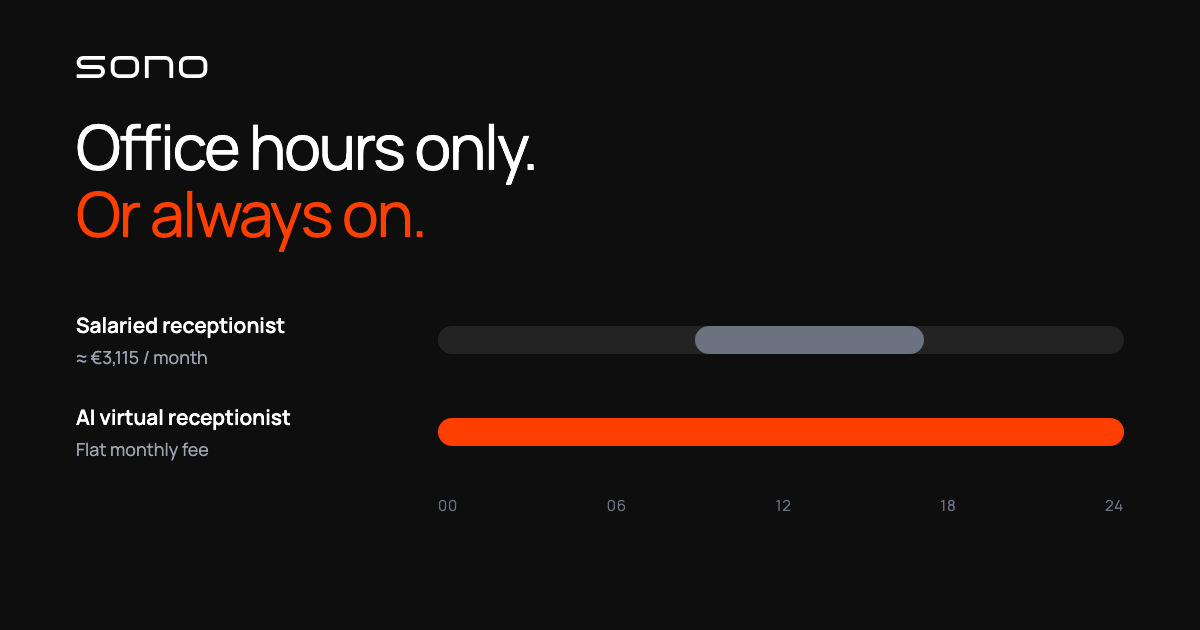
Every missed call is a missed customer, and for a small Irish business — a garage in Cork, a plumber in Galway, a property manager in Dublin — the phone is still the front door. Hiring a full-time receptionist costs €35,000–40,000 a year (Morgan McKinley 2026 Salary Guide) — about €3,115 a month in real employer cost once PRSI is added — while a traditional answering service charges per call or per minute and still leaves callers queuing. A third option has matured fast: the AI receptionist — voice AI like Sono that answers, books and routes calls itself. This guide compares an AI receptionist, a human virtual receptionist and a traditional answering service on cost, speed, coverage and quality, so you can decide what fits.
What is an AI receptionist?
An AI receptionist is a voice AI agent that answers your phone, understands what the caller wants in natural language, and completes the routine work itself. That means booking appointments, answering common questions, routing urgent calls to the right person, and taking messages after hours. Unlike a pre-recorded IVR menu (“press 1 for sales”), it holds a real conversation and finishes the task on the call.
For operational businesses — automotive, home services, property management, logistics — most inbound calls are repetitive: “Are you open?”, “Can I book a service?”, “Where’s my delivery?” An AI receptionist resolves these without a human, and passes the rest to a person with full context. If you’re weighing up a deployment, our guide to setting up an AI answering service walks through call-flow design, integrations and pricing in detail.
AI receptionist vs virtual receptionist vs answering service
The short version: an answering service mostly takes messages; a human virtual receptionist can do more but costs more and doesn’t scale; an AI receptionist completes routine tasks instantly, around the clock, at a flat cost. For a closer look at the two models of the middle option, see our guide to the virtual receptionist for Irish SMBs.
| Feature | AI receptionist | Virtual receptionist (human) | Traditional answering service |
|---|---|---|---|
| Availability | 24/7, no queue | Business hours (extra cost for after-hours) | Often 24/7, but with hold times |
| Answer speed | Instant, every call | Depends on staffing | Queues during peak times |
| Simultaneous calls | Unlimited | One per agent | Limited by staff |
| Cost model | Flat/usage, no per-seat | Per hour or per call | Per call or per minute |
| Handles bookings | Yes, in real time | Yes | Usually takes a message only |
| Languages | Multiple, switchable | Depends on agent | Limited |
| Consistency | Identical every call | Varies by agent | Varies by agent |
Why does this matter for Irish businesses right now?
Missed calls cost Irish SMBs real revenue, because most callers who reach voicemail simply move on to a competitor. Three pressures make the comparison urgent:
- Voicemail doesn’t capture demand. 80% of consumers hang up without leaving a voicemail (HubSpot, 2023) — for a services business, one recovered job a week can outweigh the entire cost of the tool.
- After-hours demand is real. A meaningful share of inbound calls to trades, garages and property managers arrives outside 9–5 (Sono customer data, 2026). An AI receptionist captures those instead of losing them to voicemail; see how after hours answering works in practice.
- Staffing is tight. Rather than pull a technician or office manager off their work to answer the phone, an AI receptionist absorbs the routine volume and only escalates what genuinely needs a person.
Replacing a single full-time front-desk hire (€35,000–40,000 a year, Morgan McKinley 2026 — about €3,115 a month in real employer cost once PRSI is added) with an AI receptionist typically cuts front-office phone costs by more than half while extending coverage from 40 hours a week to 168. Our virtual receptionist pricing breakdown for Ireland works that figure out line by line, including what the salary comparison leaves out. If you’re specifically comparing voice AI against a traditional call-answering setup, our AI answering service guide for Irish SMBs breaks down the options side by side.
When is an AI receptionist the right call?
An AI receptionist fits best when your call volume is high but repetitive, and calls slip away outside staffed hours. Specifically:
- Your calls are dominated by bookings, status checks and FAQs.
- You lose calls after hours or during peaks (lunch, end of day, weekends).
- You want appointments booked directly into your calendar, not just messages taken.
- You operate across more than one language (English plus, say, Polish or Irish).
A human virtual receptionist may still be preferable for very low call volumes, or for highly bespoke, relationship-heavy conversations where nuance matters more than speed.
How does Sono’s AI receptionist work?
Sono is a voice AI customer-service agent built for operational industries: it answers inbound calls, completes routine requests and routes the rest. It handles appointments and bookings in real time, covers after-hours and overflow, resolves FAQs and inquiries, and transfers the calls that need a human — with a summary already attached. See the full AI receptionist use case for how it’s deployed.
If you want to see what it would sound like answering your phone, book a free scoping call — we’ll map your call types and show where automation pays off first.