Most customer service calls are not complaints — they’re questions. Opening hours, order status, “can I book in for Thursday”, “put me through to service”. For Irish SMBs, answering those instantly is the difference between a customer served and a customer gone, because 80% of consumers hang up without leaving a voicemail when no one picks up (HubSpot, 2023). That is what AI customer service does: it uses a voice AI agent to handle the routine, high-volume calls so your team can focus on the ones that actually need them. This guide covers what voice AI customer service can do today, where it still falls short, and how Irish businesses can deploy it without making the experience worse.
What is AI customer service?
AI customer service uses a voice AI agent to handle customer phone calls in natural language — understanding the request, answering it or completing the task, and routing what needs a person. Instead of a phone menu or a queue, the caller simply speaks: the AI books the appointment, takes the message, gives the status update, or transfers to the right person with context attached.
It is not a chatbot. A chatbot handles typed text on your website; AI customer service on the phone handles spoken conversation in real time — which is where operational businesses actually get their calls. If you want the mechanics of how speech-to-text, reasoning and speech synthesis fit together, our explainer on voice AI customer service walks through it step by step.
What does AI customer service do well?
Voice AI is strongest on high-volume, repetitive calls — the routine requests that make up most of your inbound. The practical strengths:
- Answers instantly, 24/7. No hold music, no voicemail, no closed sign — every call picked up on the first ring, day or night.
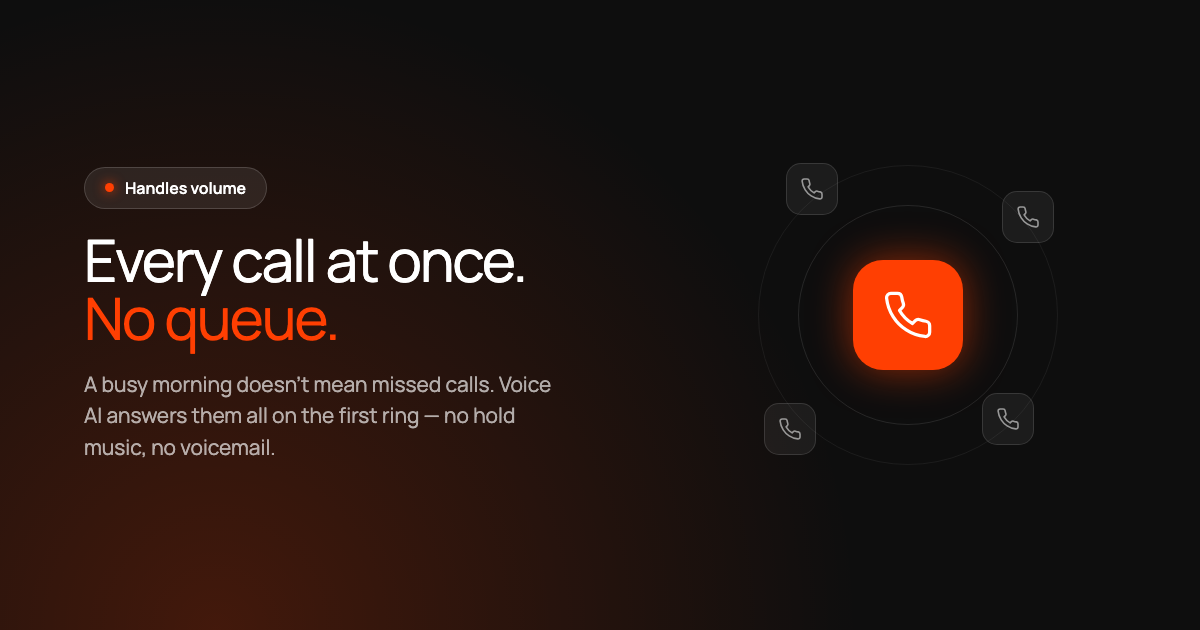
- Handles volume. It takes many calls at once, so a busy morning doesn’t turn into missed calls.
- Books and updates. Connected to your calendar and CRM, it creates appointments and records during the call, not after.
- Stays consistent. The same accurate answer every time — on the tenth call as on the first.
- Deflects the routine. FAQs, bookings, routing and status checks are resolved without a human — the bulk of inbound volume.
This is where the technology is heading fastest. Gartner predicts that agentic AI will autonomously resolve 80% of common customer service issues by 2029 (Gartner, 2025) — and the pressure to adopt is already here: 91% of customer service leaders say they are under pressure to implement AI (Gartner, 2026). In most operational businesses, the majority of inbound calls are routine and repetitive, which is exactly the work voice AI resolves end to end, freeing staff for the minority that need human judgment.
Where do humans still win?
Humans still win on calls that need empathy, discretion, or judgment the AI hasn’t been set up for. Be honest with customers and with yourself about the limits:
- Emotional or sensitive calls — complaints, distress, delicate negotiations.
- Genuinely novel problems — situations the AI hasn’t been configured to handle.
- High-value judgment calls — where discretion or a relationship matters more than speed.
The right model is not “AI replaces the team.” It is AI handles routine volume; humans handle the exceptions — with clean escalation and full context passed to the person who takes over. A voice agent that recognises its limits and transfers gracefully beats one that tries to handle everything and traps the caller.
AI customer service vs. phone menus and human-only teams
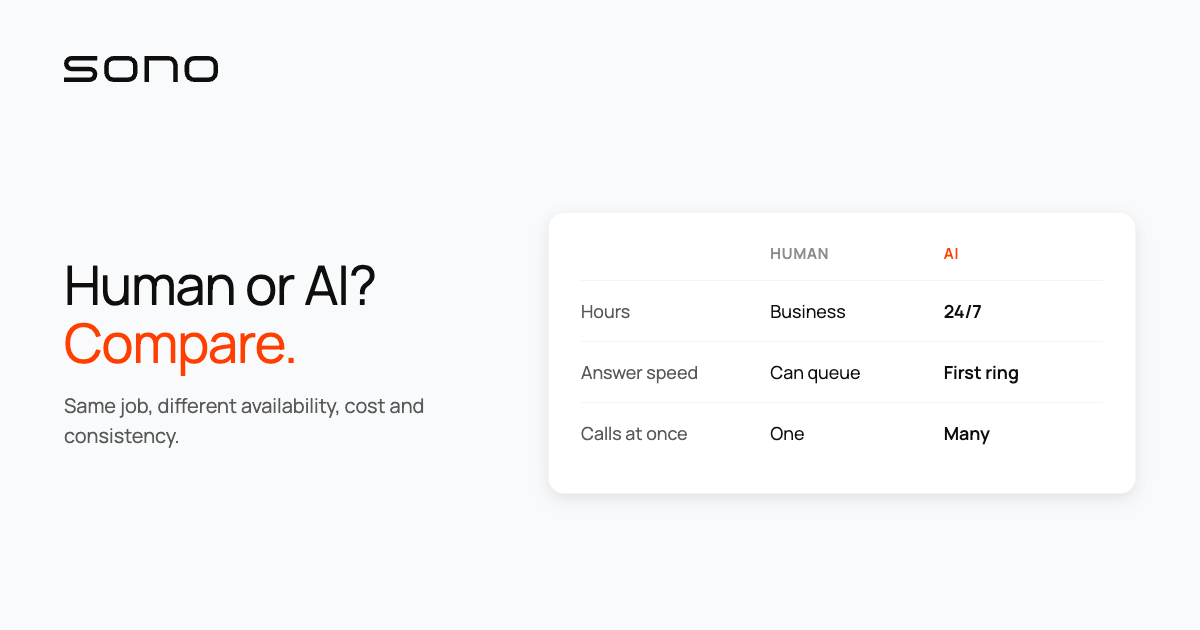
Compared with a phone menu or a human-only team, voice AI keeps the natural conversation of a person while matching the always-on availability of automation. Here is how the three options line up:
| Phone menu / IVR | Human-only team | AI customer service (voice AI) | |
|---|---|---|---|
| Caller experience | “Press 1…”, rigid and slow | Personal, but limited hours | Natural conversation, 24/7 |
| Availability | Always on, but inflexible | Business hours only | 24/7, no rota |
| Handles volume | Yes, but poorly | Limited by headcount | Yes, many calls at once |
| Resolves the request | Rarely | Yes | Routine yes, complex escalated |
| Cost at scale | Low, but costs you calls | High | Flat monthly, scales |
If your current setup is a phone tree, the biggest early win is usually replacing it — our guide on conversational IVR vs. traditional phone menus explains why natural-language call routing cuts abandonment. This overview is the entry point to two companion guides that go deeper: if cost is your question, read the answering service options and costs breakdown; if you’re deciding between a person and an agent, read virtual receptionist — human vs AI. Both build on the AI receptionist vs. answering service distinction.
How do you deploy AI customer service without losing the personal touch?
Deploy it in stages, starting with your highest-volume, lowest-complexity calls, so you get quick wins at low risk. The sequence that works:
- Start with bookings and FAQs first. They are frequent, predictable, and forgiving — the fastest return with the least downside.
- Set clear escalation rules. Decide exactly which calls go to a human, and make sure the caller’s context travels with them.
- Match your brand voice. A custom greeting and tone so the agent sounds like your business, not a generic bot.
- Integrate for real. Connect your calendar and CRM, so a booking lands in the diary — not in a transcript emailed after the fact.
- Test with real recordings. Validate Irish accent handling and edge cases with your own callers before going live.
Most Sono deployments go live in days rather than months: map the call types, connect the systems, set escalation, test, launch — then refine over time. For the full setup walkthrough, see how to set up an AI answering service.
How much does AI customer service cost in Ireland?
Most AI customer service is priced as a flat monthly fee that scales with call volume, rather than the per-minute or per-agent model of a traditional answering service. That makes cost predictable and, at scale, lower than paying people to sit on a phone line for calls that are largely routine. The variables that move the price are call volume, the number of integrations, and how much custom call-flow logic you need.
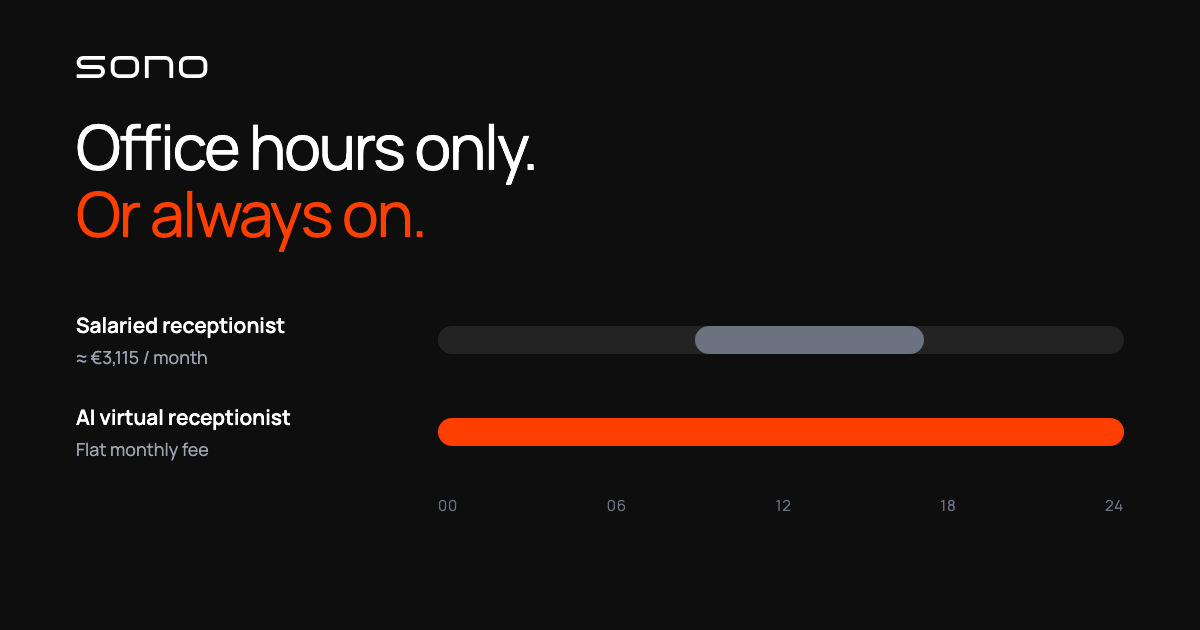
We keep the full pricing picture in one place: our virtual receptionist pricing breakdown for Ireland works out what a salaried receptionist actually costs an employer — about €3,115 a month once employer PRSI is added — and sets that against the flat-monthly, per-call and platform-plus-usage models AI vendors use. Start there if cost is your main question. For the wider buyer’s comparison across per-minute human services, retainers and AI, see the answering service options and costs guide.
Where this leaves Irish businesses
If your phone drops calls after hours, during peaks, or simply because the routine ones swamp the team, AI customer service is now a practical option — provided you deploy it honestly. Automate the routine volume, keep humans on the exceptions, and make the handover clean. Sono is a voice AI customer service agent built for operational industries — motor and car repair, trades, property, logistics and more — that resolves routine calls, books appointments, and routes what needs a person. Start narrow, measure it, and expand from there; the sensible first step is a small pilot on the calls you’re losing today.