Irish businesses have three ways to get the phone answered when nobody’s free: a per-minute call centre, a human virtual receptionist on a retainer, or a flat-rate AI answering service that answers every ring, day or night. This guide takes each one in turn — what it does, what it costs, and which calls it drops. The short version: the pricing model matters more than the headline rate, and the right choice depends on your call volume, not your headcount.
For the wider picture of what AI customer service can and can’t do, start with our overview. To weigh a person against an agent for the front desk specifically, see virtual receptionist: human vs AI, and for what a human one costs, our virtual receptionist pricing breakdown.
Option 1: a traditional answering service (call centre)
A staffed call centre picks up under your business name, takes the caller’s details, and sends you a message. Some will follow a short script — confirm an address, quote an opening time — but the defining feature is that the outcome is a message, not a completed job.
What it’s good at: overflow. If your phone rings hardest between 10 and 12 and you just need somebody to catch the spill, this is the simplest thing that works.
What it drops: anything that needs an action. A caller who wanted an appointment leaves without one, and somebody on your team now owes them a callback. That callback is real work, and it happens later, when the caller has often already rung the next business.
How it’s priced: per minute or per call, usually with a small monthly minimum. Cost rises exactly when you’re busiest — a good ad campaign or a seasonal rush pushes the bill up with it.
Option 2: a human virtual receptionist
A named person, or a small pooled team, who answers as if they sit in your office — with access to your diary, your prices and your escalation rules. They can book, they can qualify, they can handle a delicate call properly.
What it’s good at: complex, emotional or high-value conversations. A person still wins these, and it isn’t close.
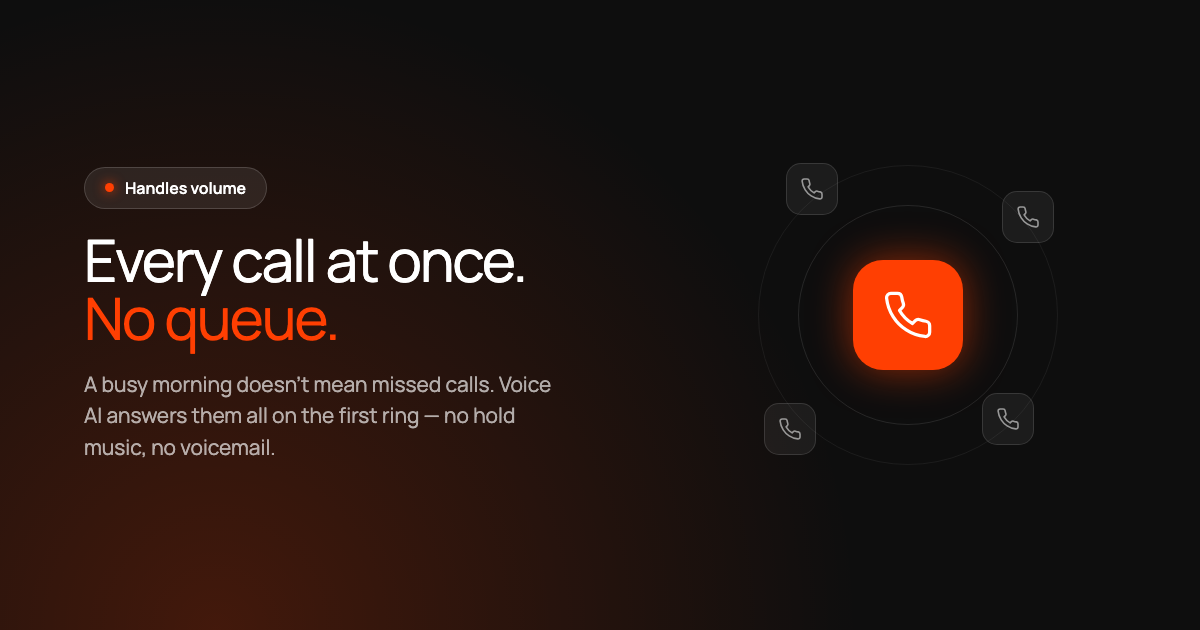
What it drops: simultaneous calls and hours. One agent takes one call. Cover ends when their day ends, and evenings, weekends and holidays are either unstaffed or charged as extra.
How it’s priced: a monthly retainer covering a bundle of calls or minutes, with per-unit overage beyond it. Predictable until a busy month, then the overage stacks up.
Option 3: an AI answering service
A voice AI agent answers the call, understands what the caller wants in natural language, and completes the task itself — books the appointment, answers the question, routes the call, or takes a detailed message with full context attached. No human operator, no per-minute fee, and no rota.
Unlike a recorded voicemail or a rigid phone menu (“press 1 for sales”), it holds a real conversation. The gap between a conversational agent and a traditional phone tree is obvious on the first call. Only the calls that genuinely need a person get escalated. For the deployment detail — call-flow design, integrations, pricing — see our guide to setting up an AI answering service.
What it’s good at: volume, speed, and the hours nobody wants to staff.
What it drops: the genuinely bespoke conversation. That’s what escalation is for.
How it’s priced: a flat monthly fee that steps up by volume tier rather than spiking per call — so a busy week doesn’t produce a surprise invoice.
The three side by side
| 1. Traditional answering service | 2. Human virtual receptionist | 3. AI answering service | |
|---|---|---|---|
| Outcome of a call | A message | A completed task or a message | A completed task or a message |
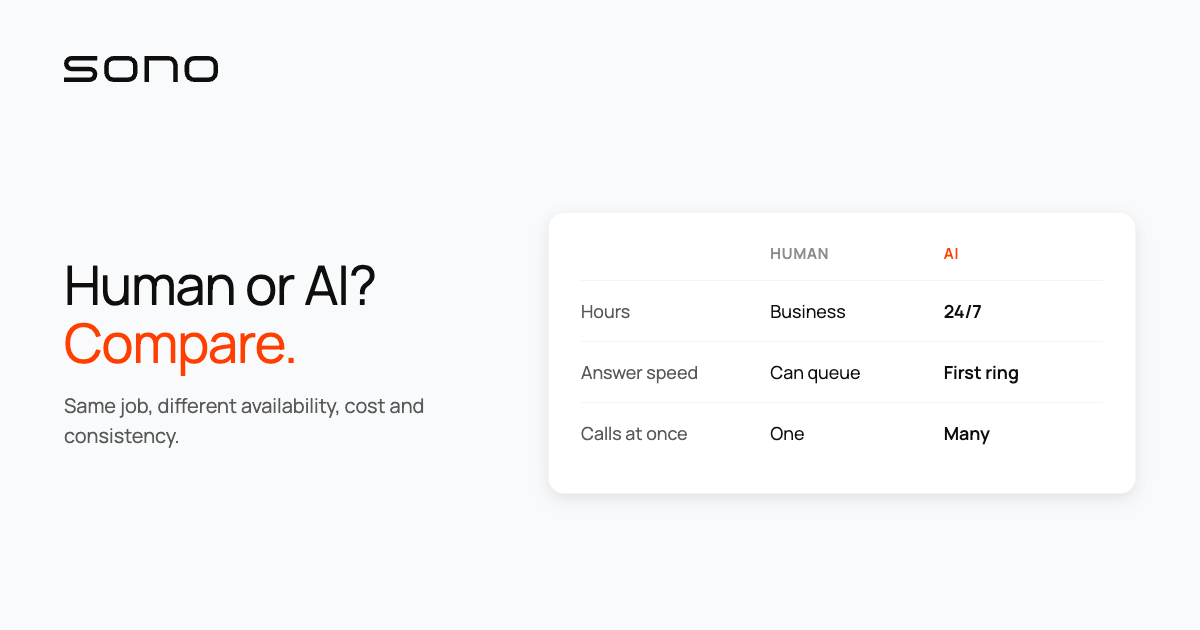
| Availability | Business hours or overflow | Business hours, per agent | 24/7, no rota |
| Simultaneous calls | Limited by staff | One per agent | Effectively unlimited |
| Cost model | Per minute / per call | Retainer + overage | Flat monthly, by volume tier |
| Consistency | Varies by operator | Varies by person | Identical every call |
| Languages | Usually one | Depends on agent | Multiple, switchable mid-call |
| Best for | Simple message-taking | High-touch, complex calls | Routine, high-volume inbound |
The honest trade-off: a human still wins on genuinely complex, emotional or high-value conversations. Voice AI wins on volume, speed, cost and after-hours cover — which is where most missed calls actually happen. For a deeper head-to-head aimed at small firms, see AI receptionist vs answering service.
What does a phone answering service cost in Ireland?
Ask which of the three models you’re being quoted before you compare any two providers:
- Per-minute or per-call (call centres). You pay for time on the phone. The more successful your marketing is at making the phone ring, the more you pay.
- Retainer plus overage (human virtual receptionists). A base fee covers a bundle; anything beyond it is charged per unit.
- Flat subscription (AI answering service). A fixed monthly fee that scales by volume tier, not per call.
The alternative to all three is hiring. In Dublin, a receptionist / front-of-house executive costs:
| Experience | Salary (Dublin, 2026) |
|---|---|
| 0–3 years | €30,000–35,000 |
| 3–5 years | €35,000–40,000 |
| 5+ years | €40,000–45,000 |
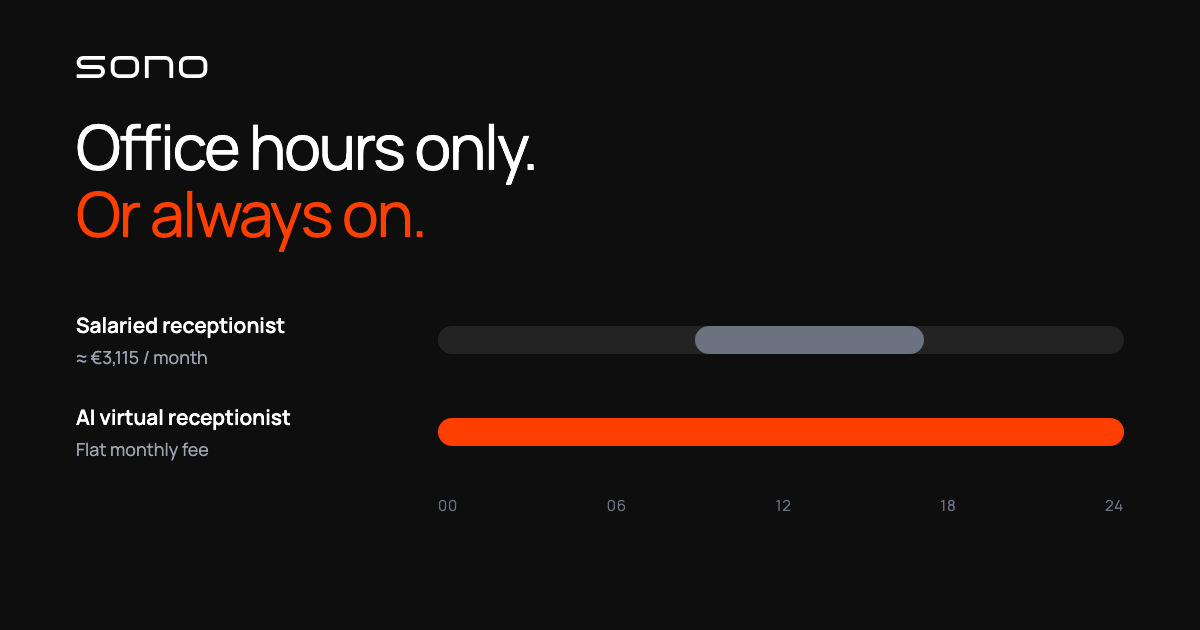
Source: Morgan McKinley 2026 Salary Guide. Those rates are for a 39-hour week — which is the number that matters here. Everything outside those 39 hours is either uncovered or costs extra. And the salary isn’t what the role costs you: our virtual receptionist pricing breakdown adds employer PRSI to the national average receptionist wage and lands at roughly €3,115 a month in real employer cost — on the Dublin bands above, higher still.
Whichever model you compare, ask for a line-by-line quote — monthly fee, setup fee and overage rate listed separately — so a low headline price isn’t hiding a large setup charge or a twelve-month contract.
What is a pay-as-you-go answering service?
One with no monthly commitment: billed per call or per minute, only when calls come in. It’s the cheapest option when the phone is quiet and the most expensive one in the week a campaign lands. If your volume is genuinely low and irregular, it’s a sensible place to start. If it’s growing, the model works against you at exactly the wrong moment.
Which answering service suits a small business?
Volume decides this, not headcount. A two-person plumbing firm taking 300 calls a month has more in common with a 30-person motor dealer than with a two-person consultancy taking twelve.
- Under ~50 calls a month. A pay-as-you-go message-taking service is usually cheapest, and the admin of a callback is manageable.
- 50–300 calls a month, mostly routine. This is where per-minute billing starts to hurt and where an AI answering service is normally both cheaper and better-covered, because it takes the evenings and weekends too.
- Low volume, high value per call. A human virtual receptionist, or your own team with AI catching only the overflow and the out-of-hours calls.
- Anything with a queue at predictable times. Whatever else you do, get the peak covered. A caller in a queue and a caller in your voicemail behave the same way.
Is a message-taking service enough?
Only if a callback is an acceptable outcome for you. A message means the customer waits and your team owes them a call. Roughly 85% of callers whose call goes unanswered won’t ring back — they simply try the next business (Aircall, 2016). The same logic applies one step further along: the caller who did get through to a message-taker still hasn’t got what they rang for.
If most of your calls are bookings, status checks and repeat questions, a service that finishes the job on the call is worth more than one that writes it down.
What the call actually sounds like
This is the part most answering-service comparisons skip. Here’s a booking call handled end to end, which is the single most common call type we see in Irish trades and motor:
Sono: Good afternoon, Kelly Motors, you’re through to the service desk. How can I help?
Caller: Yeah, hi — I need to book the car in for a service.
Sono: Of course. Can I take the registration?
Caller: 21-D-44718.
Sono: Thanks — that’s the grey Octavia, is that right? Last in with us in March.
Caller: That’s the one.
Sono: I’ve got Thursday morning at half eight, or Friday at eleven. Which suits?
Caller: Thursday.
Sono: Booked — Thursday the tenth, half eight, full service. I’ll send a text confirmation now. Anything else you want them to look at while it’s in?
Caller: The near-side wiper’s gone.
Sono: Noted on the job card. See you Thursday.
Two things to notice. The agent confirms the vehicle from the registration before offering times, which is what stops the “are you sure you’ve got the right car” call later. And it asks one open question at the end — that wiper is a line item the garage would otherwise have found on the ramp and had to ring about.
And the caller who doesn’t want to talk?
Some callers won’t wait, won’t leave a message, and won’t ring back — but they will reply to a text. Ireland runs on WhatsApp for exactly this kind of local trade and service contact, and no answering service in this market covers it. Every provider’s answer stops at the phone.
A missed call that turns into a WhatsApp reply is a lead you’d otherwise never have heard from. The handoff is automatic — the call comes in unanswered or the caller drops out of a queue, and a message goes out within the minute:
Hi — Kelly Motors here, sorry we missed your call. Reply here and we’ll sort it, or tell us a good time and we’ll ring you back. Booking a service? Send us your reg and we’ll come back with two slots.
Keep it to three lines, name the business in the first four words, and give the caller something to do. Note that a business needs an approved template to open a WhatsApp conversation outside a 24-hour window — see our notes on the WhatsApp Business API for how that works in practice.
Which channel for which moment
| Channel | Use it for | Reach |
|---|---|---|
| 1. Phone call | Anything you want resolved now — bookings, urgent jobs, anything with a decision in it | Highest, and the only channel that finishes a job in one go |
| 2. WhatsApp | The caller who wouldn’t wait; confirmations; photos of the fault or the part | High and rising; replies come back fast |
| 3. SMS | Confirmations and reminders, and anyone not on WhatsApp | Universal, but one-directional in practice |
| 4. Email | The paper trail — quotes, invoices, terms | Lowest for anything time-sensitive; treat it as documentation, not as reach |
Typical calls an AI answering service handles
- After-hours and overflow — the phone is answered at 9pm and during the lunchtime rush. This is the after-hours and overflow cover that stops evening and weekend demand leaking to voicemail.
- Appointments and bookings — availability checked and the slot written into your calendar. See appointments and bookings.
- FAQs and inquiries — opening hours, pricing, location, order status, answered instantly.
- Call routing — the right calls reach the right person; everything else is handled or logged.
These are the patterns we see most in automotive, home services, property management and logistics — sectors where the phone drives revenue and calls cluster outside staffed hours.
What to look for in an AI answering service
Five things separate a system that pays for itself from one that annoys your callers.
- Natural conversation, not a phone tree. The caller should speak normally and be understood — no menus, no “press 1”.
- Real integrations. It should book into your actual calendar and log to your actual CRM, not email you a transcript.
- Escalation that works. Clear rules for when a call goes to a human, with full context passed along.
- Local language and accent handling. For Ireland, fluent English with strong accent robustness; for cross-border teams, the ability to switch language mid-call.
- More than one channel. Ask what happens to the caller who hangs up. If the answer is “nothing”, you’re buying a phone line with better manners.
How setup actually works
Most Sono deployments go live in days, not months: map your most common call types, connect your calendar and CRM, set escalation rules, and test against real call recordings before going live. Because it’s software, you refine it over time.
The fastest return comes from automating your single most common call type first — usually appointment booking or a repeat FAQ — and taking it off your team’s desk before expanding.
So what should an Irish business do?
If your calls are dominated by bookings, status checks and FAQs, and you lose calls after hours or at peak times, an AI answering service is the fastest win available. It replaces the routine, repetitive part of reception — answering, booking, routing — and frees your team for the conversations that genuinely need a person. A human virtual receptionist still makes sense for very low call volumes or highly bespoke, relationship-heavy work.
Sono is a voice AI customer service agent built for operational industries — motor, trades, property, logistics and more. It answers every call, books appointments, follows up on WhatsApp when the caller won’t talk, and routes what needs a person with a summary already attached. See the full AI receptionist use case, or book a free scoping call and we’ll map your call types and show where automation pays off first.