A virtual receptionist answers your calls, greets customers and books appointments without anyone sitting at a front desk — and pricing depends entirely on whether that’s a human service or an AI voice agent like Sono. The clearest benchmark is what a salaried receptionist actually costs an employer: on the Irish national average wage of €33,596 (ERI SalaryExpert, 2026), that works out at roughly €3,115 a month once employer PRSI is added — and that’s for office hours only. This guide breaks down both sides: what an in-house receptionist really costs, how AI virtual receptionist pricing models work, and how to tell whether either is worth it for your call volume.
Most Irish businesses looking at this compare the wrong things — a vendor’s monthly price against a receptionist’s take-home pay rather than the full employer cost, or against 24/7 cover a human role was never going to provide in the first place. The numbers below fix that comparison.
What does a salaried receptionist actually cost in Ireland?
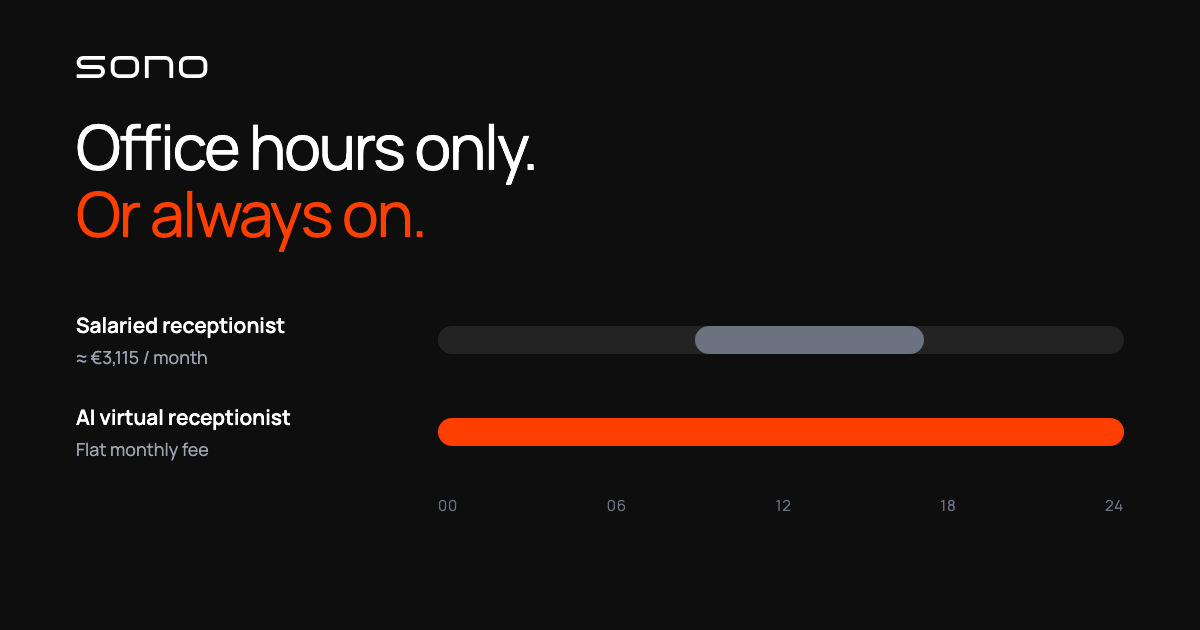
About €37,400 a year, or €3,115 a month, once employer PRSI is added to the average wage. The Irish national average receptionist salary is €33,596 a year, or about €36,930 in Dublin specifically (ERI SalaryExpert, 2026). That’s the gross wage — not what it costs the employer.
On top of the wage, employers pay Class A employer PRSI, currently 11.25% where weekly earnings exceed €552, rising to 11.4% from 1 October 2026 (Citizens Information; Department of Social Protection, SW 14). A receptionist on the national average wage earns about €646 a week, above that threshold, so the higher rate applies.
| Amount | |
|---|---|
| Average gross salary (national) | €33,596/yr |
| + Employer PRSI (11.25%) | ≈ €3,780/yr |
| Real employer cost | ≈ €37,376/yr → ≈ €3,115/month |
| Coverage | Office hours only (typically 9am–5pm, Mon–Fri) |
Recruitment salary guides put front-of-house roles a little higher again, at €35,000–40,000 a year (Morgan McKinley 2026 Salary Guide), so treat €33,596 as the conservative end of the range.
That figure is before recruitment costs, holiday cover, sick leave, pension contributions and equipment — all of which push the real number higher. It also buys office-hours cover only; nights, weekends and lunch breaks are gaps by default unless you pay for a second person or an after-hours answering service on top.
Those gaps are where the money leaks. Around 85% of callers whose call goes unanswered never ring back — they try the next business — and 80% of callers who reach voicemail hang up without leaving a message (HubSpot, 2023). A receptionist you’re paying €3,115 a month for still can’t answer the 6pm call.
How is an AI virtual receptionist priced?
By the month or by usage, not by the hour of staff time. AI virtual receptionists use one of three models:
- Flat monthly fee. A set price per month with a call or minute allowance. Predictable and easiest to budget, and the most common choice for small and mid-size businesses.
- Per call or per minute. You pay only for what you actually use. Suits businesses with uneven call volume — seasonal trades, for example.
- Platform fee plus usage. A base fee for the service plus a variable per-call cost. Common when the AI integrates with a booking system, ticketing tool or existing phone system.
On top, there’s often a one-off setup fee covering the voice profile, call flows and integrations with your calendar or booking system.
Exact prices vary too much between vendors and call volumes for a single number to be meaningful here — get a quote against your own monthly call volume rather than a published list price, and always ask what happens if you go over your plan’s allowance. If you want the underlying unit economics rather than list prices, our breakdown of what one customer service call really costs models human and AI contacts from the bottom up across European markets.
What’s usually included, and what costs extra
The base price normally covers the answering service itself: the AI picks up, handles common questions, books appointments and takes messages. What tends to sit outside the base price:
- Integrations with your calendar, booking system or CRM.
- Higher call volumes once you pass your plan’s allowance.
- Extra languages beyond your primary one.
- Advanced escalation rules and custom call flows for multiple teams or sites.
Ask for those line by line before you sign — they’re where two quotes that look identical stop being comparable.
Human vs AI vs traditional call centre: the real trade-offs
| Cost model | Availability | |
|---|---|---|
| AI virtual receptionist | Flat monthly fee, or usage-based | 24/7, every day |
| Salaried in-house receptionist | Fixed wage + employer PRSI, ≈ €3,115/month | Office hours only |
| Human answering service / call centre | Per call or per minute — scales with volume | Often limited hours |
| Voicemail | Usually included in your phone plan | Always on — but nobody actions it until someone listens |
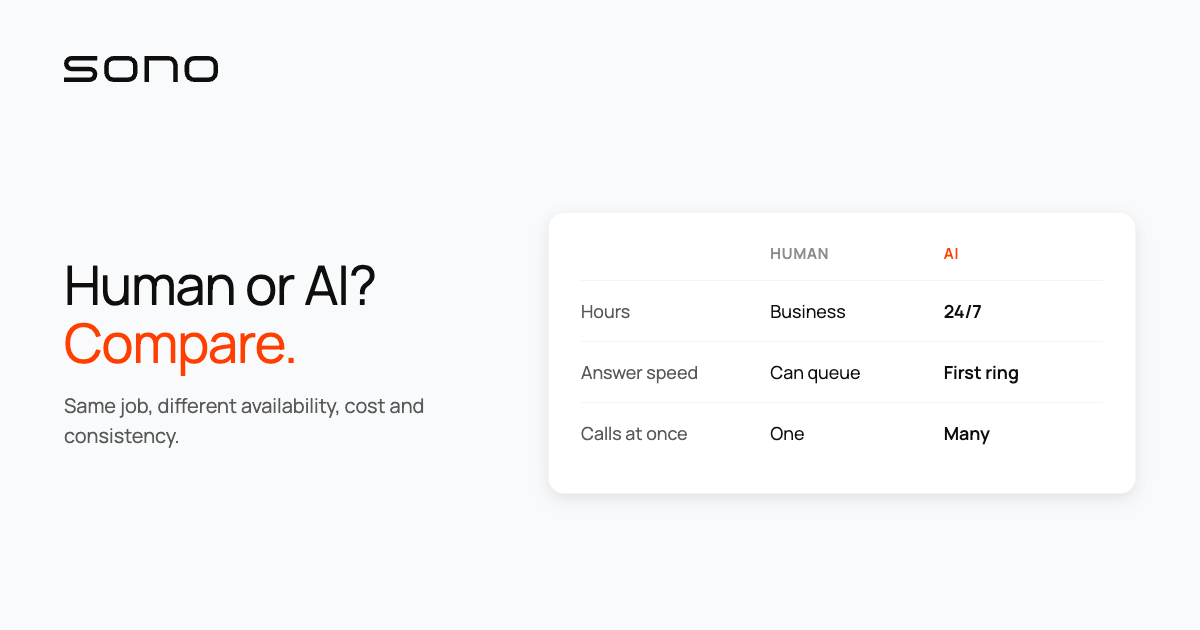
The only line in that table backed by a hard, citable number is the salaried role. Vendor pricing for the other three rows is worth comparing directly against your own call volume, not a generic table. For the capability side of the same comparison — what each option can actually complete on a call — see our guide to virtual receptionist: human vs AI and the wider comparison of AI receptionist vs answering service.
Is it worth it for your business?
Run the numbers on your own situation rather than a vendor’s:
- Calls you currently miss × your average booking or job value. That’s the revenue currently leaking.
- Staff time freed up when routine calls — hours, availability, simple bookings — are handled without an interruption.
- The cost of the alternative — extending a human answering service into evenings and weekends, or hiring a second part-time receptionist to cover the gaps.
If your phone already runs through a booking system or CRM, that system’s call log is the fastest way to estimate your real volume before asking any vendor for a quote.
The maths lands differently by sector. A home services or trades business where one missed call is a €400 job reaches payback on a handful of calls a month; a property management office fielding high volumes of low-value routine queries gets there on staff time instead.
Common pricing mistakes to avoid
- Comparing a vendor price to a salary, not to employer cost. The right benchmark is €37,400 a year, not €33,596 — and neither number includes cover for absence.
- Ignoring what the human role doesn’t cover. Office hours only means every evening, weekend and bank holiday call is unpriced in that comparison.
- Buying on list price instead of your own volume. A per-minute service is cheap at 40 calls a month and expensive at 400; a flat fee is the reverse.
- Missing the overage terms. Ask what a call above your allowance costs before you sign, not after your busiest month.
- Treating setup as free. Onboarding, call flows and integrations are real work. Get them itemised.
See what it would cost for your call volume
Sono is a voice AI customer service agent built for operational industries — automotive, trades and home services, property management and logistics. It answers every call, books appointments and routes what needs a person; see the full AI receptionist use case for how it’s deployed, or the answering service page for the always-on cover side.
If you want a real number rather than a range, book a free scoping call — we’ll map your call types and volume and show where automation pays off first.
Useful links and sources
- ERI SalaryExpert — Receptionist salary in Ireland, 2026
- Morgan McKinley — Receptionist / Front of House salaries, Ireland 2026
- Citizens Information — Paying social insurance (PRSI)
- Department of Social Protection — PRSI contribution rates and user guide (SW 14), January 2026
- KPMG Ireland — Budget 2026: tax rates and credits
- Aircall — Missed calls: the real impact on your business
- HubSpot — State of Marketing: consumer communication preferences