Should you hire a virtual receptionist or let AI answer? For complex, sensitive, high-value conversations, a trained human is still better. For everything else — bookings, opening hours, “put me through to service”, the call that comes in at 19:40 — an AI voice agent answers every time, at a flat cost, and writes the booking into your calendar before the caller hangs up. Most Irish SMBs in motor, trades, property and logistics end up wanting both: AI on the routine volume, a person on the exceptions.
This guide compares the two honestly, shows you the exact greeting script an AI receptionist uses, and gives you a six-point checklist to put to any provider.
What is a virtual receptionist?
A virtual receptionist handles your inbound calls remotely and represents your business to callers — answering in your company name, dealing with routine requests, and routing anything that needs a person. There are two models:
- Human virtual receptionist — a trained person, usually shared across several clients, who answers your calls during agreed hours.
- AI virtual receptionist (voice AI) — a voice AI agent that answers calls in natural language, books appointments, answers FAQs, routes calls and follows up by WhatsApp, around the clock.
Both remove the need for a physical front desk. The difference is availability, cost structure, and how much routine work actually gets finished rather than written down.
Human or AI: which virtual receptionist should you choose?
The honest trade-off: a skilled human is better for sensitive or complex conversations. An AI virtual receptionist wins on cost predictability, round-the-clock cover, and never putting a caller on hold — which is where most businesses actually lose calls.
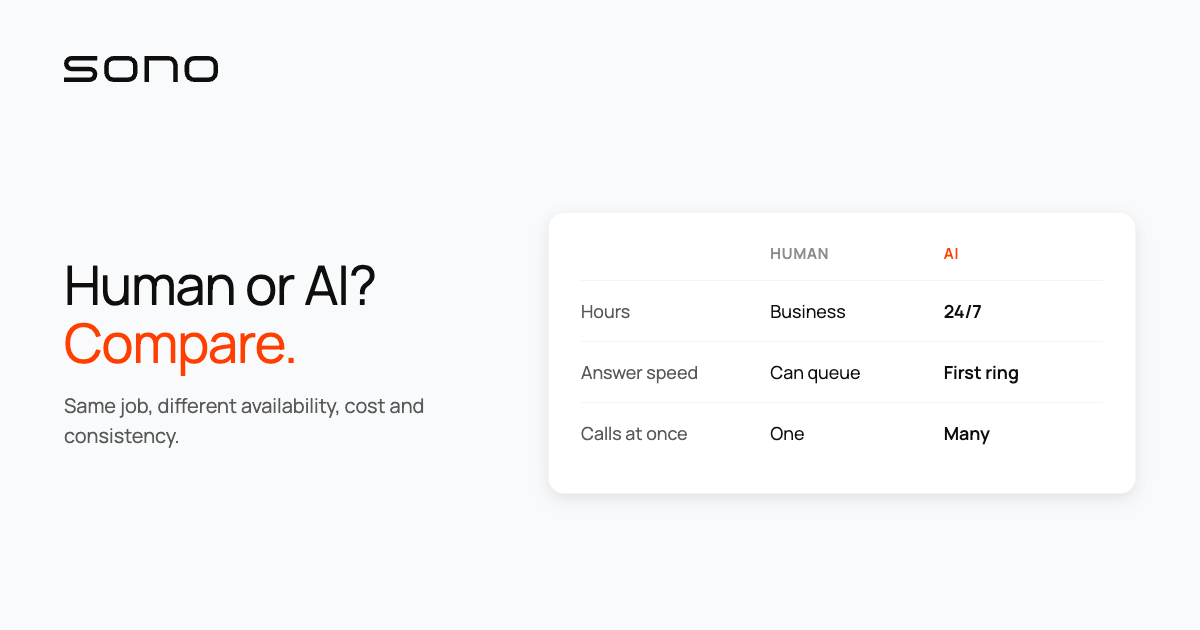
| Human virtual receptionist | AI virtual receptionist (voice AI) | |
|---|---|---|
| Availability | Agreed hours; extra for after-hours | 24/7, no rota |
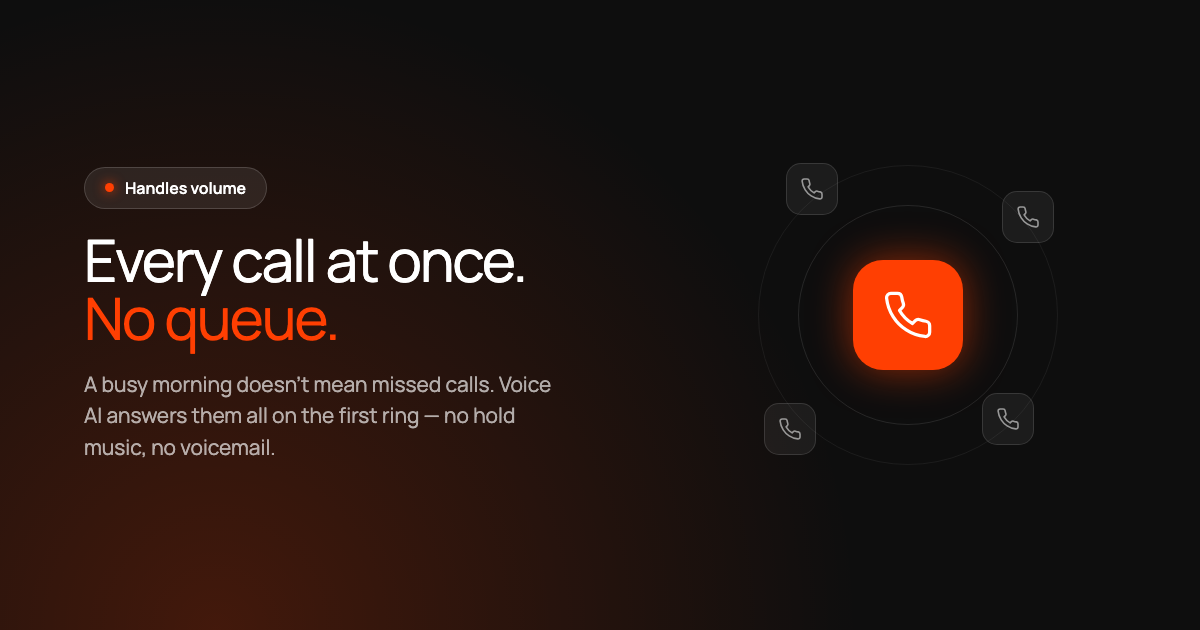
| Simultaneous calls | One per agent | Effectively unlimited |
| Cost model | Per minute / per call / retainer | Flat monthly, independent of volume |
| Consistency | Varies by person and shift | Identical every call |
| Bookings & CRM | Manual entry, often after the call | Written in during the call |
| Channels covered | Phone; message taken and emailed on | Phone, plus WhatsApp and SMS follow-up on the same conversation |
| Languages | Depends who is on shift | Multiple, switchable mid-call |
| Complex, sensitive calls | Better | Escalates to a named person with full context |
| Best for | Complex, high-touch conversations | Routine, high-volume, after-hours cover |
Two rows deserve emphasis because they are where the money is.
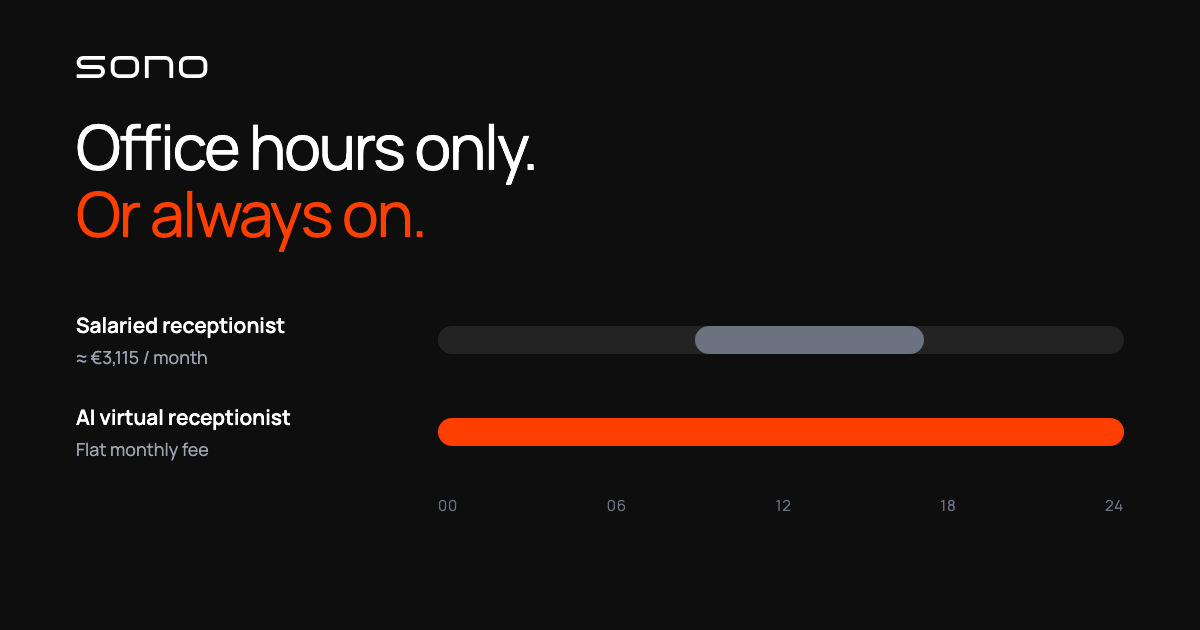
Cost model. Per-minute and per-call pricing means your bill rises precisely when you are busiest — the week the campaign lands, the morning after a storm, the Monday after a bank holiday. A flat monthly fee removes that. Our virtual receptionist pricing breakdown for Ireland works through what a salaried receptionist actually costs an employer once cover is included, and the answering service options and costs guide sets per-minute, retainer and flat-rate models side by side.
Channels. A human service takes a message and emails it to you. An AI agent finishes the job on the channel the caller prefers — confirming the booking on WhatsApp before they have put the phone down. More on that below.
What does an AI virtual receptionist actually say?
Every provider on page 1 of Google describes its service. None of them shows you the call. Here is the script, so you can judge it rather than take it on trust.
Greeting and routing — the call script
AI: “Good afternoon, Murphy Motors, you’re through to our booking line. How can I help?”
Caller: “Yeah, hi — I need to get the car in for a service, the engine light’s on.”
AI: “I can book that in. Can I take the registration?”
Caller: “12-D-45678.”
AI: “Thanks — that’s the 2012 Golf, and I can see you were last in for a service in March. Because the engine light is on, the earliest diagnostic slot is Thursday at 8:30 or Friday at 11:00. Which suits?”
Caller: “Thursday.”
AI: “Booked — Thursday the 20th at 8:30, diagnostic and service. I’ll send the confirmation and the address to this number on WhatsApp. Anything else?”
Out of hours
AI: “Thanks for calling Murphy Motors — the workshop is closed now and opens at 8:00 tomorrow. I can book you in for tomorrow or take a message for the service manager. Which would you prefer?”
Escalation — the rule that matters most
AI: “That sounds like something our service manager should handle directly rather than me. Can I take your number and have him ring you back? He’ll have your registration and what you’ve told me in front of him, so you won’t have to repeat it.”
Note what the escalation line does: it declines the call and promises the human will already have the context. That combination is what stops escalation feeling like a dead end. When you evaluate providers, ask to hear this specific moment.
Adapt the wording to your trade and put your own opening hours and booking rules in. If you want the same treatment for outbound calls, see AI receptionist vs answering service.
What happens after the call? WhatsApp follow-up
This is the part almost no virtual receptionist service covers, and it is where calls quietly fall apart. The caller agrees a time on the phone, then forgets the address, the price, or what to bring.
An AI virtual receptionist can send the follow-up on WhatsApp while the call is still live, so the details arrive before the conversation ends.
Booking confirmation
Hi John — you’re booked in at Murphy Motors on Thursday 20 August at 8:30 for a diagnostic and service. We’re at Unit 4, Blackthorn Road, Sandyford. Bring the keys and the service book if you have it. Need to change it? Just reply here.
Reminder, the day before
Reminder: Murphy Motors tomorrow at 8:30, Unit 4 Blackthorn Road. Reply RESCHEDULE if the time no longer works.
Missed call, called back and still no answer
Hi — Murphy Motors here, we tried to ring you back about your service booking and couldn’t get through. Happy to sort it here on WhatsApp if that’s easier. What day suits you?
Why WhatsApp rather than email: it lands on the phone the person just rang you from, it is read, and the reply comes back into the same thread — so a rescheduling does not become a new phone call. The channel order Sono works in is call first, then WhatsApp, then SMS, then email. Email is the fallback, not the plan.
Why are Irish SMBs moving to AI voice agents?
Because most of the receptionist role is repetitive, and voice AI now finishes that part instead of noting it down. “Are you open?”, “Can I book in for Thursday?”, “Can you put me through to service?” — an AI virtual receptionist resolves these consistently, which frees your team for the calls that need judgment.
The pattern that works is not replacement. It is: AI takes first answer on every call, handles what it can end to end, and escalates the rest to a named person with the context attached. For the wider picture of what AI customer service can and can’t do, start with the overview.
What should you look for in a virtual receptionist service?
Six things separate a good service from an expensive one. Put all six to any provider before you sign.
- A greeting that sounds like your business. Ask to hear a recording of your own greeting, not a demo of someone else’s. A generic script tells every caller they have reached an outsourcer.
- Real bookings, not messages. The appointment should appear in your calendar and CRM during the call. “We’ll email you the message” is a slower version of a missed call.
- Escalation rules you control, with context attached. Ask exactly what triggers a handover, who it goes to, and what that person sees. Escalation without context makes the caller repeat themselves.
- Irish-accent handling, tested on your callers. Modern voice AI handles Irish English well, including fast and interrupted speech, but accents vary sharply by region and trade. Test on recordings of your own customers before going live.
- Follow-up on the caller’s channel. Confirmations and reminders on WhatsApp or SMS, in the same thread, so a change of plan is a reply rather than another phone call.
- Predictable pricing. Per-minute models charge you most in your busiest month. Ask what the bill looks like on your worst week, not your average one.
How long does setup take?
Shorter than most people expect, because nothing needs to be replaced. You forward your number, or a subset of it — out-of-hours only is a common and sensible start. You give the agent your opening hours, services, prices and booking rules. You connect the calendar and CRM. Then you listen to the first week of calls and tighten the wording.
Starting with after-hours and overflow only is the low-risk way in: nothing changes about the calls your team already answers, and you stop losing the ones that arrive at 19:40. From there, extend to daytime overflow, then to appointments and bookings and 24/7 on-call cover.
See Sono as your virtual receptionist
Sono is an AI receptionist that answers your calls in natural English, books appointments straight into your calendar, follows up on WhatsApp, and passes complex calls to the right person with the context already attached. Flat monthly pricing, no per-minute billing.
Book a demo and hear it answer your own greeting.
Useful links
- Virtual receptionist pricing in Ireland — what a receptionist really costs an employer
- AI answering service in Ireland: options and costs — per-minute vs retainer vs flat rate
- AI receptionist vs answering service — the wider comparison
- AI customer service in Ireland — what it can and can’t do