Accounts receivable collections is the process a business uses to collect its own overdue invoices, from the first reminder to the decision to hand an account to an agency. Done well, it works the whole ledger by aging bucket, so the right invoices get a call while they are still easy to collect.
This guide is for finance teams, controllers and business owners who chase invoices across many customers. If you need wording for a single late invoice, our overdue invoice checklist goes day by day.
What are accounts receivable collections?
Accounts receivable (AR) is the money customers owe you for goods or services already delivered on credit. Collections is the part of AR that starts when an invoice passes its due date. It ends when the invoice is paid, written off or referred to a collection agency.
AR collections is different from debt collection by an agency. Your own team does it, under your own name, while the customer is still a customer. That matters for tone, for the law and for cost.
The workload is large. In the Atradius Payment Practices Barometer for the US (survey run mid-2024), half of all B2B invoices were overdue. Bad debts averaged 8% of B2B credit sales, and overdue invoices were turned into cash 20 days past due on average. In Europe, Intrum’s European Payment Report 2026 found the average B2B payment delay widened from 16 days in 2023 to 20 days.
What are the stages of the AR collections process?
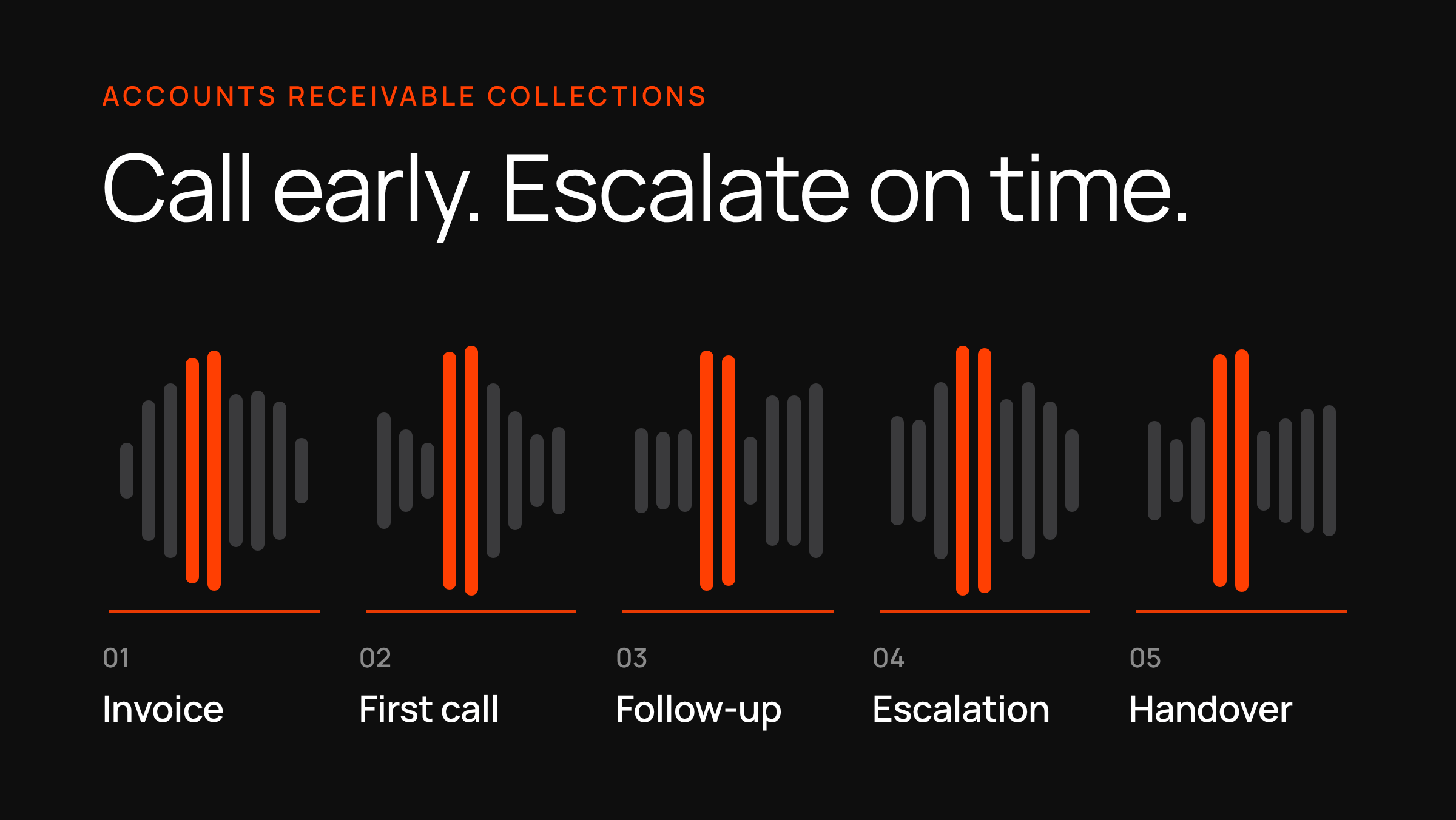
Most B2B teams run collections in six stages, keyed to the aging report. The days below are an example, so match them to your payment terms.
| Stage | Aging bucket | Main action | Channel | Owner |
|---|---|---|---|---|
| 1. Clean invoice | Before the due date | Correct PO number, contact and payment link on every invoice | Email with payment link | Billing |
| 2. Pre-due nudge | 3 to 5 days before due | Confirm the invoice is approved for payment | WhatsApp or email | Billing or automation |
| 3. First overdue call | 1 to 7 days past due | Ask why it is unpaid and get a payment date | Phone call, then WhatsApp link | AR team or AI voice agent |
| 4. Promise follow-up | 8 to 30 days past due | Check the promised date, call again if it slipped | Phone call, WhatsApp, text | AR team |
| 5. Escalation | 31 to 60 days past due | Final notice, call a decision maker, credit hold | Phone call, email notice | AR lead or controller |
| 6. Handover | 61 to 90+ days past due | Payment plan, agency referral or legal | Phone call, formal notice | Controller or CFO |
The stages are simple. The hard part is coverage. A two-person AR team with 400 open invoices cannot call every account in stage 3. So they email instead, and the call happens at stage 5, when the invoice is already harder to collect.
How do you prioritize which accounts to collect first?
Sort the overdue list by two numbers: amount and days past due. Then work it in this order:
- Large and early: high balances in the 1 to 30 day bucket. These pay fastest when someone calls.
- Broken promises: any account that gave a date and missed it. Call the same day.
- Large and late: high balances over 60 days. These need a decision maker and a decision.
- Small and early: low balances in the first 30 days. Automate these with a call and a WhatsApp link.
- Small and late: low balances over 90 days. Decide quickly whether to refer, settle or write off.
Disputed invoices come off the collections list until the dispute is resolved. Chasing a disputed invoice burns goodwill and rarely brings in cash.
Why should the first overdue touch be a phone call?
Because a call is the only channel where the customer answers back. “We never got the invoice”, “the PO number is wrong” and “we can pay on the 15th” are all answers your team can act on today. An email reminder collects none of them.
Timing compounds the effect. In Sono’s 2026 consumer-credit calling program, a first call at day 3 recovered €499,100 per 10,000 overdue accounts. A first call at day 65 recovered €203,350 from the same book (what a collection call is worth). That is consumer credit in euros, not B2B invoices, so read it as evidence about timing rather than a forecast for your ledger.
The same data shows how promises convert: 235 of 1,000 reached contacts promised to pay, and 70% of those promises were kept. A promise with a date is the most useful output of any collections call, because your team can track it.
What do you say on an AR collections call?
Keep the first call short and specific. Here is a version for stage 3:
“Hi, this is Jordan from Harbor Point Supply, calling about invoice 4471 for $3,850, which was due on November 10. I wanted to check it reached the right person. Is anything holding it up? … Great. Can I put you down for payment by Friday the 21st? I’ll send the payment link to this number on WhatsApp right now.”
Three rules make it work. Name the invoice, amount and due date in the first sentence. Ask an open question about what is blocking payment. End with a specific date, not “soon”. If the customer disputes the invoice, stop and route it to whoever owns disputes.
For voicemail wording, objections and later-stage calls, see the full collection call script.
Which channel works best at each stage?
| Channel | Best for | Strength | Limit |
|---|---|---|---|
| Phone call | First overdue touch, broken promises, escalation | Two-way: gets the reason and a payment date | Takes staff time unless automated |
| Payment link right after a call, quick confirmations | Read on the phone the customer already uses, link is one tap | Needs a WhatsApp Business setup and an opt-in | |
| Text (SMS) | Payment link where WhatsApp is not used | Works on any phone | Short, one-way, easy to ignore |
| Invoice copy, statements, the written record of what was agreed | Formal, searchable, attachments | Easy to ignore, often lands with the wrong person |
The order that works: call first, WhatsApp the link second, text if WhatsApp is not an option, and email to confirm in writing. For response data by channel, read reminder call vs text or email.
Which KPIs measure AR collections performance?
Track a few numbers weekly, by customer segment if you can.
| KPI | Formula | What it tells you |
|---|---|---|
| Days sales outstanding (DSO) | (AR balance ÷ credit sales in the period) × days in the period | How many days of sales are tied up in receivables |
| Collection effectiveness index (CEI) | (Beginning AR + credit sales − ending total AR) ÷ (beginning AR + credit sales − ending current AR) × 100 | How much of what was collectible you actually collected |
| AR over 90 days | AR more than 90 days past due ÷ total AR | How much of the ledger is at risk of write-off |
| Promise-to-pay rate | Accounts that gave a payment date ÷ accounts reached | Whether your calls reach decisions |
| Promises kept | Promises paid on time ÷ promises made | Whether those decisions turn into cash |
| Cost per collected invoice | Total collections cost ÷ invoices collected | Whether your process pays for itself |
DSO moves with sales volume, so a busy month can hide a collections problem. CEI and promises kept show what your team actually did.
How are B2B and consumer collections different in the US?
The Fair Debt Collection Practices Act defines a “debt” as a consumer’s obligation from a transaction that is primarily for personal, family or household purposes (15 U.S.C. 1692a). Business-to-business invoices fall outside that definition. The FDCPA also generally does not cover a creditor collecting its own debts under its own name.
That does not mean anything goes. The FTC notes that creditors outside the FDCPA are still subject to Section 5 of the FTC Act, which bans deceptive and unfair practices (FTC). Some states have their own collection laws. If you collect from consumers, or hand consumer accounts to an agency, see the US rules in our dunning letter guide. This is general information, not legal advice.
When should you hand an account to a collection agency?
Refer an account when your own process has run its course and the customer has stopped engaging. Common signals:
| Signal | Typical point |
|---|---|
| No reply to calls, WhatsApp or email for three weeks | 60 days past due |
| Two or more broken payment promises | Any stage |
| The customer refuses to pay an undisputed invoice | Any stage |
| The business has closed or changed ownership | Any stage |
| The balance is too small to justify more internal time | 90 days past due |
Agencies usually charge a share of what they recover, and the relationship with the customer rarely survives the handover. That is the strongest reason to make stages 3 and 4 work: every account settled on an early call is one you never pay a fee on.
How do you automate AR collections without losing the conversation?
Most AR automation tools handle invoices, email reminders and payment matching well. The step they leave to people is the call, and that is the step a busy team skips. Our debt collection software comparison sorts the main tools by what they automate.
Sono fills that gap. Our AI voice agent calls every invoice in the 1 to 30 day buckets, in your company’s name and in the customer’s language. It asks what is holding the payment, records the promised date and sends the payment link by WhatsApp. Disputes and payment-plan requests go to your team with a summary. See how AI payment reminder calls work, or read the dunning process guide for where the call sits among your written reminders.