
Debt collection software is a system that tracks overdue accounts, contacts the people who owe money and records what happens next. The category splits into four types, and the right one depends on whether you collect for other people or chase your own invoices. This guide compares eight tools across those types, using what each vendor states on its own public page as of October 29, 2026.
What are the main types of debt collection software?
Search results for “debt collection software” mix products built for very different buyers. Sorting them first saves a lot of demo calls.
| Type | Built for | Examples in this guide | What to check first |
|---|---|---|---|
| Agency and lender platforms | Collection agencies, banks, lenders, debt buyers | Collect! by Comtech, C&R Software, Experian | Credit bureau reporting, skip tracing, compliance flags |
| AR and invoice dunning | Finance teams chasing their own B2B invoices | Upflow, HighRadius, Chaser | ERP and accounting integrations, promise-to-pay tracking |
| Contact center dialers | Teams with human agents making many calls | Five9 | Dialer modes, agent scripts, reporting |
| Voice AI | Teams that want calls placed without agents | Sono | Hand-off rules, disclosure, write-back to your system |
If you send invoices to business customers, start with the second row. If you hold consumer portfolios or collect for clients, start with the first.
Which debt collection software should you compare?
The table below lists what each vendor says on its own product page. We did not test the products, and prices are not shown because most vendors do not publish them.
| Tool | Type | Built for (per its page) | Contact channels named on the page | Pricing on the page |
|---|---|---|---|---|
| Upflow | AR dunning | B2B finance teams: CFOs, controllers, AR managers | Email, SMS, phone calls, letters. No WhatsApp | Not published, demo offered |
| HighRadius | AR platform | Mid-market and enterprise AR teams | Automated dunning, email, in-app calling | Not published |
| Chaser | AR dunning | Businesses, finance teams, accountants | Email, SMS, automated phone calls, in-app calling. No WhatsApp | Free trial, no figures on the page |
| Collect! by Comtech | Agency platform | Agencies, credit unions, banks, medical billing, legal, leasing | SMS reminders, dialer integrations, letters, portals | Quote on request |
| C&R Software | Lender platform | Lenders and banks, with debt buyers, utilities and telecoms | “Omnichannel”, channels not itemized | Demo or RFP |
| Experian Debt Collection Software | Agency platform | Small collectors and agencies | Data, skip tracing, scoring. Contact channels are not the focus | Flat monthly subscription, no per-seat fee, no figures |
| Five9 | Contact center | AR and debt recovery teams with agents | Voice, with predictive, power and preview dialers | Not published, form for pricing |
| Sono | Voice AI | Creditors and agencies that want the calling done by an AI voice agent | Phone calls first, WhatsApp and SMS for follow-up | Ask for a quote |
A few patterns stand out. The AR tools lean on email and SMS, and calling is usually an in-app feature for your staff. The agency platforms are strongest on data and compliance. Only the dialer and the voice AI row are built around the phone call itself.
How do you choose debt collection software?
Work through five questions before you book any demos.
- Whose debt is it? Your own invoices need a dunning or AR tool. Other people’s portfolios need an agency platform with reporting and client portals.
- Which channels do your debtors actually answer? Ask each vendor whether it supports phone calls and WhatsApp as well as email. None of the seven pages we read names WhatsApp.
- Who makes the calls? A dialer speeds up your agents, but a person still has to talk. An AI voice agent can work the long tail of small balances a desk would skip.
- What happens at hand-off? A dispute, a hardship story or a request for a person should go to a human with the transcript attached.
- Does it write back to your system? Dispositions, promised dates and recordings belong on the account, not in a separate inbox.
Where does voice AI fit next to collection software?
Most teams do not need to replace their collections platform. The written reminders, case history and reporting already work. The gap is usually the call. It gets a customer to say a date out loud, and it is the step people run out of time to make.
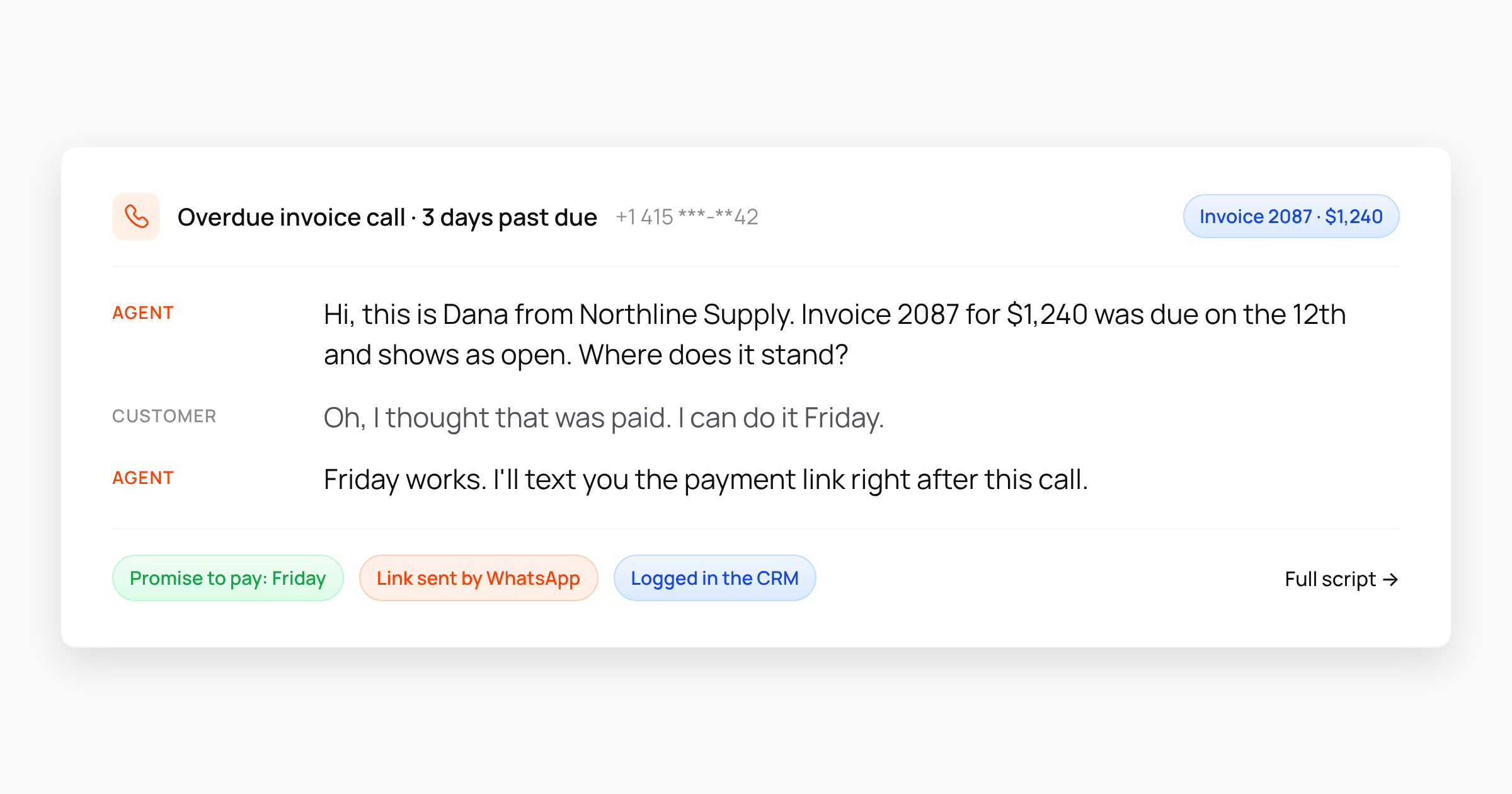
A voice AI layer fills that gap. It calls overdue accounts on the schedule you set, confirms who it is speaking to, states the balance and asks for a payment date. Then it sends the payment link by WhatsApp or SMS and writes the outcome back to the account. Disputes and sensitive cases go to your staff. Our guide to an AI voice agent for debt collection walks through the call step by step, and the collection call script shows the words it uses.
Timing is the reason to call early. In Sono’s own collection data, calls made on day 3 past due recovered 1.94 times more than calls made on day 65 (see what a collection call is worth). In one live collections program, 48.9% of debtors answered and 23.5% agreed a payment arrangement, at an average cost of 2.35 euros per arrangement, according to Sono’s collection calls page. Those are results from one program, not a promise for yours.
What do US rules mean for software that calls debtors?
Two rules matter most for any tool that places calls in the US.
- Regulation F. A debt collector is presumed to comply if it does not call a person about one debt more than seven times in seven consecutive days. It is also presumed to comply if it waits seven days after a phone conversation about that debt (12 CFR 1006.14). The rule sits under the FDCPA debt collector rules, so check whether it covers you. The collection call script guide explains who it covers and who it does not.
- TCPA. On February 8, 2024, the FCC ruled that calls made with AI-generated voices are “artificial” under the TCPA, which brings the same consent standards (FCC declaratory ruling).
Whatever tool you pick, ask how it enforces call limits, calling hours and do-not-call flags, and whether it says it is an AI at the start of the call. This is not legal advice. Your counsel should review the setup.
How do you run a pilot without a long project?
Keep your current platform and test one slice. Pick one segment, such as invoices 1 to 14 days past due, and keep the written reminders you already send. Add the new tool for the call step and a WhatsApp or text follow-up with the payment link. Run it for three to four weeks against a comparable segment, and compare cash collected, promises kept and complaints. If you want the process around the call first, read about the dunning process and accounts receivable automation.
If the phone is the step your team keeps skipping, Sono runs AI payment reminder calls in English and most European languages. It reports promise-to-pay and call-to-cash from the first week, and you can book a demo to hear a live call.
Sources
- Vendor product pages, read October 29, 2026: Upflow (debt collection software page), HighRadius (best debt collection tools article), Chaser (home page), Collect! by Comtech (home page), C&R Software (home page), Experian (small business debt collection software page), Five9 (debt collections solutions page). Features and channels are as each vendor describes them.
- CFPB, 12 CFR 1006.14, harassing, oppressive or abusive conduct
- FCC declaratory ruling, February 8, 2024, AI-generated voices under the TCPA