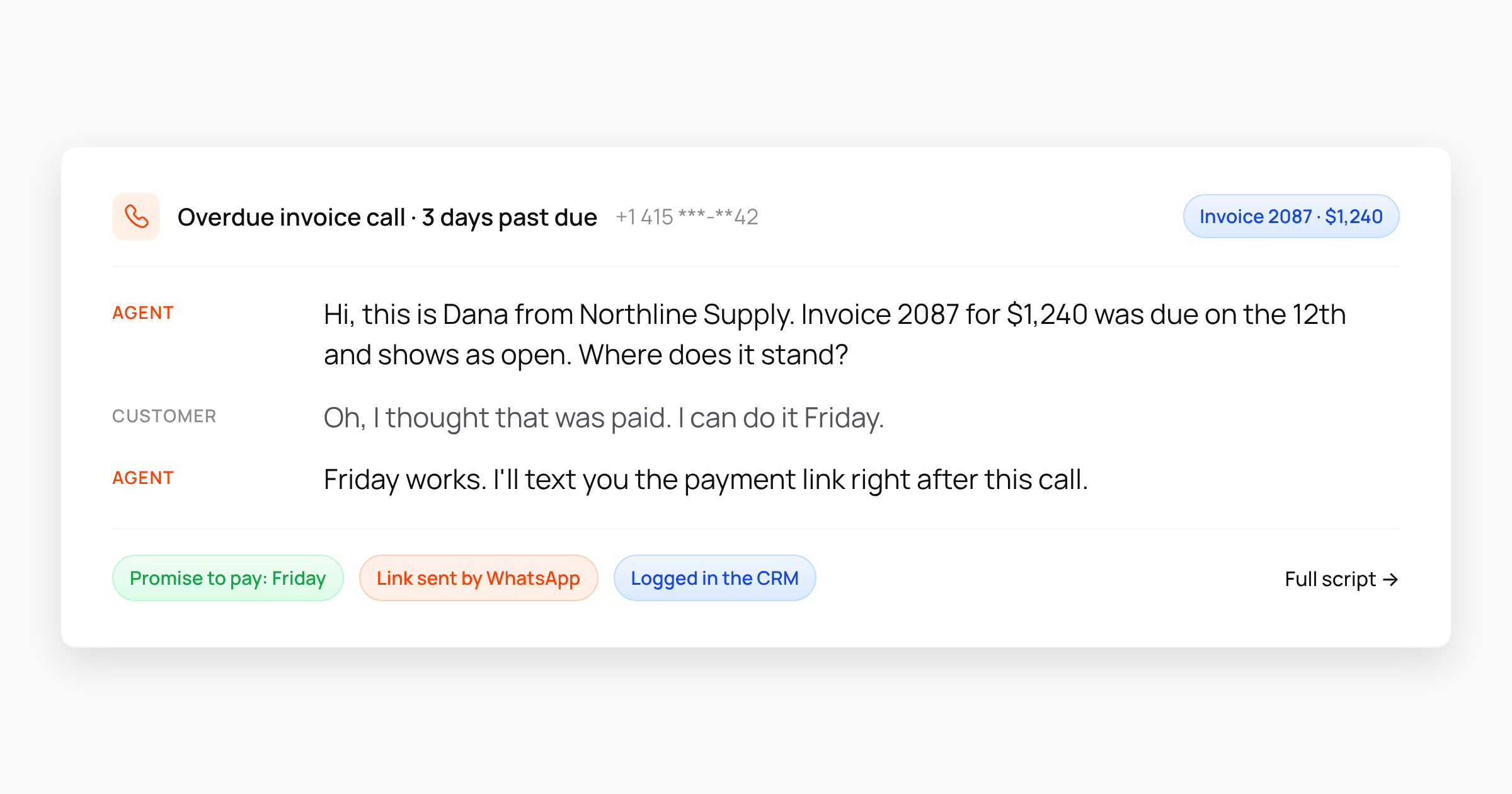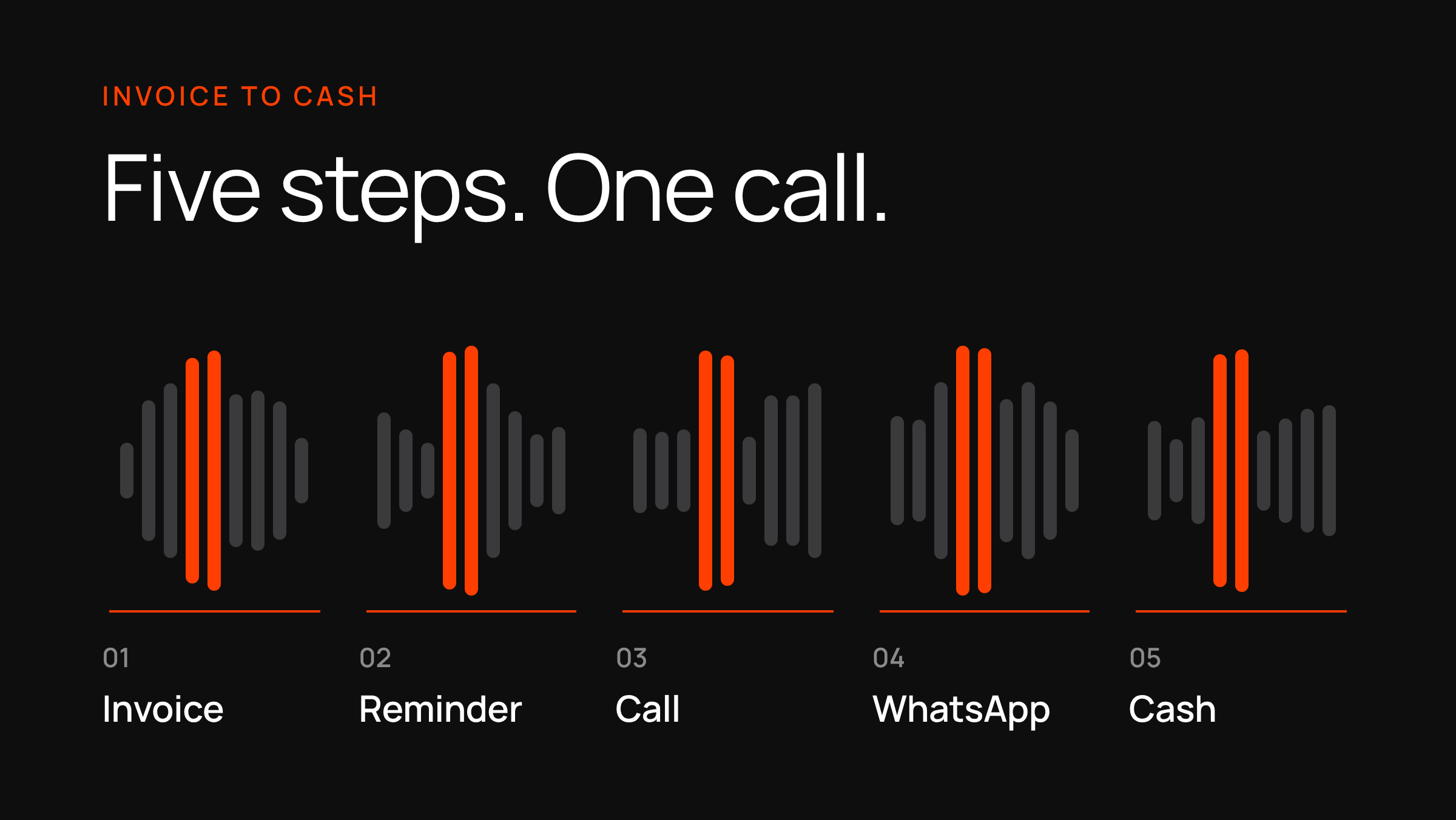
A collection call script is the set of words your team or voice agent uses on a call about an overdue invoice. It covers who is calling, what is owed, and what the customer will do about it and by when. The best ones are short. They open politely, confirm the facts, ask for a specific payment date and repeat it back. Below are five scripts to copy, replies to the objections you will hear most, a voicemail version and the message to send after the call. They are written for businesses collecting their own receivables, in a dunning process where the call comes after the written reminders.
What are the four beats of a collection call?
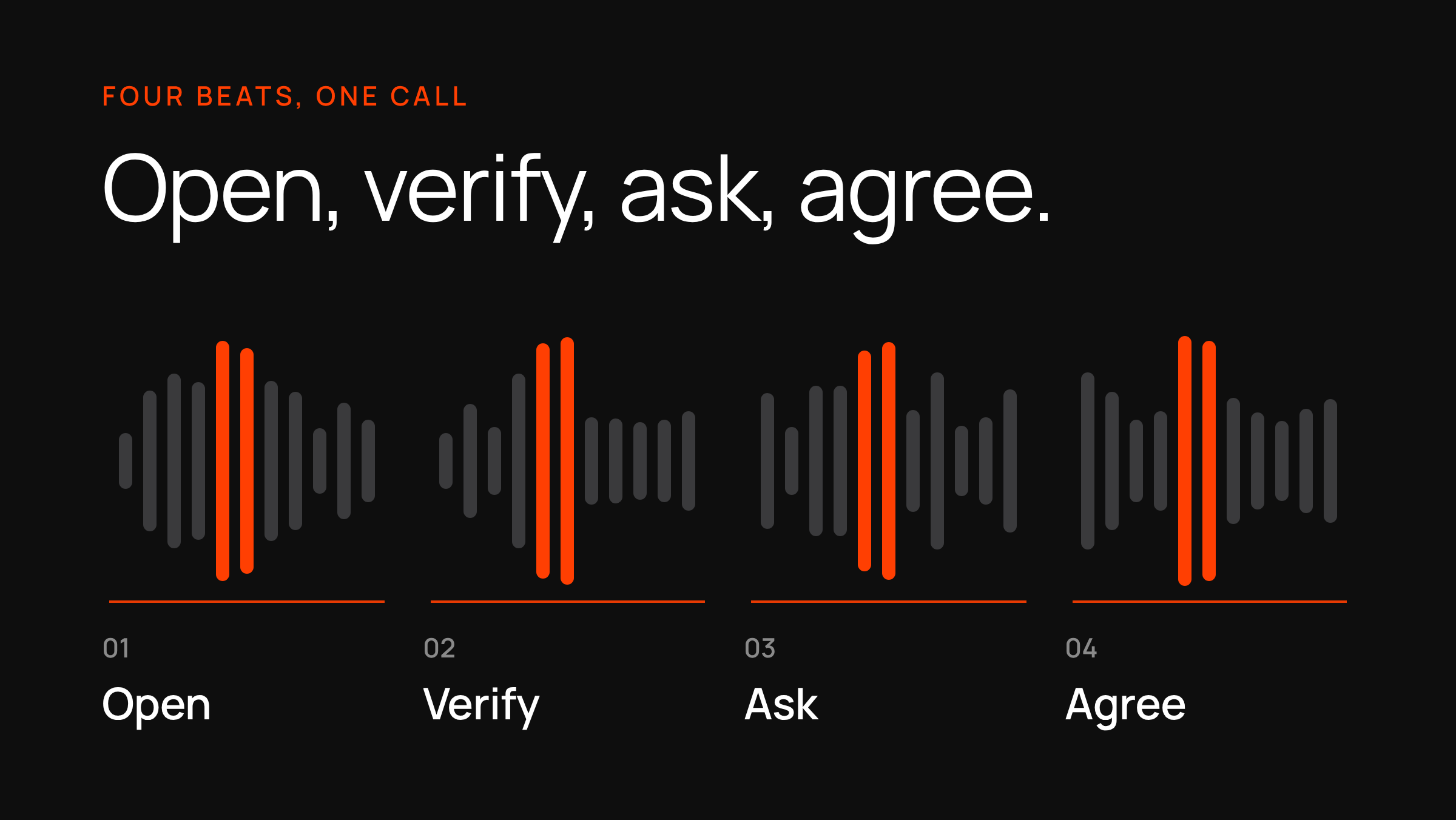
Every script that works follows the same order, whatever the industry.
- Open. Say who you are, which company you call for and why, in one sentence.
- Verify. Confirm you are speaking to the right person before you mention the amount.
- Ask. State the invoice, the amount and the days overdue, then ask for a payment date.
- Agree. Repeat the date back, say what you will send, and end the call.
The ask is where most scripts fail. “Can you pay this soon?” invites a vague yes. “Can you pay it by Friday?” gets a date, or a reason why not, and either answer is something you can act on.
Script 1: the first call, a few days overdue
Most invoices at this stage are late because someone forgot, not because the customer disputes them. Keep it light. Timing matters: in Sono’s collection data, calls made on day 3 past due recovered 1.94 times more than calls made on day 65 (see what a collection call is worth).
You: Hi, this is Sam calling from Northside Supplies. Am I speaking with Dana Reyes? Customer: Yes. You: Thanks, Dana. I’m calling about invoice 4471 for $2,340, which was due on Monday. It looks like it hasn’t come through yet. Do you know where it is in your approval process? Customer: I think it’s sitting with our manager. You: That’s helpful. Could it be paid by this Friday? Customer: I’ll ask her to approve it today. You: Great, so payment by Friday. I’ll text you the payment link right now. Thanks, Dana.
Script 2: the 30-day call
By 30 days the easy explanations are gone. Stay polite, but be specific about what has already happened and what you need.
You: Hi Dana, it’s Sam at Northside Supplies again. I’ve emailed twice about invoice 4471 for $2,340, which is now 30 days overdue. I’d like to settle it today. What is stopping it from being paid? Customer: We’ve had a cash crunch this month. You: Thanks for telling me. Could you pay half this week and the rest by the end of the month? Customer: We can do half on Thursday. You: So $1,170 on Thursday and the balance by month end. I’ll confirm that in a message now.
Offering a split is not a concession you should hold back. A confirmed partial payment with a date beats a full payment promised “soon”.
Script 3: the customer broke a promise
Name the promise without blame, then ask what changed.
You: Hi Dana, it’s Sam from Northside Supplies. Last week we agreed payment of invoice 4471 by Friday, and I can’t see it yet. Did something change? Customer: Our payment run was delayed. You: Understood. Can you confirm the new date, and can I send you the payment link so it can go out today?
If a second promise is broken, move the account to a person. A script should not argue with a customer who has already missed twice.
Script 4: the customer disputes the invoice
Do not push for payment on a disputed invoice. Log the dispute and route it.
Customer: That invoice is wrong. We never received half of those goods. You: Thanks for flagging it. I’ll note that the invoice is disputed and pass it to our accounts team today, so no more reminders go out while they check. Which line items are in question? Customer: Lines 3 and 4. You: Got it, lines 3 and 4. Someone will contact you by tomorrow afternoon.
This protects the relationship, and it keeps your reminder sequence from chasing an invoice that will be credited.
Script 5: voicemail
Voicemails are short and say nothing about the amount to whoever might hear them.
“Hi, this is Sam from Northside Supplies calling for Dana Reyes about an account matter. Please call me back on 555-0142, or reply to the text I’m sending now. Thanks.”
Then send the text or WhatsApp message straight away, so the customer has the details and a payment link in front of them.
How do you answer the objections you will hear most?
| What the customer says | A reply that works |
|---|---|
| “I already paid.” | “Thanks. Could you give me the date and the amount, so I can check it against our records? I’ll pause reminders until then.” |
| “Send me an email.” | “Of course. I’ll send it now with the payment link. What date can I note for payment?” |
| “I can’t pay right now.” | “I understand. What amount could you pay this week, and when could you pay the rest?” |
| “Talk to my accountant.” | “Happy to. What is the best number or email for them, and can I note that you’ll confirm a date by Friday?” |
| “I never got the invoice.” | “I’ll resend it right now. Once you have it, could you pay within 7 days?” |
| “Stop calling me.” | End the call, log the request, and route the account to a person. |
What should you send after the call?
A call settles the date, and a short message makes it stick. Put the call first and the message straight after. WhatsApp tends to work well where customers already use it for business, and a text works everywhere else.
| Channel | Role after the call | Example |
|---|---|---|
| Call | Agrees the date | “Payment by Friday.” |
| Confirms the date and sends the payment link | “Thanks Dana, as agreed, $2,340 by Friday. Pay here: [link]” | |
| Text (SMS) | Same, where WhatsApp is not an option | Same wording, shorter |
| The written record with the invoice attached | “Invoice 4471 attached, payment agreed by Friday.” |
For ready-made wording for each channel, see our payment reminder templates.
Do collection call rules apply to your business?
It depends on who is calling and who owes the money. In the US, the CFPB’s Regulation F covers “debt collectors”, defined as people who regularly collect debts owed to another (12 CFR 1006.2). It defines “debt” as a consumer obligation for personal, family or household purposes. A business collecting its own invoices under its own name is generally outside that definition, and a B2B invoice is not a consumer debt. This is a reading of the regulation, not legal advice, and state laws can differ.
If you or a vendor collect consumer debts for someone else, the call rules apply. Regulation F presumes a collector complies if it places no more than seven calls within seven consecutive days. It also presumes compliance if the collector waits seven days after a phone conversation before calling again (12 CFR 1006.14). It treats a time before 8 a.m. or after 9 p.m. at the consumer’s location as inconvenient (12 CFR 1006.6).
Good practice is the same either way: call in business hours, be accurate about the amount, and stop when asked.
Can a voice agent run a collection call script?
Yes. A script like the ones above is a good fit for an AI voice agent, because the beats are fixed and the customer’s answers fall into a short list. The agent checks who it is speaking to, agrees a date within your rules and logs the outcome. You can hear how it sounds in an annotated AI payment reminder call.
Two things matter in the US. The FCC ruled in February 2024 that calls made with AI-generated voices are “artificial” under the Telephone Consumer Protection Act (FCC news release, 8 February 2024), so check consent requirements before any automated call. Separately, we recommend the agent says it is an AI at the start of the call.
In Sono’s data, 235 of every 1,000 reached contacts promised to pay, and 70% kept the promise. Sono’s collection calls run these scripts in English and most European languages, and the payment reminder calls page shows how a pilot works.
How do you test a new script?
Change one thing at a time. Keep the list and timing you already use. Swap in the new opening or the new ask for a few weeks. Then compare four numbers: how many calls reach the right person, how many agree a date, how many of those dates are kept, and how many disputes come up.
Useful links and sources
- 12 CFR 1006.2, definitions (CFPB)
- 12 CFR 1006.14, harassing, oppressive or abusive conduct (CFPB)
- 12 CFR 1006.6, communications in connection with debt collection (CFPB)
- FCC news release on AI-generated voices and the TCPA, 8 February 2024
- Sono collection data, published in what a collection call is worth