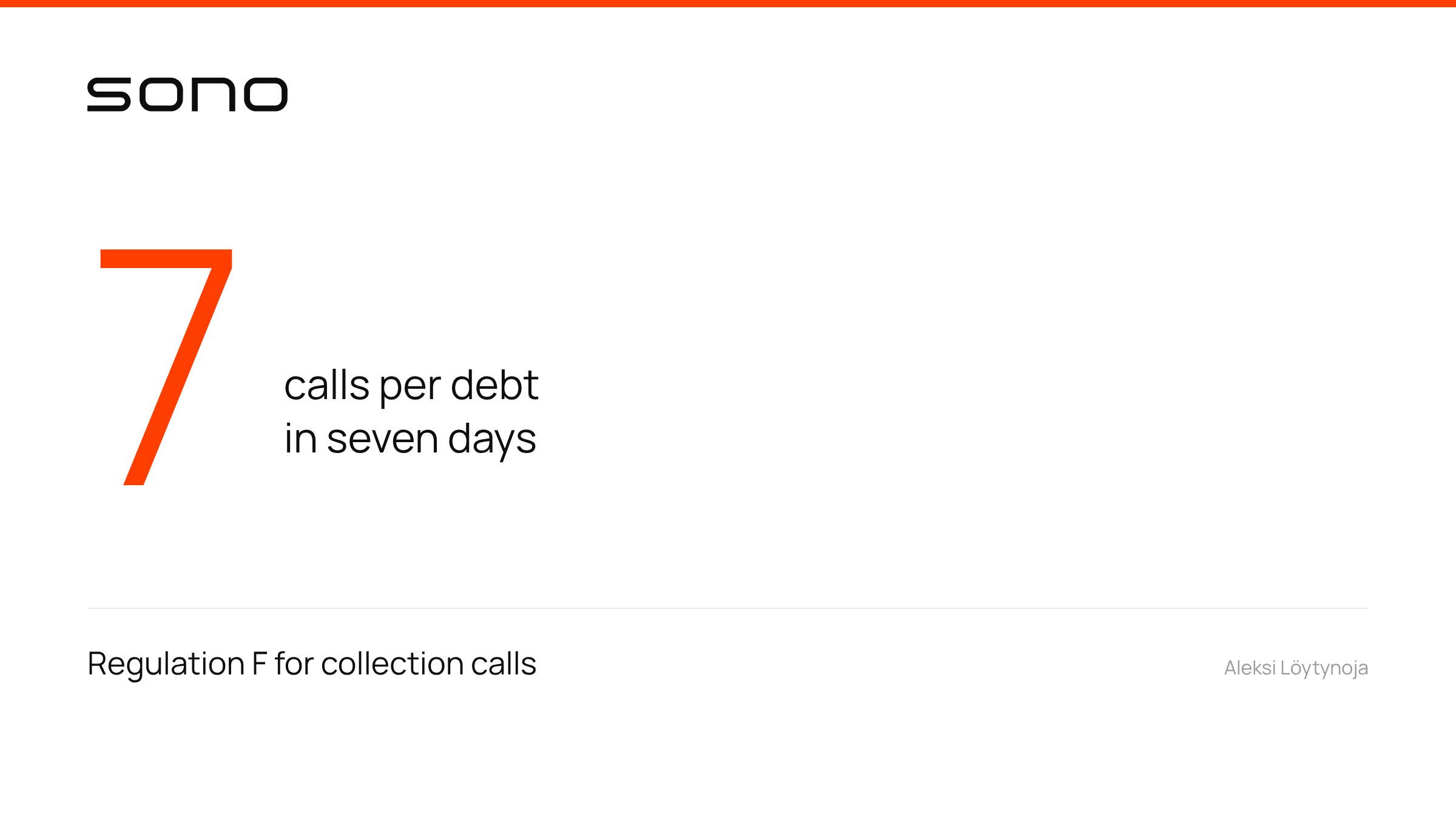
Regulation F is the Consumer Financial Protection Bureau (CFPB) rule, 12 CFR Part 1006, that implements the Fair Debt Collection Practices Act (FDCPA). For collection calls it sets a presumed cap of seven calls per debt in seven days, limits calls to 8 a.m. to 9 p.m. at the consumer’s location, and says what a collector must disclose and when it must stop. The rules took effect on November 30, 2021 (CFPB).
This guide is for agencies, debt buyers and lenders’ collection teams that run calls in the US, whether people or an AI voice agent place them. It quotes the regulation section by section. It is a plain-English reading, not legal advice, and state laws can be stricter. (The Federal Reserve also has a “Regulation F”, on banks’ interbank liabilities. This page is about the CFPB rule.)
Who does Regulation F apply to?
It applies to “debt collectors” as the FDCPA defines them, collecting “debts” from “consumers”. The CFPB puts it this way: Regulation F prescribes “Federal rules governing the activities of debt collectors, as that term is defined in the FDCPA” (12 CFR Part 1006).
In practice that means a person whose business is collecting debts, or who regularly collects debts owed to someone else (12 CFR 1006.2). A “debt” is a consumer obligation for personal, family or household purposes (15 U.S.C. 1692a).
| Who is calling | Whose debt | Consumer or business debt | Regulation F applies? |
|---|---|---|---|
| Collection agency | A client’s | Consumer | Yes |
| Debt buyer | Its own, bought in default | Consumer | Usually yes, check with counsel |
| Lender or utility | Its own, in its own name | Consumer | Generally no, but the FTC Act still bans deceptive practices |
| Lender using a name that suggests a third party | Its own | Consumer | Yes, the FDCPA treats it as a collector |
| Any business | Its own or a client’s | Business (B2B invoice) | No, a B2B invoice is not a consumer debt |
Creditors outside the FDCPA are not free of rules. The FTC says their collection activity is still covered by Section 5 of the FTC Act (FTC). Many creditors adopt the Regulation F limits anyway, because their agencies have to.
What is the 7-in-7 rule?
The 7-in-7 rule is a presumption about call frequency in 12 CFR 1006.14(b). A collector is presumed to comply if it places a call about a particular debt neither:
- more than seven times within seven consecutive days, nor
- within seven consecutive days after a telephone conversation with the person about that debt. The day of the conversation is day one.
Breaking either limit flips it into a presumed violation. Both are presumptions, so they can be rebutted. The regulation’s commentary lists a consumer’s request not to be called as one factor that can rebut the presumption of compliance.
The cap is counted per particular debt, meaning each of a consumer’s debts in collection. A consumer with two accounts in collection can get two separate counts.
Which calls count toward the cap?
This is where most dialer settings go wrong. Under the regulation and its official interpretations:
| Call outcome | Counts toward 7-in-7? |
|---|---|
| Answered, any length | Yes |
| Rang with no answer | Yes |
| Reached voicemail or a recorded message | Yes |
| Ringless voicemail | Yes, it is “placing a telephone call” |
| Busy signal or number not in service | No, the call was not connected |
| Placed with the consumer’s prior consent, within seven days of that consent | No |
| Text, email or WhatsApp message | No, an electronic message is not a call |
The commentary says “placing a telephone call” includes a ringless voicemail “but does not include sending an electronic message” (12 CFR 1006.14, comment 14(b)-1). Electronic messages have their own rules, covered below.
Here is how one week plays out for one debt, with the counter a dialer or agent should keep:
| Day | Calls placed | Outcome | Running count (7-day window) |
|---|---|---|---|
| Mon | 2 | No answer, voicemail | 2 |
| Tue | 1 | Busy signal | 2 |
| Wed | 2 | No answer | 4 |
| Thu | 1 | Ringless voicemail | 5 |
| Fri | 2 | No answer | 7, stop until Mon drops out of the window |
| Mon (next) | 1 | Conversation | 6 in the window, then no calls through Sun |
What times can debt collectors call?
Unless the collector knows otherwise, “a time before 8:00 a.m. and after 9:00 p.m. local time at the consumer’s location is inconvenient” (12 CFR 1006.6(b)(1)(i)). The clock that matters is the consumer’s, not the call center’s.
When the data conflict, call only in the overlap. The CFPB’s own example: a mobile number with an Eastern area code and a Pacific address give a window of 11:00 a.m. to 9:00 p.m. Eastern. For a text, email or WhatsApp message, the time is when you send it, not when it is read.
A consumer can also tell you a time or place is inconvenient, such as work hours. From then on, that is “knowledge of circumstances to the contrary”, and the window shrinks.
What must a collector say on the call?
Two disclosures, from 12 CFR 1006.18(e):
- First communication: that the debt collector “is attempting to collect a debt and that any information obtained will be used for that purpose.”
- Every later communication: that the communication is from a debt collector.
Verify the person’s identity before you say either. Telling a third party that someone owes a debt is its own problem under the FDCPA.
If the call is your initial communication, the validation information comes next. You either give it orally on that call or send a validation notice with that first contact or within five days (12 CFR 1006.34). The consumer then has a validation period of 30 days from receiving it. Our dunning letter guide shows where that notice sits in a collection sequence.
What can a voicemail say?
Regulation F created the limited-content message, a voicemail that is not treated as a communication, so it needs no debt-collector disclosure (12 CFR 1006.2(j)). It must include all four of these and nothing beyond the optional items:
| Must include | May include |
|---|---|
| A business name that does not say you collect debts | A salutation |
| A request that the consumer reply | The date and time of the message |
| The name of one or more people to contact | Suggested times to call back |
| A phone number to reply to | That any of your representatives can help |
A safe AI or human voicemail therefore sounds like this:
Hi, this is a message for Dana Reyes from Northside Services. Please call Sam Lee back at 555-0142. Any of our team can help, weekdays until 8 p.m. Thanks.
No amount, no account number, no “collections”. Every one of these voicemails still counts toward the 7-in-7 cap.
When must the calls stop?
Four triggers stop or narrow contact, and each one should set a flag your dialer or agent cannot override:
| Trigger | Rule | What the system does |
|---|---|---|
| Consumer asks in writing to stop, or refuses to pay | 1006.6© | Stop all contact on that debt, except the narrow notices the rule allows |
| You know the consumer has an attorney for this debt | 1006.6(b)(2) | Contact the attorney instead, unless they don’t respond in a reasonable time or consent |
| Consumer asks you not to use a medium, such as calls | 1006.14(h) | Block that channel. An electronic confirmation of the opt-out is allowed |
| Consumer opts out of texts, email or other electronic messages | 1006.6(e) | Stop on that address or number |
An AI agent should treat a spoken “stop calling me” as a medium opt-out and hand the account to a person. The cease-communication rule is triggered by a written notice, but nobody wants to argue the difference in a complaint.
How do texts and WhatsApp fit in?
Electronic messages don’t count toward the call cap, which makes them the natural follow-up after a call. They carry their own conditions:
- Opt-out in every message. Each electronic message must include “a clear and conspicuous statement describing a reasonable and simple method” to opt out, with no fee (1006.6(e)). The CFPB’s example is “Reply STOP to stop texts to this telephone number.”
- Number checks for texts. For the text-message safe harbor, the consumer must have texted you about the debt or given direct consent within the past 60 days. You must also confirm the number was not reassigned (1006.6(d)(5)).
- Same time window. 8 a.m. to 9 p.m. at the consumer’s location, measured when you send.
Regulation F names email and text but not WhatsApp. In our reading a WhatsApp message is an electronic message, so treat it like a text: opt-out line, consent on record, same hours. Confirm that with counsel before you scale it.
| Channel | Counts toward 7-in-7 | Opt-out requirement | Role in the sequence |
|---|---|---|---|
| Phone call | Yes, if connected | Consumer can ban the medium (1006.14(h)) | Agrees a payment date |
| No | Opt-out statement in each message | Confirms the date, sends the payment link | |
| Text (SMS) | No | “Reply STOP” style statement; 60-day consent and reassignment check | Same as WhatsApp where it is not used |
| No | Opt-out statement | Written record and validation notice |
What about time-barred debt?
A time-barred debt is one where the statute of limitations has expired. A collector “must not bring or threaten to bring a legal action against a consumer to collect a time-barred debt” (12 CFR 1006.26). For a call script, that means no line that hints at court, ever, on accounts flagged as time-barred. Statutes of limitations are set by state, so the flag has to come from your data, not the script.
How long must you keep call records?
Records that show compliance must be kept until three years after your last collection activity on the debt. If you record calls, each recording must be kept for three years after the date of the call (12 CFR 1006.100). Recording is not required, but most AI voice agents record and transcribe calls, so plan storage for it.
Can an AI voice agent make collection calls under Regulation F?
Yes. Regulation F does not ban automated or AI calls. It governs what any collector does, whoever or whatever dials. The extra gate is the Telephone Consumer Protection Act. The FCC ruled on February 8, 2024 that “calls made with AI-generated voices are ‘artificial’” under the TCPA, which brings the same consent standards (FCC).
An agent is easier to keep inside the rules than a large team, because the limits live in configuration instead of training. Here is the checklist we would hold any voice agent to, including ours:
| Requirement | Source | What the agent must do |
|---|---|---|
| Consent for an artificial voice | TCPA, FCC Feb 2024 | Call only numbers with the consent the TCPA requires |
| Call cap | 1006.14(b) | Keep a rolling 7-day counter per debt, counting voicemails and ringless voicemails |
| Pause after a conversation | 1006.14(b) | Block calls for 7 days, conversation day included |
| Calling window | 1006.6(b)(1)(i) | Dial 8 a.m. to 9 p.m. at the consumer’s location; use the overlap when data conflict |
| Identity check, then disclosure | 1006.18(e) | Verify the person, then state the debt-collector disclosure |
| Voicemail | 1006.2(j) | Leave only a limited-content message |
| Stop flags | 1006.6(b)(2), ©, 1006.14(h) | Honor attorney, cease and medium opt-outs; hand off to a person |
| Time-barred accounts | 1006.26 | Use a script with no reference to legal action |
| Validation | 1006.34 | Trigger the notice within five days of an initial communication |
| Records | 1006.100 | Keep recordings 3 years from the call date |
| AI disclosure | Good practice | Say it is an AI at the start of the call |
Our debt collection software guide lists the questions to ask vendors, and the collection call script gives word-for-word openings you can adapt. Sono’s collection calls run in English and most European languages, with a call first and a WhatsApp or text follow-up after it.
Does Regulation F apply outside the US?
No. It is a US federal rule. In the EU, collection calls fall under national rules and the GDPR, and our AI debt collection rollout guide covers that side. If you collect consumer debts from people in the US, check with counsel whether it covers you, wherever your team sits.
Sources
- CFPB: Debt Collection Practices (Regulation F), final rule page with effective date
- CFPB: 12 CFR Part 1006, Regulation F
- 12 CFR 1006.2, definitions incl. limited-content message
- 12 CFR 1006.6, communications, call times, opt-outs
- 12 CFR 1006.14, call frequency and communication media
- 12 CFR 1006.18, required disclosures
- 12 CFR 1006.26, time-barred debt
- 12 CFR 1006.34, validation notice
- 12 CFR 1006.100, record retention
- 15 U.S.C. 1692a, FDCPA definitions (Cornell LII)
- FTC: Think your company’s not covered by the FDCPA?
- FCC news release on AI-generated voices and the TCPA, February 8, 2024