Käyttöauto is one of the largest car dealership chains in Finland, operating nationwide. The main switchboard numbers at its locations are how most customers reach the service desk. Before Sono, those callers were routed through a multi-level keypad menu: getting through could take minutes, left people frustrated, and often landed them in the wrong place.
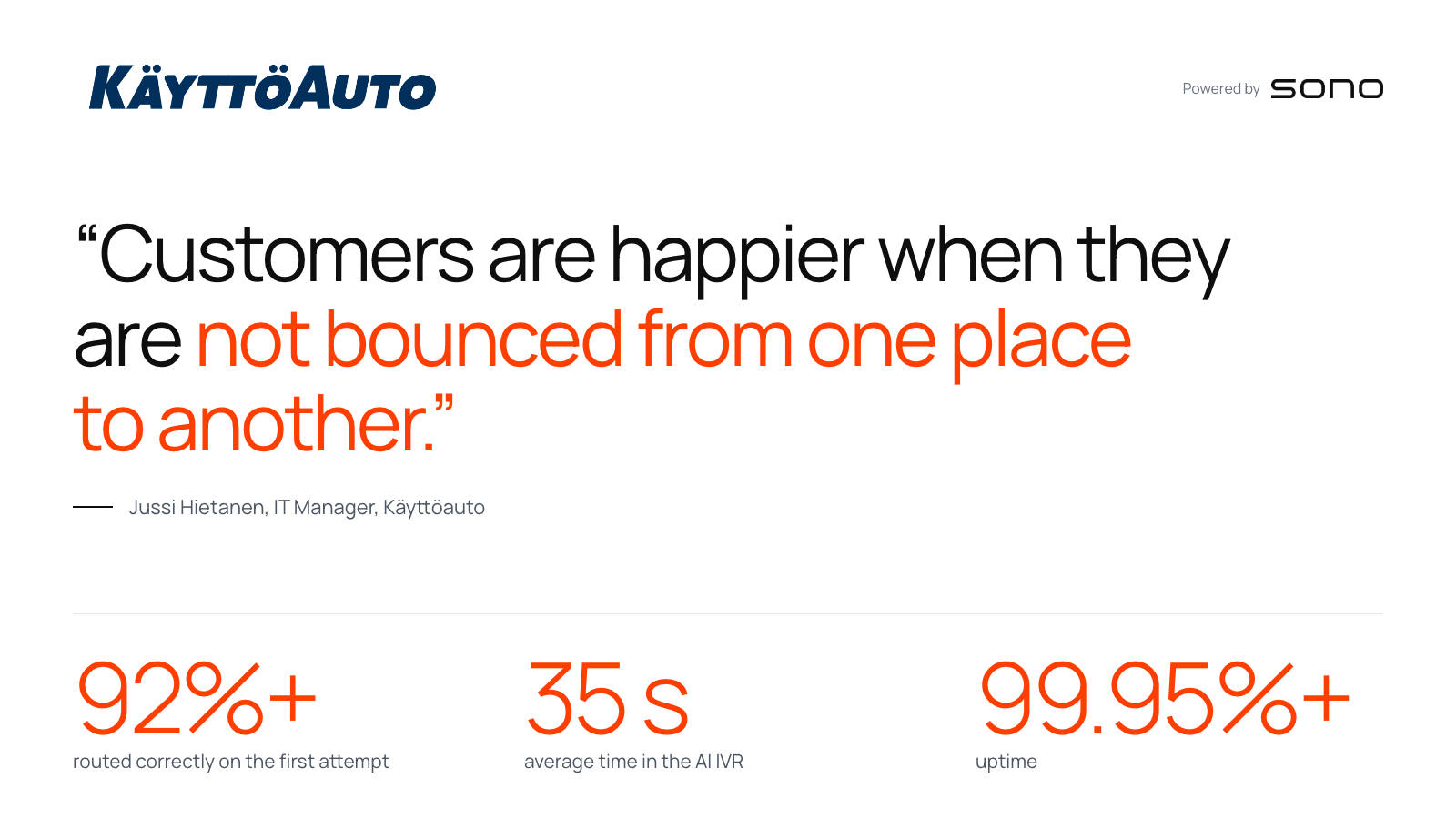
Sono’s AI Receptionist replaced it. Tens of thousands of calls later, 92%+ of callers reach the correct destination on the first attempt, with 99.95%+ uptime. Starting from the first pilot location, the agent has expanded to six of Käyttöauto’s ten sites over nearly a year in production.
The problem: a menu that took minutes
Käyttöauto sells 17 passenger car brands and runs sales, workshop and parts operations out of 10 locations across Finland. That’s a business where the phone matters: it is still the main way customers reach the workshop for service.
The old setup was a traditional, tiered IVR menu navigated with the phone keypad. Language, then sales or service, then a brand, and often more choices after that. Getting through it could take minutes. The caller had to hold the whole tree in their head and guess which branch might match their problem.
Plenty of callers ended up in the wrong place, and some gave up and took the quickest path just to be connected somewhere.
What’s more, many people call about their car while driving. Tapping through a keypad menu is not something you can do behind the wheel.
This had two consequences. Callers were already irritated when the conversation started, and staff spent part of their day fixing the routing mistakes the menu had made.
“Our business is complex by nature. In many of our locations, that turned into a long and tiered phone menu. A customer could spend a couple of minutes pressing numbers and still end up in the wrong place. We could hear that frustration in the customer feedback.”
— Jussi Hietanen, IT Manager, Käyttöauto
What changed: a single open-ended question instead of a complex phone tree
Käyttöauto implemented Sono’s AI Receptionist to solve this problem. Sono’s AI agent greets the caller and asks an open-ended question about what they need. If the answer is unclear, the agent follows up until it knows where to route the call. Depending on the location, this means choosing from dozens of possible options.
The caller just says what they need, and Sono forwards them to the right place. Working out which team the customer’s issue belongs to is the agent’s job now, not the customer’s. The agent serves callers in Finnish and Swedish, so the language branch of the old tree disappeared along with the rest of it.
Where the keypad menu took minutes, this takes 35 seconds on average. It is the same shift covered in general terms in our guide to conversational IVR versus traditional phone trees — here measured on a live nationwide dealership network rather than in the abstract.
The results
Since going live:
- Tens of thousands of calls handled
- 92%+ connected to the correct destination on the first attempt
- 99%+ connected somewhere useful, so almost nobody hits a dead end
- 99.95%+ uptime
The 92% is the number that matters most. Accuracy across a handful of options is easy. Accuracy across dozens of endpoints, or 60+ in the largest locations, is the hard part. It’s also where the traditional menu was failing.
Sono’s AI Receptionist removes the guesswork for the customer. With the AI in charge of forwarding, many more customers land in the right place.
“Sono won us over with determined execution and the ability to build future-facing services that are easy for end users to understand. The collaboration has been smooth, and everything has been handled professionally and exactly as agreed.”
— Jussi Hietanen, IT Manager, Käyttöauto
Where the old friction went
A misrouted call is never just the caller’s problem. It costs two people time: the customer, who has to explain their issue again from the start, and the service manager, who has to break off their own work to pick up a call that wasn’t theirs.
At Käyttöauto’s volumes, those minutes add up. Even a modest share of calls landing in the wrong place turns into a steady stream of unnecessary internal transfers over time.
Getting to high forwarding accuracy takes most of that traffic out of the internal phone system. The person who picks up gets a call they can handle, and they don’t need to act as an ad hoc switchboard between customers and colleagues.
“The calls that reach our people are now calls those people can actually handle. Customers are happier when they are not bounced from one place to another.”
— Jussi Hietanen, IT Manager, Käyttöauto
What’s next
After nearly a year in production, the solution is battle-tested at real volumes. We look forward to a long partnership and to making sure every Käyttöauto customer gets fast, personal service whenever they call.
“We started working with Sono when they were early, and it has worked because they listen carefully and move quickly. We intend to keep going.”
— Jussi Hietanen, IT Manager, Käyttöauto
If your phone menu has grown in the same way
Käyttöauto’s original IVR menu got long for a reason. The business behind it is large and complex, and every new brand, location and department had to go somewhere. Most multi-site service operations we talk to are in the same position, and they assume the only options are a longer tree or a shorter one that covers less.
There is a better option. If you want to see what the numbers above look like on your own call volume, get in touch — or read how the same setup applies to car dealerships and workshops and to multi-site operations more broadly.
Frequently asked questions
What does Sono do for Käyttöauto?
Sono’s voice AI agent answers inbound calls, asks the caller what they need, and connects them to the right team. Each location has its own set of endpoints, in some cases in multiple languages. It replaced a multi-level keypad menu.
How accurate is the routing?
Across tens of thousands of calls, 92%+ reached the correct destination and 99%+ were connected to a person rather than dropped.
Does Sono handle the whole call?
Not in this setup. At Käyttöauto, Sono handles the routing layer that used to be a keypad IVR menu. The conversation itself still happens with Käyttöauto’s own people. While the most important and complex conversations will always happen with humans, there are multiple ways to automate routine tasks with Sono’s AI.
Does the caller have to talk to a robot instead of a human?
The caller talks to the agent for call forwarding, then to a person. Compared with the old menu, that’s less machine, not more.
What happens if the agent doesn’t understand the caller?
If the agent can’t determine the right destination within 60 seconds, or the caller asks to speak to a human, the call goes to a fallback number, where a customer service rep routes it manually.
Where is call data hosted?
Every call is handled on EU-hosted infrastructure. More on how that works in our guide to secure, GDPR-compliant voice AI.
How long did it take to get live?
New locations are onboarded within 3 days of Sono receiving a description of the current IVR menu.