AI receptionist pricing is how vendors charge for an AI that answers your business phone. The unit is the minute, the call, the unique caller, or a flat monthly plan with an allowance. Public plans for small businesses start at $0 to $149 a month, while services with a human in the loop start at $300 for 30 calls. This guide compares the plans on the public price pages of five vendors, works through one 300-call example and lists what a quote should spell out before you sign. If you want the wider picture first, start with our guide to the AI receptionist.
What are the four ways AI receptionists charge?
Almost every plan on the market uses one of four units, and the unit matters more than the headline price.
| Pricing unit | How the bill grows | Works best when | Example from a public price page |
|---|---|---|---|
| Per minute | With call length | Calls are short and predictable | Rosie: $49 a month for 250 minutes |
| Per call | With call count | Calls vary a lot in length | Smith.ai AI-first: $500 a month for 300 calls |
| Per unique caller | With the number of different phone numbers | Customers call back several times a month | Goodcall: $79 a month for 100 unique customers |
| Flat plan with minutes | In steps, with overage above the plan | You know your volume | Ruby: $395 a month for 100 minutes |
Per-caller pricing is the one to read twice. A customer who calls five times in a month counts once, so it can be cheaper than per-call pricing. A new number every call, such as a field technician’s mobile, counts every time.
How much does an AI receptionist cost per month?
Between $0 and about $300 a month for small AI-only plans, and $300 to $2,100 a month when humans take part in the call. The table below uses the price pages of five vendors as we read them on 27 October 2026. Plans change often, so check the vendor page before you budget.
| Vendor and plan type | Plan and price | Included | Above the allowance |
|---|---|---|---|
| Rosie (AI) | $49 / $149 / $299 a month | 250 / 1,000 / 2,000 minutes | Not stated on the page |
| Goodcall (AI) | $79 / $129 / $299 a month | 100 / 500 / 2,000 unique customers | 79¢ / 26¢ / 15¢ per extra customer |
| Smith.ai AI-first | $0 free tier, $150 Pro, $500 Enterprise | 25 calls free, 75 to 300 calls on Pro, 300 or more on Enterprise | $3.00 on the free tier, $2.17 to $2.50 on paid tiers |
| Smith.ai human-first | $300 / $810 / $2,100 a month | 30 / 90 / 300 calls | $11.50 / $10.50 / $8.50 per extra call |
| Ruby (human) | $250 / $395 / $720 / $1,725 a month | 50 / 100 / 200 / 500 minutes | Contact sales |
| Sono (AI, fully managed) | €0.30 to €0.40 per minute | Billed on use | Not applicable, billed per minute |
Sources: Rosie, Goodcall, Smith.ai AI receptionist, Smith.ai receptionists, Ruby, and Sono’s own AI phone agent page. We list only what each page states. Where a page gives no overage rate, we say so instead of guessing.
What does 300 calls a month cost on each plan?
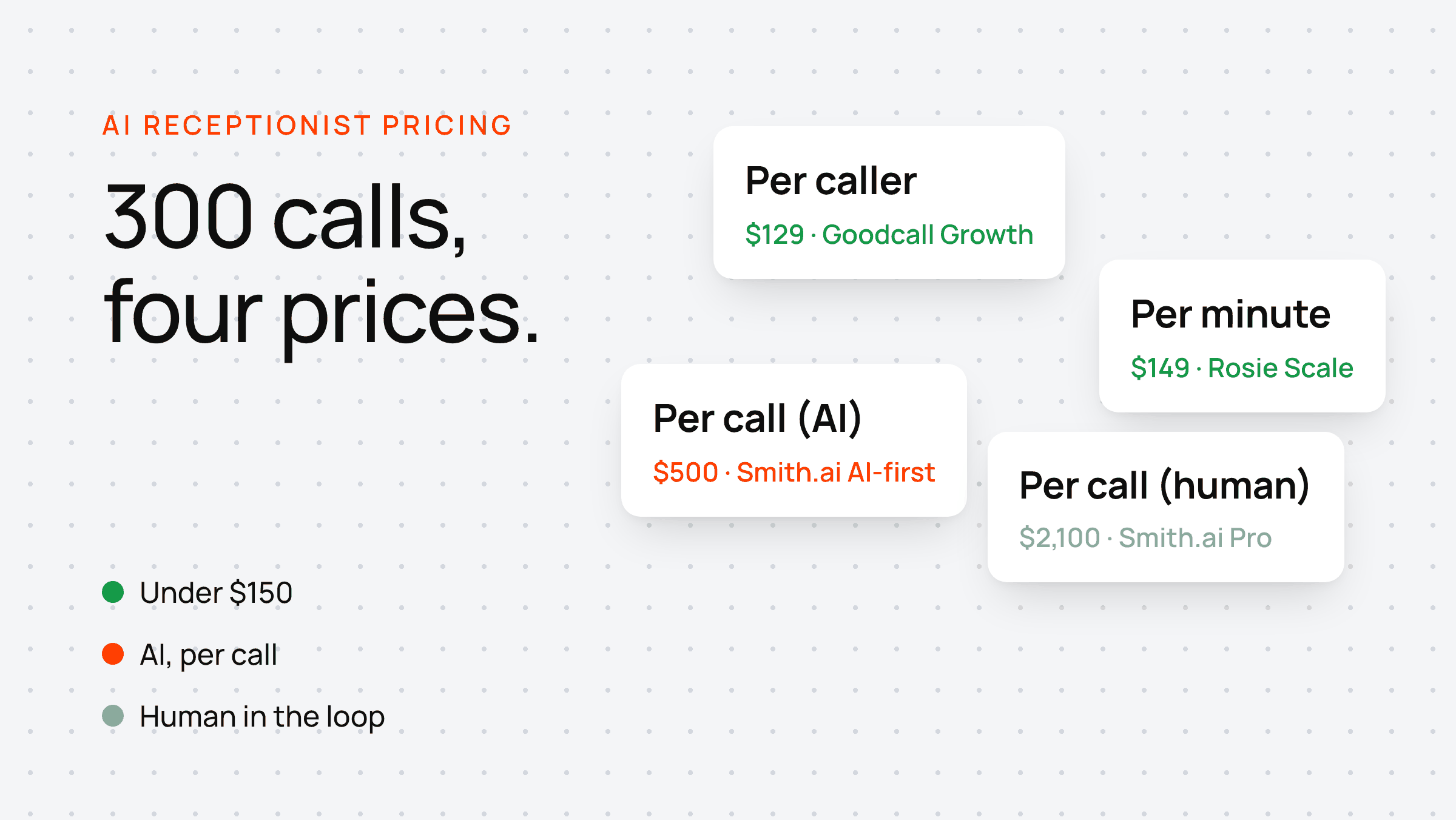
On the plans above, roughly $129 to $500 for AI-only service and $2,100 for human-first service. The comparison depends on assumptions, so here they are: 300 calls a month, each from a different caller, averaging 3 minutes, which is 900 minutes in total.
| Option | Plan that fits | Monthly cost | Per call |
|---|---|---|---|
| Goodcall | Growth, 500 customers | $129 | $0.43 |
| Rosie | Scale, 1,000 minutes | $149 | $0.50 |
| Sono | 900 minutes at €0.30 to €0.40 | €270 to €360 | €0.90 to €1.20 |
| Smith.ai AI-first | Enterprise, 300 calls | $500 | $1.67 |
| Smith.ai human-first | Pro, 300 calls | $2,100 | $7.00 |
Ruby is missing from this table on purpose. Its public plans stop at 500 minutes, and the page gives no rate above that.
Two things stand out. The cheapest plans are cheap because the unit is generous, not because the service is better. And the human-first plan costs about four times the AI-first one for the same call count. The gap buys a person on the line. That matters for complex or sensitive calls and matters little for “what time do you open?”
The list prices also leave out what happens after the call. If your team needs the caller to get a confirmation text or a WhatsApp message, check that it is included. Sono handles the call first and a WhatsApp follow-up second, as part of the same deployment.
Is an AI receptionist cheaper than hiring one?
For most small businesses, yes, and the gap grows once you count the hours covered. The Bureau of Labor Statistics reports a median pay of $38,010 a year, or $18.27 an hour, for receptionists in the US (BLS Occupational Outlook Handbook, May 2025 data). That is about $3,168 a month in wages alone, before payroll taxes, benefits, recruiting and vacation cover.
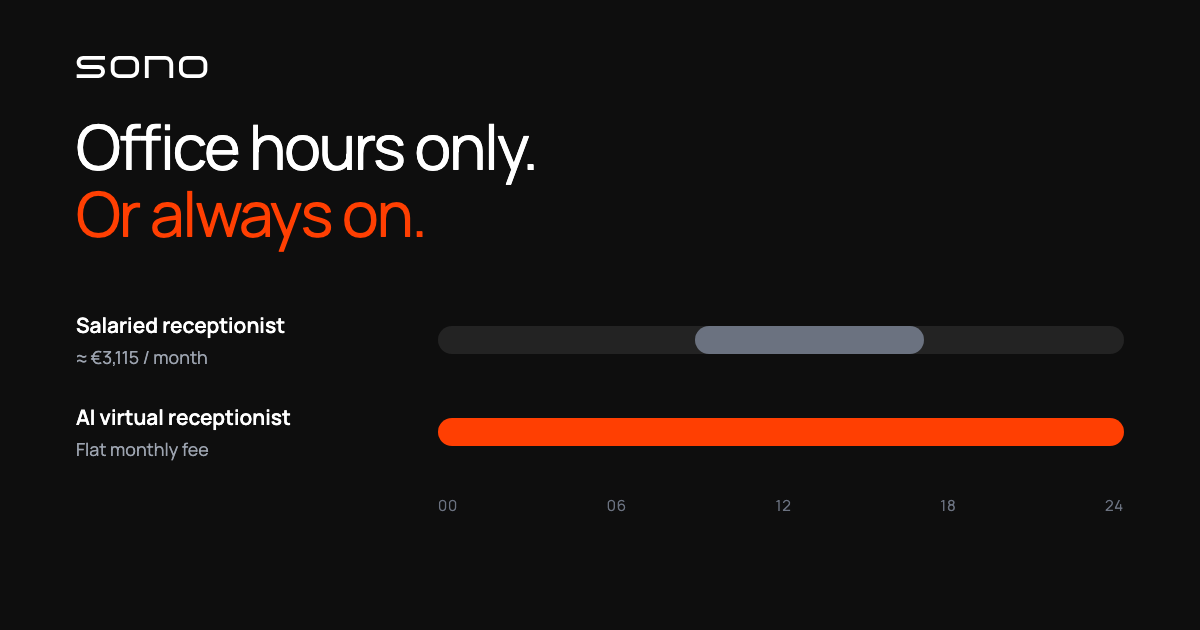
That wage buys roughly 40 of the 168 hours in a week, so nights, weekends and lunch breaks are uncovered. Paying one person’s hourly wage for all 8,760 hours in a year would cost about $160,000, and that is arithmetic on the BLS median, not a staffing plan. Nobody staffs a phone that way, which is why after-hours cover is where AI usually starts.
The honest caveat: an AI receptionist rarely replaces the whole role. It takes the routine calls, so the person at the desk spends the day on work that needs one.
What drives the price of an AI receptionist?
Six things move the bill more than the headline rate.
- Call volume and length. Minutes and calls both scale with how busy you are. A plan sized for 100 calls gets expensive in a month with 400.
- Overage rates. Goodcall’s extra-customer rate falls from 79¢ to 15¢ across its tiers, and Smith.ai’s per-call overage falls from $3.00 to $2.17. Moving up a tier can be cheaper than paying overage.
- Human involvement. Plans where agents join or take over calls cost several times more per call than AI-only plans.
- Integrations. Connecting a calendar, CRM or booking system is often a setup fee or a higher tier.
- Languages. Support for more than one language, which matters across the Nordics and the Netherlands, can sit outside the base plan.
- Setup. Voice profile, call flows and testing are real work. Ask whether setup is free, itemized or bundled.
What should an AI receptionist quote include?
Ask for the same ten lines from every vendor, and the quotes become comparable.
| Line to ask for | Why it changes the price |
|---|---|
| Unit and allowance | Minutes, calls or unique callers, and how many are included |
| Overage rate | The price of a busy month |
| Setup fee | One-off cost to build your call flows |
| Integrations | Calendar, CRM, ticketing, booking system |
| Languages | Which are included and which cost extra |
| After-hours and holidays | Whether the rate changes outside office hours |
| Transfers to a human | Whether a handoff counts as a billed call |
| WhatsApp or text follow-up | Whether the confirmation after the call is included |
| Contract term | Monthly, annual, or a minimum commitment |
| Call recordings and transcripts | Storage and retention limits |
How does an AI receptionist compare with an answering service on cost?
An answering service charges for the human on the line, so cost scales with volume and drops off after hours. An AI receptionist charges for usage and answers at any hour at the same rate. Our guide to AI receptionist vs answering service covers the capability side, and the guide to setting up an AI answering service covers call-flow design.
In Ireland? Salary and payroll-tax numbers differ, so see virtual receptionist pricing in Ireland for euro figures.
What does Sono cost?
Sono is priced per minute of conversation, from €0.30 to €0.40 per minute for a fully managed deployment. A business with 800 calls a month averaging 2 minutes uses 1,600 minutes, which is €480 to €640. Sono answers on the phone first and follows up on WhatsApp.
We do not publish a rate card beyond that, because the right number depends on your call log. Ask for a quote built on your own volume, or read how the AI phone agent works before you do.