After hours answering service cost is what a business pays to have someone, or something, pick up the phone when the office is closed. On the public price pages we checked, live services start at $164 a month and reach $2,100 for 300 calls, while AI plans start at $49. This guide shows what each plan costs at 100, 300 and 600 after-hours calls, and which line items change the bill. For how the service itself works, see our page on after hours answering.
How much does an after hours answering service cost?
For live receptionists, roughly $164 to $2,100 a month for plans of 30 to 500 calls or minutes. For AI plans, $49 to $299 a month for 250 to 2,000 minutes. The table reflects the vendor price pages as we read them on 10 November 2026. Plans change often, so check the page before you budget.
| Service | Type | Plans (monthly) | What the plan includes | Overage |
|---|---|---|---|---|
| Smith.ai | Live receptionists | $300 / $810 / $2,100 | 30 / 90 / 300 calls | $11.50 / $10.50 / $8.50 per extra call |
| Ruby | Live receptionists | $250 / $395 / $720 / $1,725 | 50 / 100 / 200 / 500 minutes | Not listed |
| Abby Connect | Live, AI or mixed | $164 / $329 / $599 / $1,380 | 50 / 100 / 200 / 500 “Abby Minutes” | Not listed |
| Rosie | AI | $49 / $149 / $299 | 250 / 1,000 / 2,000 minutes | Not listed |
| Goodcall | AI | $79 / $129 / $299 | 100 / 500 / 2,000 unique customers | 79¢ / 26¢ / 15¢ per extra customer |
| Sono | AI, fully managed | €0.30 to €0.40 per minute | Billed on use | Not applicable |
Sources: Smith.ai, Ruby, Abby Connect, Rosie, Goodcall and Sono’s AI phone agent page. We list only what each page states. Where a page gives no overage rate, we say so instead of guessing.
Do answering services charge extra for nights and weekends?
Mostly no. Smith.ai states that its plans include 24/7 coverage and that a call at 2 p.m. costs the same as one at 2 a.m. Ruby includes after-hours, weekend and holiday answering in every plan. Abby Connect offers a 24/7 option with no weekend upcharge, and its Starter plan is marketed for after-hours and overflow calls.
So skip the question about an after-hours rate. Ask what the allowance is and what happens when you pass it. A quiet after-hours line fits a small plan, but one storm week at an HVAC company can use a month of calls in a night.
What does 100, 300 and 600 after-hours calls a month cost?
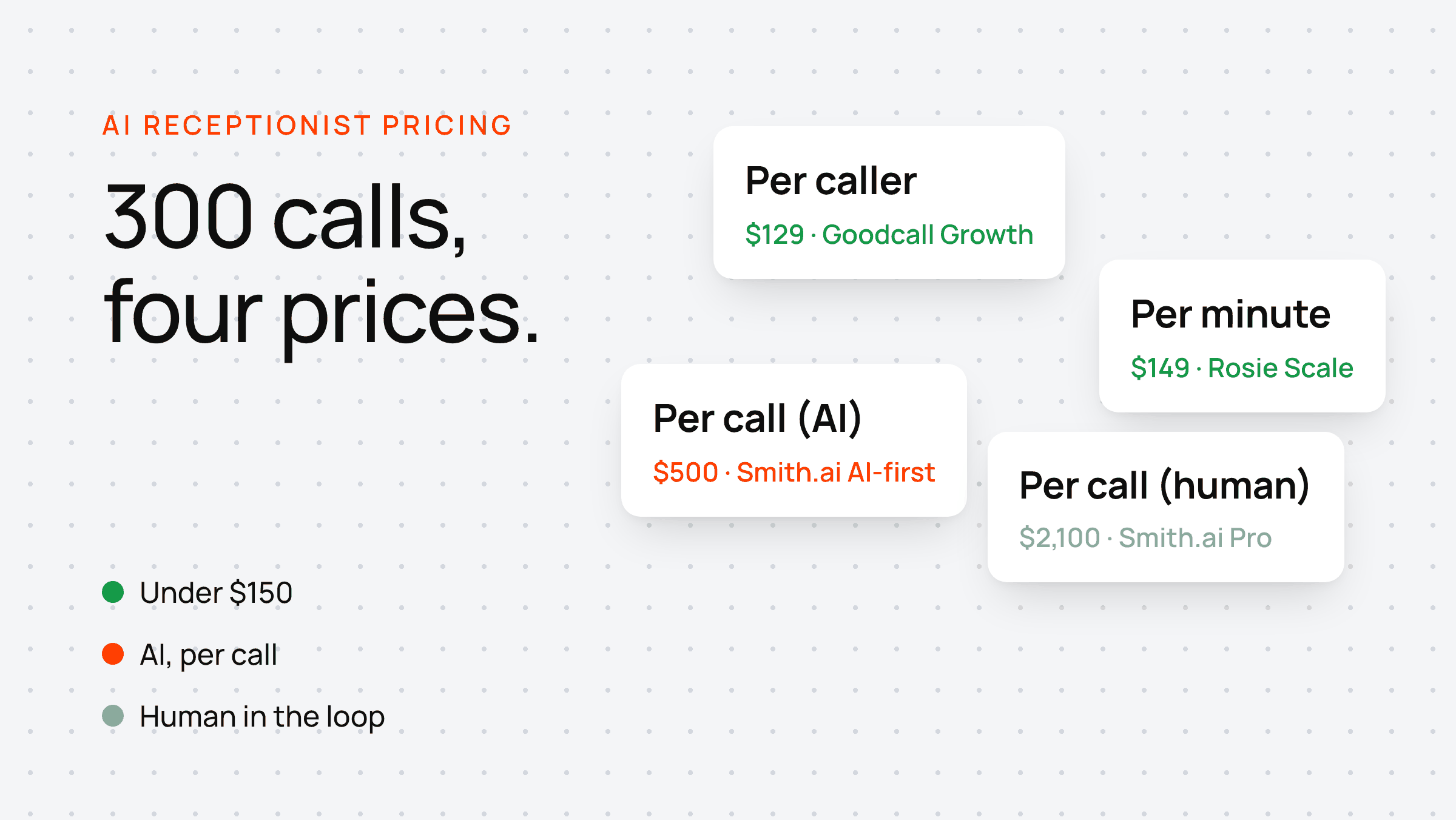
For 100 calls, between $79 and $1,725 depending on the service. The comparison depends on assumptions. Each call comes from a different caller and lasts 3 minutes, so 100, 300 and 600 calls are 300, 900 and 1,800 minutes. We picked the cheapest published plan that covers the volume, and counted Smith.ai overage where it is listed.
| Service | 100 calls (300 min) | 300 calls (900 min) | 600 calls (1,800 min) |
|---|---|---|---|
| Smith.ai | $915 (Basic plus 10 extra calls) | $2,100 (Pro) | $4,650 (Pro plus 300 extra calls) |
| Ruby | $1,725 (500-minute plan) | Above the largest plan | Above the largest plan |
| Abby Connect, live minutes | $1,380 (500-minute plan) | Above the largest plan | Above the largest plan |
| Rosie | $149 | $149 | $299 |
| Goodcall | $79 | $129 | $155 (Growth plus 100 extra customers) |
| Sono | €90 to €120 | €270 to €360 | €540 to €720 |
“Above the largest plan” means the price page lists no rate beyond 500 minutes, so you need a custom quote. Abby Connect counts an AI minute as half an Abby Minute, so an AI-handled 900 minutes uses 450 and fits its $1,380 plan. Goodcall bills unique callers, not calls, so repeat callers lower its bill. Sono bills in euros.
Two things stand out. Live services cost at least six times as much as AI plans at the same volume in this table. And the live plans scale in steps, so the bill depends on where your volume falls between two tiers.
Is it cheaper to staff after hours yourself?
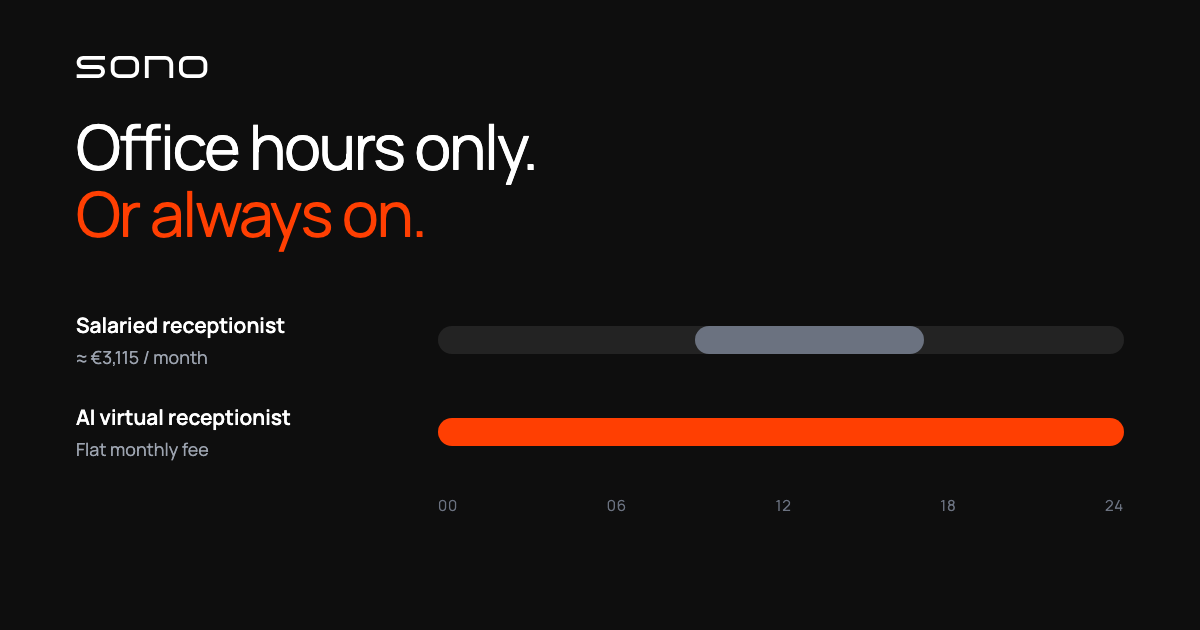
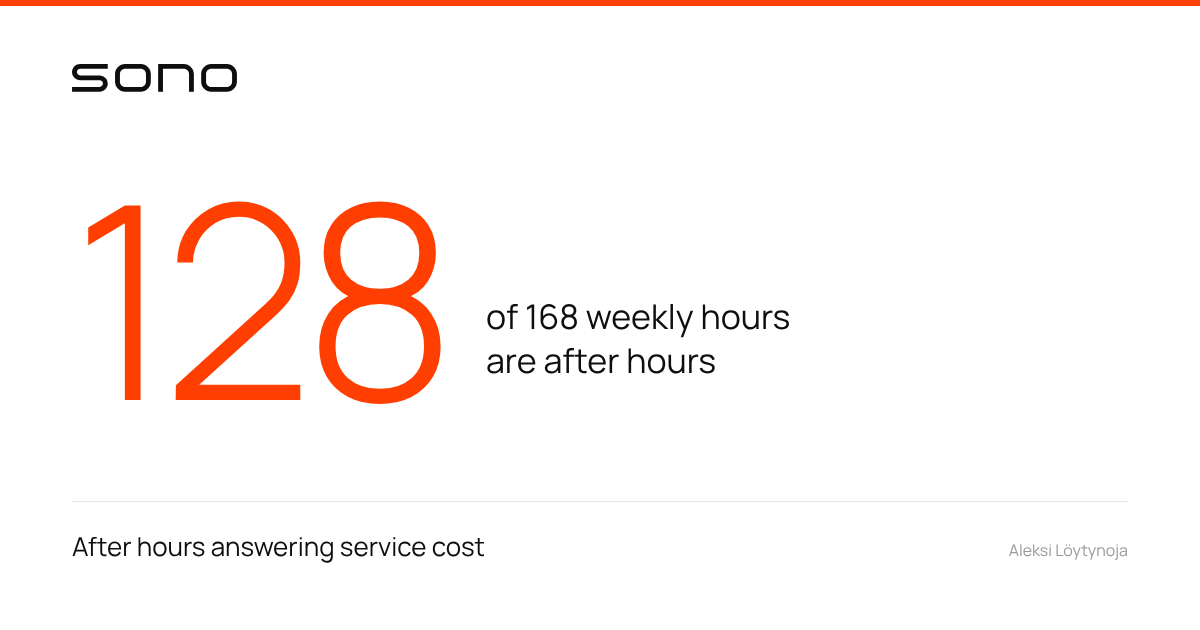
No, not for any realistic volume. The Bureau of Labor Statistics reports a median $18.27 an hour for receptionists in the US (BLS Occupational Outlook Handbook, May 2025 data). A 40-hour business week leaves 128 of the 168 hours in a week uncovered, which is about 76% of the week.
Paying the median wage for those 128 hours comes to roughly $2,339 a week, or $121,600 a year. That is arithmetic on the BLS median, before payroll taxes, shift pay, benefits and vacation cover, and it is not a staffing plan. It shows why even the $2,100 plan looks cheap next to a dedicated night and weekend desk.
What else changes the price?
Seven line items move the bill more than the headline rate.
- Allowance and tier steps. A plan sized for 90 calls costs far more in a month with 110.
- Overage rates. Smith.ai’s overage falls from $11.50 to $8.50 per call as you move up. Moving up a tier can be cheaper than paying overage.
- Who answers. Live agents cost several times more per call than AI-only plans. A mixed plan splits the difference.
- Call transfers. Some plans include a set number of transfer destinations, and Smith.ai lists 1, 2 or 10 by tier. Ask what an after-hours handoff to your on-call person counts as.
- Contract term. Smith.ai offers 10% off for a 12-month commitment, which locks you in. Test for a month first if you can.
- Integrations and languages. A calendar, CRM or second language can sit in a higher tier.
- Follow-up channel. Check whether a text or WhatsApp message after the call is included or billed.
Which channel does a missed after-hours call need?
The phone first. Callers who ring at night expect a voice, and a voicemail box gives them nothing to act on. A live service or an AI agent answers. WhatsApp second, for the follow-up: the confirmation, the job details or the photo of the fault. Compare what each option includes:
| Option | Answers the call | WhatsApp follow-up | Typical cost model |
|---|---|---|---|
| Voicemail | No | No | Free |
| Live answering service | Yes, by a person | Not stated on the price pages we checked | Per call or per minute |
| AI agent, AI-only plan | Yes, instantly at any hour | Varies by vendor | Per minute or flat plan |
| Sono | Yes, instantly at any hour | Yes, part of the deployment | Per minute of conversation |
When does an AI agent beat a live service after hours?
When most after-hours calls are routine and a few are urgent. An AI agent takes the routine calls: opening hours, booking a visit, logging a fault. It escalates a true emergency to the person on call, with a summary already attached. A live service is the better fit when most calls need judgment or empathy, such as a medical triage line.
Most small businesses sit between the two, which is why many start with AI for the night shift and keep a human for the exceptions. Our guide to AI receptionist vs answering service covers the capability side. If the problem is busy lunchtimes more than nights, an overflow answering service catches only the calls your team cannot take.
For plan-by-plan AI pricing, see AI receptionist pricing. In Ireland, salary and payroll numbers differ, so see virtual receptionist pricing in Ireland.
What does Sono cost after hours?
Sono is priced per minute of conversation, from €0.30 to €0.40 per minute for a fully managed deployment. The rate is the same at 3 a.m. and noon. A business with 300 after-hours calls averaging 3 minutes uses 900 minutes, which is €270 to €360 a month. Sono answers on the phone first and follows up on WhatsApp.
The right number depends on your call log, so ask for a quote built on your own volume, or see how Sono works on the after hours answering service page.