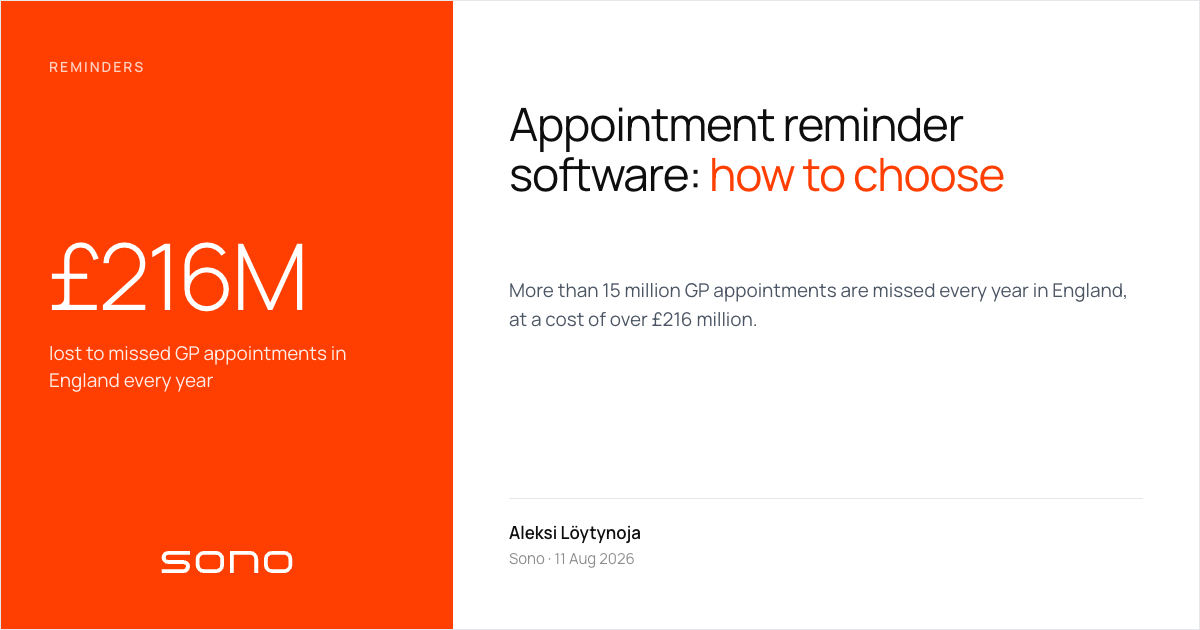
Appointment reminder software automatically sends a message or places a call before a booked appointment, pulling the date, time and location from your calendar or booking system — and, in the tools worth paying for, handling the reply as well. In England alone, more than 15 million general practice appointments are missed every year, at a cost of over £216 million (NHS England, 2019). The loss is rarely the conversation itself; it is the slot nobody can refill. This guide covers what these tools actually do, which channel suits which appointment, when reminders should go out, where the law draws the line, and what to compare before you buy.
What does appointment reminder software actually do?
At minimum, it reads your calendar and sends a message at a set interval before each appointment. That is the part every vendor has. The part that separates useful tools from expensive ones is what happens next.
A reminder that only sends is a notification. A reminder that can receive — a reply, a keypress, a click — is a scheduling tool, because it tells you about the cancellation while the slot is still sellable. The distinction matters more than any feature list. If someone cannot cancel in a single step, they will not cancel; they will simply not turn up, and you will find out at nine o’clock.
It is also worth being clear about what this software is not for. Reminding someone about an appointment they have booked is a different job from winning back a customer who has gone quiet — that is lead reactivation, a separate motion with different timing, different rules and different messages. Tools that promise both usually do one of them badly.
How much do missed appointments actually cost?
The NHS figures are the most rigorously counted in the UK, and they are worth reading closely. Of the 15 million missed appointments each year, roughly 7.2 million are GP appointments specifically, amounting to over 1.2 million wasted GP hours. The average cost of a missed appointment is put at £30.
Private-sector numbers are rarely published, but the arithmetic transfers. Take an hourly rate, multiply by the proportion of slots lost, and most garages, clinics and trades businesses arrive at a figure that dwarfs what reminder software costs. A workshop losing two bays a week at £90 an hour is losing more in a month than a year of messaging.
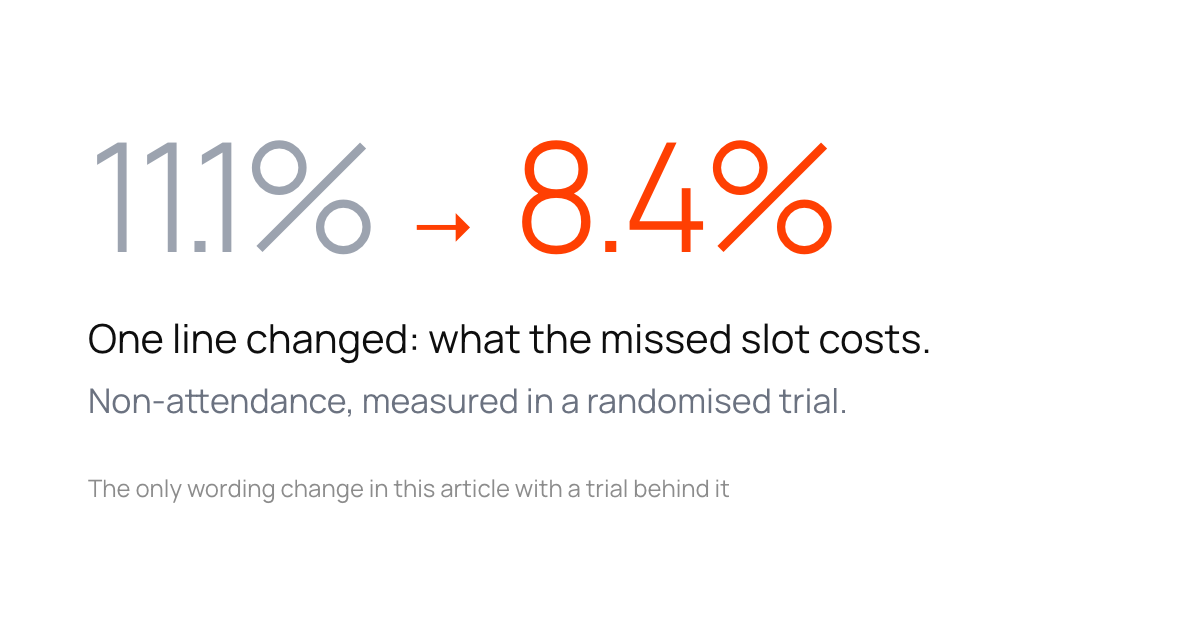
The encouraging finding is how responsive that number is. In two randomised controlled trials involving roughly 20,000 patients, changing nothing but the wording of the reminder text cut the did-not-attend rate from 11.1% to 8.4% (PLOS One, 2015). The version that worked stated what the appointment cost the health service. No new system, no new process — a better sentence.
That is the useful lesson for buyers: the gains come from message design and timing, not from the size of the platform.
Which channel should you use?
No single channel covers everything. The sensible question is what a no-show costs you and how much genuine uncertainty sits inside the appointment.
- SMS. Read almost universally, needs no app, works on any handset. The default for straightforward appointments where a missed slot is annoying rather than expensive — see our guide to running an SMS reminder service for character limits and templates.
- WhatsApp. Higher attention and a real reply path. Appointment reminders count as utility templates rather than marketing, which is materially cheaper, and once someone replies a 24-hour window opens in which further messages are free (Meta, WhatsApp Business Platform). The economics favour exactly the behaviour you want: the rebooking conversation costs nothing. Full breakdown in WhatsApp Business API in the UK.
- Email. Cheap and good for detail — directions, documents, preparation — but easily buried. Too weak to carry the reminder on its own.
- A phone call. The strongest option when a no-show is costly or a question is blocking attendance: has the part arrived, does the time still work, is someone available for handover? A call resolves that in thirty seconds. A text does not resolve it at all.
In practice the combination wins: message everyone, then call the people who did not respond. That follow-up round is the step most businesses skip because it needs a person with a free hour — which is precisely the case for automating outbound calls so the call happens on a busy Tuesday too.
When should reminders go out?
Twice, at clearly separated points.
- At booking. An immediate confirmation with date, time and location. This eliminates the misunderstandings that later show up in your figures as no-shows.
- 24 to 48 hours before. This is the window in which a cancellation is still worth something, because the slot can be refilled. Send two hours ahead and you learn about the loss earlier without preventing it.
Where more than a month separates booking from appointment — routine for MOTs, servicing, inspections and specialist consultations — add a third message about a week ahead. That gives people a chance to move the appointment before it collides with something.
One detail decides whether any of this works: cancelling must take one action. Reply with a word, tap a link, press a key during the call. Anything that requires calling back, logging in or composing an email converts a would-be cancellation into a no-show.
Is an appointment reminder marketing under PECR?
Normally not, and the distinction is worth getting right because it determines what you can send without consent.
The Privacy and Electronic Communications Regulations govern electronic direct marketing — communications promoting goods, services or aims. A message that does nothing but remind someone of an appointment they booked is a service message: it administers an existing arrangement rather than promoting anything. The Information Commissioner’s Office draws this line clearly, and it is why reminders, delivery updates and booking confirmations are treated differently from campaigns.
Two practical consequences follow.
Keep the reminder clean. The moment you add “and ask about our summer service offer” to the same message, its purpose changes and it becomes direct marketing, with the consent requirements that implies. Promotions belong in a separate message sent on a documented lawful basis.
Do not confuse the channel rules. Automated recorded calls are treated more strictly than live ones and require specific consent. If you are deploying a voice agent, check where your use case sits before you dial.
In Ireland the equivalent framework is the ePrivacy Regulations 2011 (S.I. 336/2011), supervised by the Data Protection Commission, with the same underlying split between service and marketing communications. UK GDPR and Irish GDPR apply to the personal data itself in both cases: you need a lawful basis, a retention period, and a notice at the start of any recorded call. This is general information rather than legal advice — have your specific flow reviewed.
What to compare before you buy
Most tools look identical on a feature grid. These six questions separate them:
- Can someone cancel in one action? If rebooking requires a portal login, the tool will not reduce no-shows much regardless of what else it does.
- Does it read your existing calendar? If your team retypes appointments into a second system, the tool creates work rather than removing it.
- Can it escalate to a call? Messaging alone leaves the expensive appointments unprotected and the non-responders untouched.
- Does it handle replies, or just send? One-way tools shift the work back to whoever monitors the inbox.
- Where is the data held, and for how long? Get retention periods and processing locations in writing before signing.
- What does it actually cost per reminder? WhatsApp is billed per message with country-specific rates; SMS varies by volume. Model your real appointment count, not the headline price.
What should not drive the decision: the number of supported channels, a dashboard you will look at twice, or any promise about reducing no-shows by a fixed percentage. The trials above are the honest benchmark — a few percentage points, reliably, from good timing and clear wording.
What this means for your business
If appointments regularly vanish without notice, the cause is rarely indifference and almost always a reminder that arrived at the wrong time or offered no easy way out. The fix is small and well evidenced: two messages at the right moments, cancellation in a single step, and a call rather than a text for the appointments whose loss genuinely hurts. Sono builds voice agents that make those calls, including the follow-up round to people who ignored the message. The sensible next step is to pick one appointment type, measure what you lose there now, and start with that. Book a free consultation if you would like help doing the maths.
For workshops and trades, where an empty ramp or a wasted van visit costs immediately, the practical detail is set out on our pages for automotive and home services; heating engineers in particular should see boiler service reminder software for the landlord-versus-homeowner split. And if what you are chasing is a service that falls due rather than a booking that already exists, that is a different message with different consent rules — covered in service reminder software.