Boiler service reminder software tracks when each customer’s boiler is next due attention and contacts them before that date. Straightforward enough — except that heating engineers are actually chasing two different obligations with the same tool, and they are not equally persuasive. A landlord has a legal deadline. A homeowner has advice and a warranty clause. Both land on a 12-month rhythm, and that similarity hides the fact that the message, the urgency and the consent position are all different. This article separates them.
The landlord duty is the one with teeth
If your customer lets property, the obligation is statutory and dated.
HSE states it directly: “You must ensure that any gas appliances (permanent or portable), and gas flues that you own and provide for use by your tenants have regular gas safety checks,” with “a gas safety check … done every year on each gas appliance/flue,” under regulation 36(1) of the Gas Safety (Installation and Use) Regulations 1998 (HSE). The duty catches landlords, housing associations, local authorities, hotels and B&Bs, colleges, boarding schools and hostels. And before a new lease starts, the checks must have been done within one year before the lease date.
The record matters as much as the check. HSE requires the gas safety record — “previously referred to as a gas safety record, certificate or CP12 form” — to state each appliance or flue checked and its location, the engineer’s name, registration number and signature, the date, the property address, and any safety-related defect with the remedial action taken. Existing tenants get a copy within 28 days; prospective tenants get one before they move in; records are kept at least two years (HSE).
HSE’s 2018 guide for landlords puts the consequence bluntly: “you risk being prosecuted, and this could result in you facing imprisonment or a fine of up to £20 000” (HSE, INDG285(rev3)). That figure comes from a 2018 leaflet and is worth quoting as HSE’s own wording rather than as today’s sentencing ceiling.
And here is the detail that makes a reminder system commercially useful. A check can be done up to two months before the date it is needed while retaining the original deadline date, under the 2018 amendment regulations. That two-month window is the whole opportunity. A landlord contacted inside it can be scheduled around your existing route; a landlord contacted the week the certificate lapses has to be fitted in as an emergency.
One distinction to get right in your own messaging, because HSE is emphatic about it: “You should not assume that an annual service inspection includes the points required by a safety check; neither should you assume that carrying out an annual gas safety check will be sufficient to provide effective maintenance” (HSE). Two jobs, not one. Reminder software that treats them as a single recurring event will quietly under-sell you.
The homeowner case rests on advice and a warranty
For an owner-occupier the position is softer, and pretending otherwise is a mistake — customers check.
HSE “strongly advises that all gas appliances, flues and pipework should be installed, regularly maintained and serviced at least annually by a Gas Safe registered engineer,” and notes that “every year around 7 people die from gas-related carbon monoxide (CO) poisoning” (HSE). Strong advice, backed by a real consequence. Not a statutory duty on the householder.
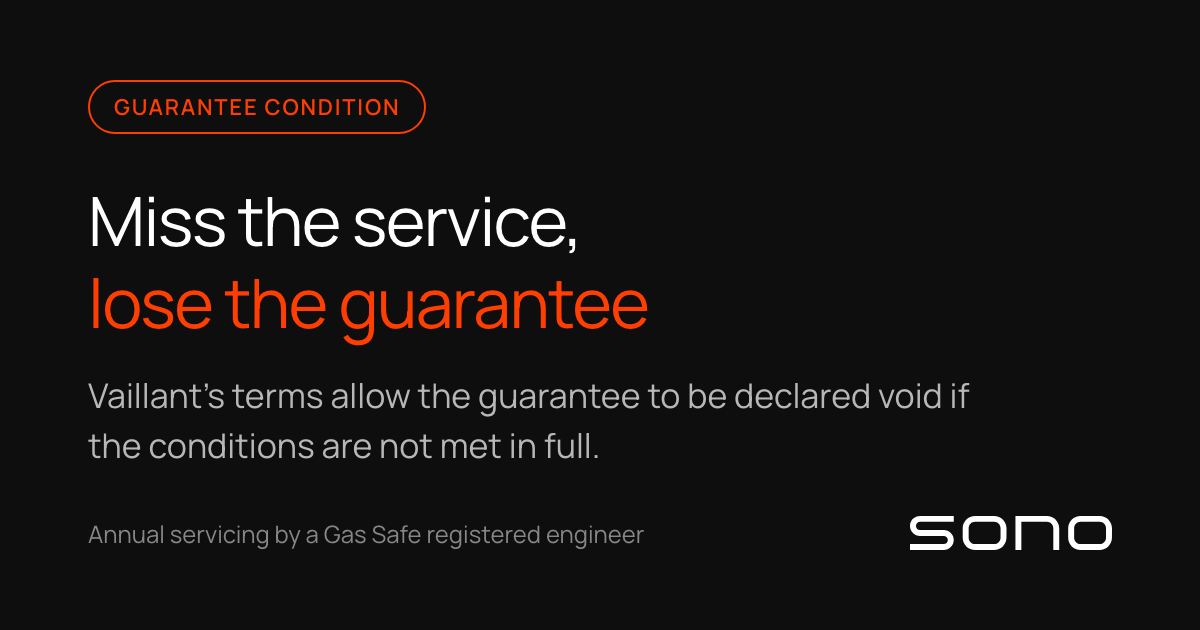
The harder commercial lever is the manufacturer’s guarantee. Vaillant’s domestic boiler guarantee terms require that “the boiler must be serviced annually by a Vaillant or other Gas Safe Registered engineer in accordance with the manufacturer’s instructions,” that “service details must be recorded in the Benchmark logbook which must be available for inspection,” and that the cost of annual servicing is not included. Failure to comply with the terms in full allows Vaillant to declare the guarantee “null and void” (Vaillant).
That is the message a homeowner responds to, and it is factual rather than pushy. Not “you should service your boiler.” Rather: your guarantee requires an annual service by a Gas Safe engineer, recorded in the logbook, and the manufacturer can void it if that lapses.
Check the specific manufacturer before you write it into a template — terms differ, and Vaillant’s are the ones verified here.
How big is the safety gap, really?
Be careful with numbers in this area, because the ones circulating are mostly PR surveys.
What is solid comes from the Gas Safe Register’s own reporting for April 2023 to March 2024: 76,630 registered businesses, 150,729 registered engineers, 60,174 inspections carried out, and 7,116 defects found on gas work classed as At Risk or Immediately Dangerous, of which 2,438 were attributable to registered businesses. There were also 1,048 reports about unregistered fitters and 457 site investigations of unregistered gas work (Gas Safe Register, At a Glance 2023/24).
Read that carefully: 7,116 is a count of defects found inside a programme of 60,174 inspections. It is not a rate for UK housing stock, and it should not be turned into a percentage of homes. Claims that a fifth of UK homes would fail a gas safety check are not traceable to Gas Safe Register and we could not verify them anywhere.
Gas Safe Register is “the only official gas registration body of gas businesses and engineers in the United Kingdom, Isle of Man, Jersey and Guernsey,” operating on behalf of the relevant health and safety authority, and “by law all gas businesses must be on the Gas Safe Register” (Gas Safe Register).
What does the software need to handle?
The two obligations mean the system has to hold two different kinds of due date.
A compliance deadline, for landlords. Hard date, legal consequence, a two-month early window, and a record to issue within 28 days. The reminder needs to fire at the start of the window, not the end. And it needs to know which property — a landlord with nine flats has nine deadlines, not one.
A warranty and condition service, for homeowners. Soft date, guarantee consequence, more price-sensitive, and much more likely to need a second nudge.
Beyond that, four things worth checking before you buy:
- Does the outcome write back? A booking or a decline should update the diary without anyone retyping it.
- Can it escalate? Message first, then a call to the non-responders. For a landlord facing a lapsing certificate, the call is worth it.
- Does it hold consent per channel? Needed for homeowners; see below.
- Does it separate check from service? So you can sell both where both apply.
Do you need consent to send the reminder?
For landlord customers who are companies or letting agents, you are dealing with corporate subscribers, and the ICO is explicit: “You can send unsolicited electronic mail marketing to corporate subscribers without consent or a soft opt-in” (ICO). A compliance reminder to a letting agent is straightforward.
For homeowners and individual landlords, you need consent or the soft opt-in in PECR regulation 22(3): you obtained the details while selling or negotiating to sell, you are marketing similar services only, and you offered an easy opt-out both at collection and in every message. An installer who fitted or serviced the boiler meets that comfortably. A bought list does not.
A note on which kind of message you are sending. A reminder about a booked appointment is a service message — the ICO’s own list of service messages includes confirming or reminding people about appointments. A message saying the annual service is now due promotes a purchase, so treat it as marketing and send it under the soft opt-in. Both are available to you; they just have different requirements.
And the contamination rule, which is where people slip: the ICO says that if a service message “has elements that are direct marketing, even if that is not the main purpose of your message, then it will count as direct marketing” (ICO). Adding “and ask about our new smart thermostat offer” to a safety-check reminder converts the whole message. Keep them separate.
What this means for your business
Split your customer list in two before you configure anything. Landlords get a compliance reminder at the start of the two-month window, naming the property and the deadline. Homeowners get a guarantee-and-safety message, and they need a second contact more often than landlords do.
Then measure one number per group: how many bookings came from the reminder. For landlords that also tells you how much emergency work you stopped having to squeeze in.
Sono builds voice AI agents and WhatsApp agents for the follow-up that gets skipped — calling or messaging the landlords and homeowners who ignored the first reminder, on whichever channel they answer. If you want to work out what a full diary in the two-month window is worth, book a free call. The wider criteria for choosing a system are in our guide to service reminder software, and our home services page covers how this runs for trades.