Lead qualification is the process of deciding whether a new enquiry is worth a salesperson’s time, and doing it before that time gets spent. You establish what the person actually needs, whether they can authorise a purchase, roughly what they can spend, and when they intend to decide. For most service businesses this happens on the phone, because enquiries arrive as a call or a callback request rather than a completed form. The problem is almost never the questions. It is that nobody is free to ask them fast enough.
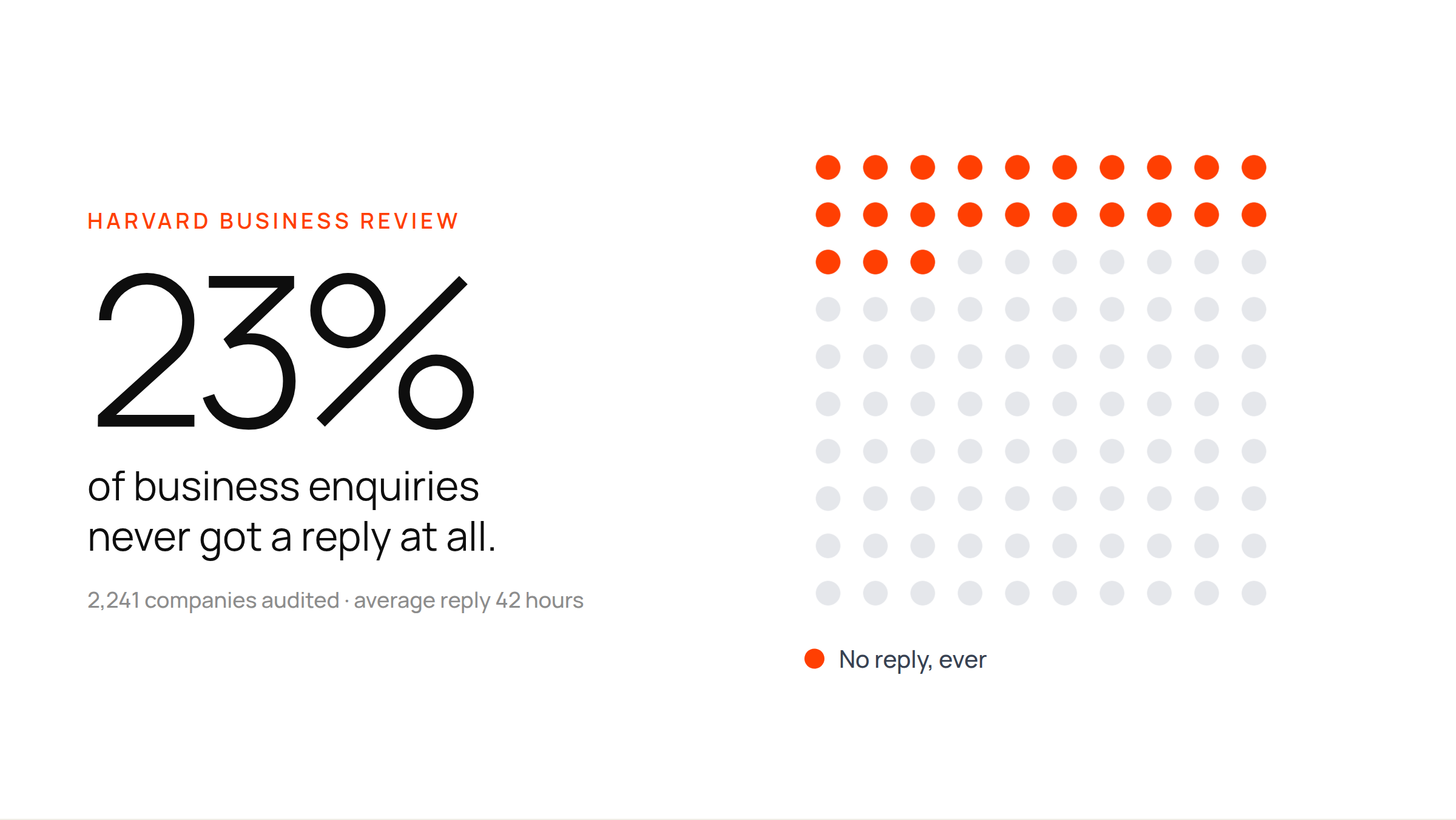
Harvard Business Review put a number on that gap in 2011. Researchers audited 2,241 companies by submitting a test enquiry to each and timing the reply. 23% never responded at all, and among those that did respond within thirty days the average time to reply was 42 hours (Oldroyd, McElheran and Elkington, HBR). This guide covers what qualification actually consists of, which questions do the work, how to score what you hear, and when to hand the lead on.
What is lead qualification?
Qualification is a filter, not a sales pitch. Its only job is to sort enquiries into three piles: worth a meeting now, worth following up later, and not a fit. Everything else — the demo, the quote, the negotiation — belongs to whoever picks the lead up afterwards.
The framework most sales teams use is BANT: Budget, Authority, Need, Timeframe. It is generally credited to IBM, and IBM does still publish it as its own opportunity-qualification standard, defining Need as the customer’s business issue and the key benefits, and Timeframe as the forecast decision date (IBM PartnerWorld BANT criteria template). Worth noting: the widely repeated story that IBM invented BANT in the 1950s has no traceable source. The framework is documented; its origin myth is not.
BANT gets criticised for being seller-centric, and fairly. But as a checklist for a five-minute phone call it is hard to beat, because each letter maps to a question you can actually ask a stranger without sounding like an interrogation.
Lead generation vs lead qualification
These get used interchangeably and they are not the same job.
- Lead generation creates the enquiry. Ads, SEO, referrals, a van with a phone number on it. Success is measured in volume and cost per lead.
- Lead qualification decides what the enquiry is worth. Success is measured in how little of your sales team’s time gets spent on leads that were never going to buy.
A business can be excellent at one and hopeless at the other. In fact that is the common failure: marketing hits its lead target, sales complains the leads are rubbish, and nobody can tell whether the leads were bad or simply never properly assessed. Qualification is what settles that argument, because it produces a record of why each lead was ranked the way it was.
Why the first five minutes decide the outcome
Response speed changes qualification outcomes more than any script does. In the HBR audit above, firms that attempted contact within an hour of an enquiry were nearly seven times more likely to qualify the lead than firms that tried an hour later, and more than sixty times more likely than firms that waited a day. Their definition of “qualify” is worth keeping in mind: having a meaningful conversation with a key decision maker.
An earlier and much-quoted study by the same group found the odds of even making contact dropped roughly a hundredfold between calling at five minutes and calling at thirty. Treat that one carefully — it was a vendor-funded 2007 white paper covering six companies, not peer-reviewed research (Lead Response Management report, 2007). The direction of the finding has held up. The precise multiple has not been independently replicated.
So why does almost nobody call back in five minutes? Because the people who would make the call are doing something else. Salesforce’s 2025 survey of 4,050 sales professionals across 22 countries found reps spend 60% of the working week on activities other than selling, with manual data entry the single biggest drain at 22% (Salesforce State of Sales, 7th edition).
And in a great many businesses there is no rep at all. Of roughly 33.5 million enterprises in the EU business economy, 31.6 million — 94% — employ fewer than ten people (Eurostat, structural business statistics, 2024). Beneath even that, 19.2 million people across the EU are self-employed with no employees at all (Eurostat labour force survey, 2025). For those firms the phone rings while the owner is under a car, on a roof, or with a customer.
Hiring someone to answer it is not a cheap fix. An hour of employed time in EU services costs an employer €34.90 on average, and €40 to €53 an hour in the Nordics and the Netherlands (Eurostat labour cost levels, 2025). Nor is it an easy one: the EU job vacancy rate in services ran at 2.3% in early 2026, rising to 3.3% in administrative and support services — the sector where phone answering usually sits (Eurostat).
That is the actual constraint. Not the script — the staffing.
Which questions actually qualify a lead?
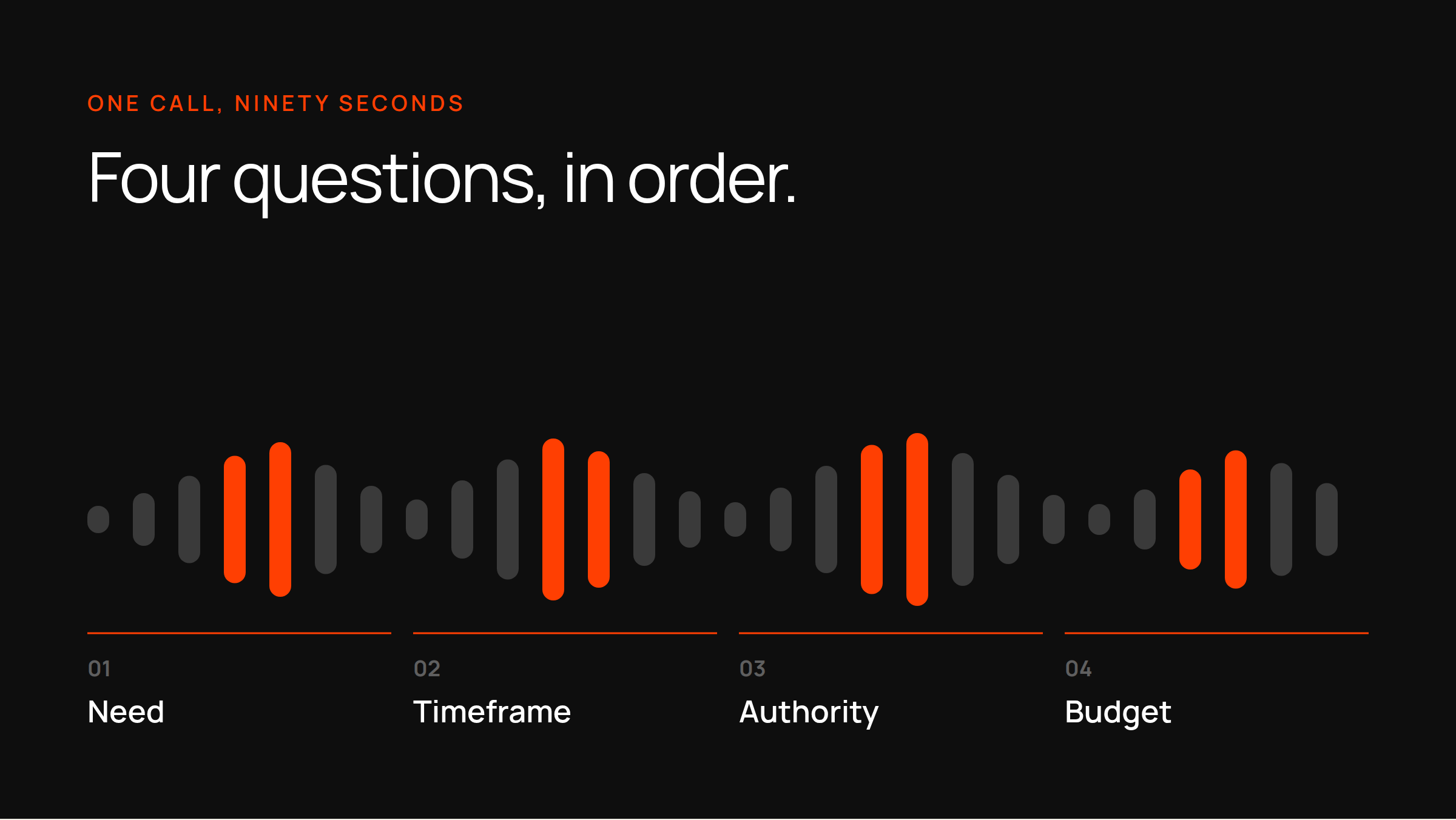
Four questions, asked in this order, will sort most enquiries. The order matters: need first, because it is the question the caller wants to answer, and budget last, because by then you have earned it.
- Need — “What’s prompted you to get in touch today?” Open, and it does most of the work. You are listening for a specific, dated problem rather than general interest.
- Timeframe — “When were you hoping to get this sorted?” The single most predictive answer in the set. Someone who says “this week” is a different lead from someone who says “sometime in the new year”, regardless of what they want to spend.
- Authority — “Is it just yourself deciding, or is there anyone else involved?” Phrased this way it is a courtesy, not a challenge. In B2B the answer is frequently “I’ll need to check with…”, which is useful to know before a salesperson prepares a proposal.
- Budget — “Do you have a figure in mind, or would a ballpark help?” Offering the ballpark is what makes this answerable. Most people will not state a number cold but will react honestly to one.
Add one vertical-specific detail question and you have everything a salesperson needs. For a garage that is the registration and the symptom. For a letting agent it is the address and the move-in date. For a trade it is the job type and the postcode. We break these down question by question in our guide to lead qualification questions.
How do you score a lead from a phone call?
Scoring turns four answers into one decision. Keep it crude — anything more elaborate than this will not survive contact with a busy week.
Give each of the four a 0, 1 or 2:
| 0 | 1 | 2 | |
|---|---|---|---|
| Need | vague or browsing | real but not urgent | specific, dated problem |
| Timeframe | no date | this quarter | this week or next |
| Authority | not involved in the decision | one of several deciders | sole decision maker |
| Budget | no idea, or far below range | plausible | stated and in range |
6 and above goes straight to a salesperson. 3 to 5 goes into a follow-up sequence — that is lead nurturing territory, not sales. Below 3 gets a polite, honest answer and no follow-up, which is a kindness to everyone involved.
The value of writing the score down is not the number. It is that three months later you can look at which scores actually converted and adjust the thresholds instead of guessing.
What a qualifying call sounds like
Below is an illustrative example, not a recording of a real customer — a first inbound call to an independent workshop, handled by a voice AI agent, at 19:40 on a Tuesday after the bays have closed.
Agent: Good evening, you’ve reached the service desk — this is an AI assistant, and I can take your details or book you in. What can I help with?
Caller: Yeah, my brake warning light’s come on. Is anyone there?
Agent: The workshop’s closed now, but I can get you booked. Is the car still drivable, or is it off the road?
Caller: It’s drivable, feels a bit spongy though.
Agent: Understood — I’ll flag that as a priority. Can I take the registration?
Caller: ABC-123.
Agent: Thanks. And how soon would you want it looked at?
Caller: Honestly, tomorrow if you can.
Agent: We’ve got a slot at 08:15 or 14:30 tomorrow. Which suits?
Caller: Morning one.
Agent: Booked for 08:15. Brakes, spongy pedal, warning light on, ABC-123. Is this the best number to reach you?
That call scores 2 on Need, 2 on Timeframe, 2 on Authority and 0 on Budget — a 6, straight through to the diary. It took under ninety seconds and happened at a time when the alternative was a voicemail nobody would have heard until Wednesday.
Three things make it work, and none of them are clever. The agent says it is an AI in the first sentence. It asks the safety question before the commercial one. And it reads the details back, which is where most phone bookings actually go wrong.
When should a lead go to a salesperson?
Immediately, if the score says so — and with the answers attached, not just a name and number. A salesperson who opens a lead and can see “brakes, spongy, wants it tomorrow, ABC-123” starts the conversation in a completely different place from one holding a callback slip.
Set two rules and hold them. A high-scoring lead gets human contact within the working day. A low-scoring lead never reaches a salesperson at all. The second rule is the one people break, and it is the reason sales teams stop trusting the qualification process in the first place.
Almost nobody is doing this with software yet. Across the EU, just 7.2% of enterprises with ten or more employees use speech recognition and 8.8% use speech or language generation — the two technologies a phone agent is built from (Eurostat ICT usage survey, 2025). And that survey does not even cover firms with fewer than ten staff, which is 94% of them. The businesses most likely to be missing calls are the ones the adoption statistics cannot see.
If your phones go unanswered outside hours, or during them, qualification is not really the thing that is broken — coverage is. Sono answers every call, asks these four questions, scores the answers and puts the qualified ones in front of your team, in eleven European languages. You can see how we set that up for workshops and dealerships on our outbound calls page, or talk to us about your own enquiry line.
Most of this is unglamorous. Ask four questions, write down what you hear, be honest about what it means. The businesses that do it consistently are not the ones with the best script — they are the ones who answer.
Useful links and sources
- The Short Life of Online Sales Leads — Harvard Business Review, March 2011
- Enterprise statistics by size class — Eurostat, dataset
sbs_sc_ovw, 2024 - Employment by professional status — Eurostat labour force survey, 2025
- Labour cost levels — Eurostat, 2025
- Artificial intelligence use by enterprises — Eurostat ICT usage survey, 2025
- BANT criteria template — IBM PartnerWorld