Lead qualification questions are the small set of questions you ask a new enquiry to work out whether it deserves a salesperson’s time. Four cover most of it — need, timeframe, authority and budget — plus one detail question specific to your trade. The skill is not in knowing them. It is in asking them in an order that does not make a stranger feel processed, and in writing down what you hear so the next person does not have to ask again.
This page is a question bank. Every question below is one you can read aloud on a first call, with the reason it earns its place and the thing you are listening for. For where qualification sits in the wider process, start with our guide to lead qualification.
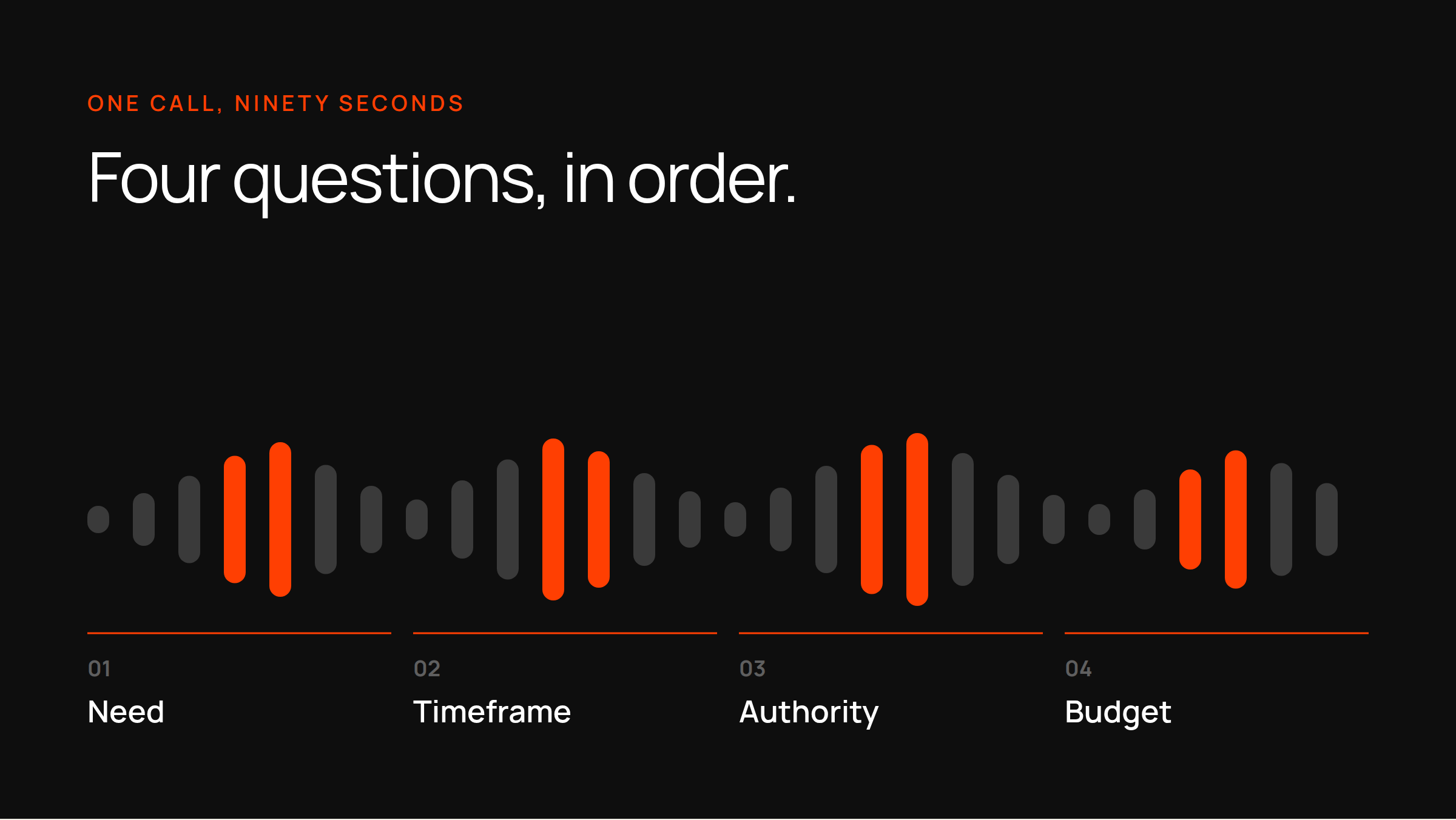
What order should you ask them in?
Need first, budget last. Always.
Need first because it is the question the caller rang up wanting to answer. Opening with anything else — especially budget — signals that you are sorting them rather than helping them, and people go quiet. Budget last because by the time you ask it you have listened for two minutes and earned the right.
Between those two, timeframe before authority. Timeframe is the most predictive answer in the whole set and the least intrusive, so it keeps the conversation moving. Authority is slightly awkward and lands better once there is some rapport.
The four questions
1. Need — “What’s prompted you to get in touch today?”
Open, short, and it does more work than any other question here. The word “today” is doing something specific: it asks for the trigger rather than the topic, which is what separates a real problem from general interest.
Listen for: a specific event with a date attached. “The light came on this morning” is a lead. “I’m just looking into options” is not, yet.
Better than: “How can I help?” — which invites a one-word answer.
2. Timeframe — “When were you hoping to get this sorted?”
The single most useful question in the set. Someone who says “this week” and someone who says “maybe in the new year” are different leads even if they want identical things and have identical budgets.
Listen for: a date, a week, or an event they are working back from (“before the inspection is due”, “before the tenants move in”).
Follow-up if they’re vague: “Is there anything driving that timing — an inspection, a deadline, an event?” A vague timeframe with a hard constraint behind it is often more urgent than the caller lets on.
3. Authority — “Is it just yourself deciding, or is there anyone else involved?”
Phrased this way it reads as a courtesy rather than a challenge, which matters, because the honest answer is frequently “I’ll need to run it past someone.” That is exactly what you want to know before a salesperson spends an afternoon on a proposal.
Listen for: who else needs to see it, and whether the caller is the user, the buyer, or both.
Avoid: “Are you the decision maker?” It puts people on the defensive and produces a yes from people who are not.
4. Budget — “Do you have a figure in mind, or would a ballpark help?”
The ballpark offer is what makes this answerable. Most people will not volunteer a number cold, but almost everyone will react honestly to one — and the reaction tells you as much as a figure would.
Listen for: the reaction, not just the number. “That’s about what I thought” and “Oh — right” are very different answers.
If they won’t say: give the range anyway. “Most jobs like this come in between €X and €Y” and then stop talking.
What should you ask that’s specific to your industry?
One detail question per vertical, asked early, because it is the thing whoever picks up the lead will need first. It also makes the call feel competent rather than generic.
| Sector | The one question | What it unlocks |
|---|---|---|
| Workshop / dealership | “Can I take the registration?” | Vehicle, model year, service history, parts availability |
| Letting / estate agency | “Which property is this about, and when do you need to move?” | Availability, chain position, viewing slot |
| Trades and home services | “What’s the address, and is it a repair or an install?” | Travel time, job type, whether it’s an emergency |
| Logistics | “What’s the consignment reference?” | Order status, delivery window, whether this is a complaint |
| Property management | “Which building, and is anyone without heat or water right now?” | Priority, contractor routing, out-of-hours escalation |
Ask the safety or urgency version of this question before the commercial one. “Is the car still drivable?” comes before “when would you like to book in.” Nobody has ever complained about that order.
Which questions should you not ask?
A few standards actively cost you information.
- “Are you the decision maker?” — produces false positives. Use the “anyone else involved” phrasing instead.
- “What’s your budget?” cold, with no anchor. Most people either refuse or lowball defensively.
- “How did you hear about us?” on a first qualifying call. It is useful marketing data and a terrible use of the caller’s patience while they have a problem. Ask it at the end, or in the confirmation email.
- Anything you already know. If the enquiry form said “brake noise”, do not open by asking what the issue is. Confirm it: “This is about the brake noise — is that right?”
- More than five questions total. Past that, callers start giving shorter answers to get off the phone, and the quality of everything you have already collected degrades.
How do you make sure the questions actually get asked?
This is where most question banks die. Not because the questions are wrong, but because the person who should ask them is under a car, on a roof, or already on another line.
The scale of that problem is easy to underestimate. 94% of the EU’s 33.5 million enterprises employ fewer than ten people, and 19.2 million Europeans are self-employed with no employees at all (Eurostat, 2024 and 2025). In those businesses the person who should be asking these questions is the person doing the work. Even where there is a sales team, Salesforce’s 2025 survey of 4,050 sales professionals in 22 countries found 60% of the working week goes to things other than selling (State of Sales, 7th edition).
Paying someone to sit by the phone is not a cheap alternative either — an hour of employed time in EU services averages €34.90 (Eurostat labour cost levels, 2025).
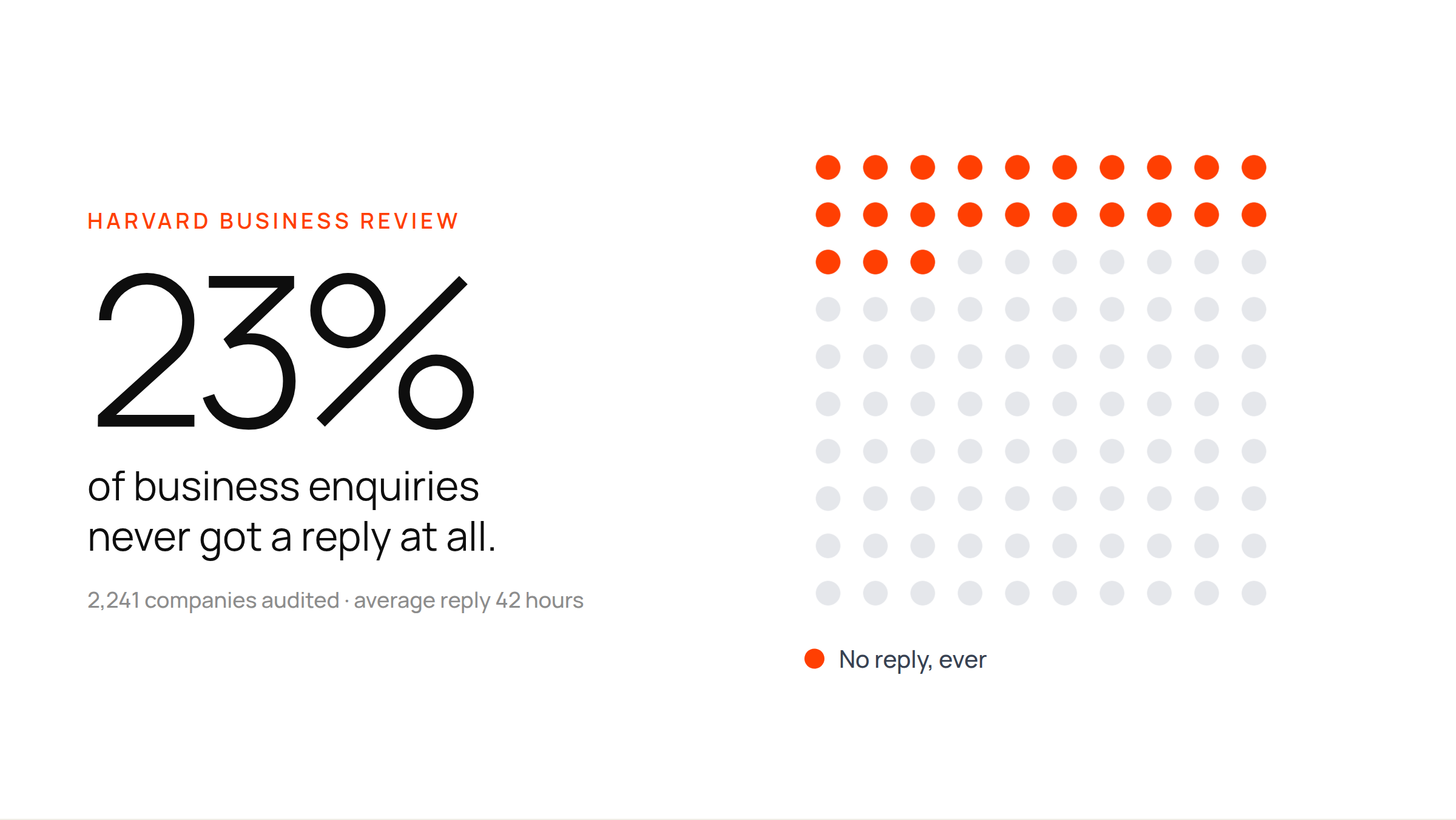
And the cost of not asking in time is measurable. Harvard Business Review’s audit of 2,241 companies found firms that made contact within an hour of an enquiry were nearly seven times more likely to qualify the lead than those that tried an hour later — where qualifying meant having a meaningful conversation with a decision maker (HBR, 2011).
Three things that help, in order of how much they help:
- Put the five questions on one card by the phone. Unfashionable, works, costs nothing.
- Write the answers into the same field every time. A shared inbox with a fixed format beats a CRM nobody updates.
- Have something answer the calls you cannot. A voice AI agent asks the same five questions at 19:40 on a Tuesday that you would ask at 10am on a Wednesday, and it writes the answers down every time.
That third one is what Sono does — it answers, asks these questions in this order, scores what it hears, and hands over the qualified ones with the answers attached. It works in eleven European languages, which matters if your enquiries are not all in English. If you want to see it against your own enquiry line, talk to us.
Whatever asks them, the questions are the same. Need, timeframe, authority, budget, and the one detail that proves you know the job.
Useful links and sources
- The Short Life of Online Sales Leads — Harvard Business Review, March 2011
- Enterprise statistics by size class — Eurostat, dataset
sbs_sc_ovw, 2024 - Labour cost levels — Eurostat, 2025
- BANT criteria template — IBM PartnerWorld