
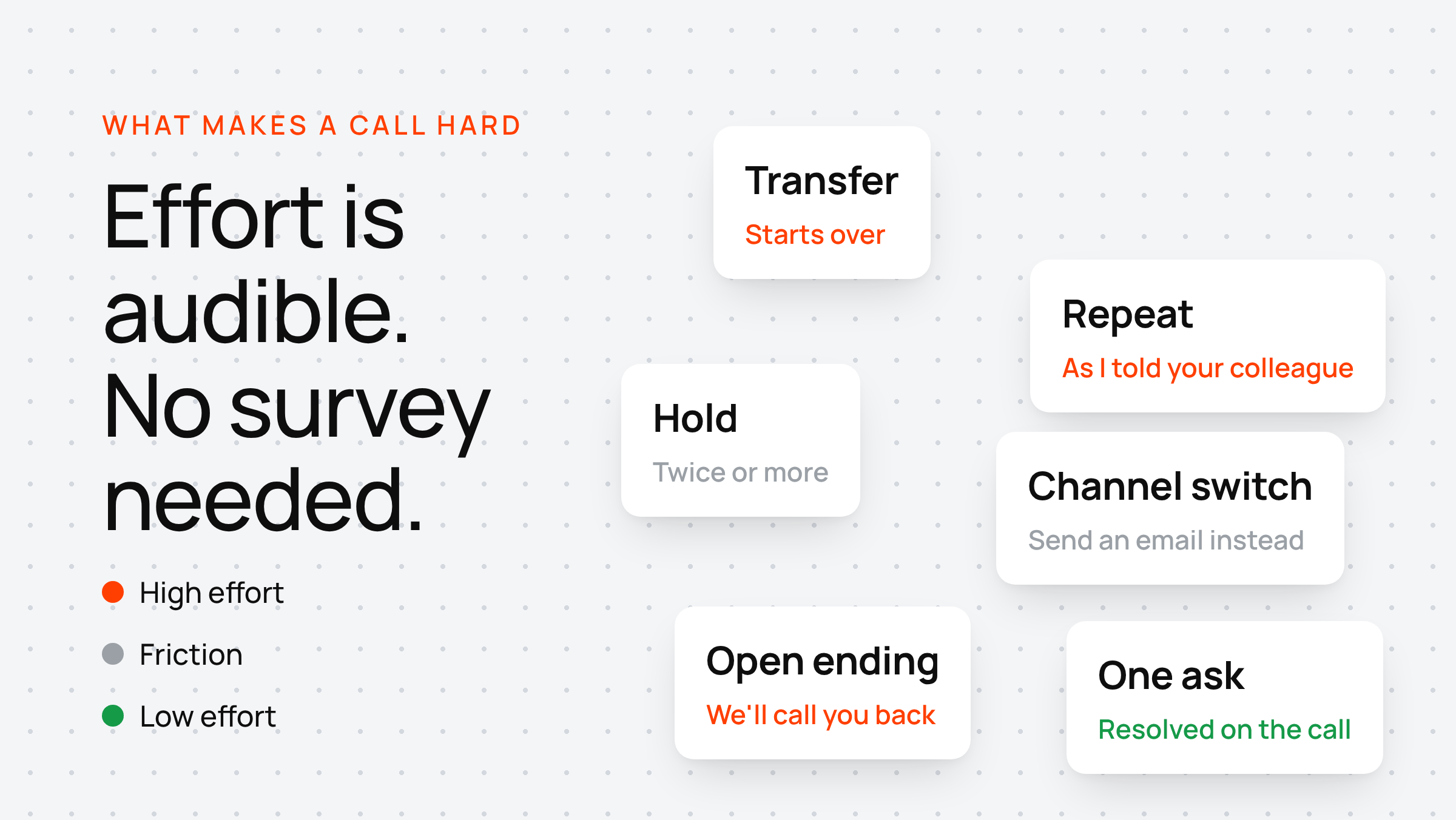
Customer effort score (CES) is a metric for how easy it was for a customer to get their issue resolved, usually asked as a single survey question after the interaction. Effort matters because it predicts loyalty. Gartner research shows that after a low-effort service experience, customers are 61% likely to stay; a high-effort one drops that to 37% (Gartner, 2020). This guide covers how CES works, why surveys undercount it on the phone, and how to measure effort on every call.
The concept comes from the Harvard Business Review article “Stop Trying to Delight Your Customers.” It was based on a study of more than 75,000 people using contact centers and self-service (HBR, 2010). The idea is simple: customers don’t reward you much for going above and beyond, but they punish you for making things hard.
How is customer effort score calculated?
The classic CES is a survey. The customer rates a statement about how easy it was to handle their issue on an agreement scale, often 1 to 7 or 1 to 5. CES is then the average score, or the share of customers who agree. The exact wording varies by vendor, so pick one version and keep it stable over time.
That works in chat and email, where the survey shows up in the same window. On the phone it’s weaker. Post-call surveys interrupt the customer, and many skip them. Across 560 CSAT surveys, the median response rate was 7.5% (Survicate, 2025 data). That data comes mostly from email and in-product surveys; we found no published benchmark for post-call surveys. A score built on a small minority of callers can move just because different people answered.
What makes a phone call high-effort?
Effort on a call is rarely mysterious. It shows up in a handful of things you can hear.
| Effort signal | What it sounds like | Why it matters |
|---|---|---|
| Transfer | “Let me put you through to…” | The customer starts over with someone new |
| Repeated explanation | “As I told your colleague…” | The context didn’t travel with the call |
| Long or repeated holds | “Can you hold while I check?” (twice) | The agent lacks the answer or the access |
| Channel switch | “Please send that by email instead” | Gartner found 62% of channel transitions are high-effort (Gartner, 2023) |
| Open ending | “Someone will call you back” | The issue isn’t solved, and a repeat call is likely |
| Repeat contact | “This is my third time calling” | The previous call failed |
Every one of these is visible in the transcript. You don’t need the customer to fill in a form to know that a call with two transfers and a promised callback was hard work.
How do you measure customer effort on every call?
Score it from the conversation. A simple, consistent 1 to 5 scale works:
- One ask, answered. Resolved on the call, no transfer, no hold.
- Resolved with a short check. One hold or one clarifying round.
- Resolved with friction. A transfer or a repeated explanation, but closed on the call.
- Not resolved, clear next step. A callback or follow-up with a date.
- Not resolved, unclear next step. Transfers, repeats and no clear outcome, or the caller says it’s a repeat contact.
Write the definitions down and apply them the same way to every call, AI and human. AI call analysis can fill in the score from the transcript; check a sample by hand at the start and monthly after. See AI call analysis for how that works.
Keep the survey if you have one. Use it as a check on the call-based score, not as the only source.
What do you do with an effort score?
Break it down by call reason. “Average effort is 2.4” tells you little. “Payment-plan calls average 3.8 because the agent has to transfer to finance” tells you exactly what to fix.
Then follow the effort to its cause:
- Transfers cluster on one reason? Give the first line the access or the authority to finish it, or route that reason straight to the right team.
- Repeated explanations after handovers? Pass the reason and summary with the transfer. This applies to AI agents too: a bot that hands over must pass on what it learned.
- Open endings with promised callbacks? Check how many callbacks actually happen. Broken callback promises are a common driver of repeat calls.
- High effort on calls your AI agent takes? Move those reasons back to people, or fix the bot’s script for them.
Effort pairs naturally with first call resolution and repeat-call causes. We cover the full set in call center metrics that lead decisions.
Customer effort and AI voice agents
AI agents can cut effort sharply on simple calls: no queue, no hold, an answer in seconds. They can also add effort if they loop, misunderstand or refuse to hand over. Customers notice: in a 2026 Gartner survey, 87% said companies using GenAI for customer service must provide access to a human agent (Gartner, 2026).
So score your bot’s calls for effort on the same scale as your team’s. If effort on bot calls rises for one call reason, that reason probably belongs with a person. See how to measure an AI voice agent.
How Sono helps
Sonolytics scores customer effort on every AI and human call, alongside call reason, resolution and anything else you define. You see effort by reason, by agent and by week, and you can open the calls behind any number. No survey needed, though you can still compare. If you run Sono’s AI phone agent, its calls sit on the same scale as your team’s.
Effort is the cheapest loyalty lever you have, and the calls already tell you where it hides.