
AI voice agent analytics is the practice of measuring what an AI phone agent actually achieves on real calls. Does it resolve the caller’s issue, how much effort does the call take, does it hand over at the right moment, and where does it go wrong? Most teams measure their bot with one tool and their people with another, so nobody can say which calls the bot should take. Gartner predicts that by 2029, agentic AI will autonomously resolve 80% of common customer service issues (Gartner, 2025). Which 80% is yours depends on measurement. This guide shows how to put an AI voice agent and a human team on one scorecard.
Sono runs AI voice agents for payment reminders, collections and inbound calls, and this is the problem we built Sonolytics to solve. The wider context is in call center analytics.
Why is containment the wrong metric for an AI agent?
Containment (sometimes called deflection) counts calls that ended without reaching a human. It’s easy to measure and easy to improve, which is the problem. A bot that hangs up, loops or gives a wrong answer also “contains” the call. The customer then calls back, writes an angry email or leaves.
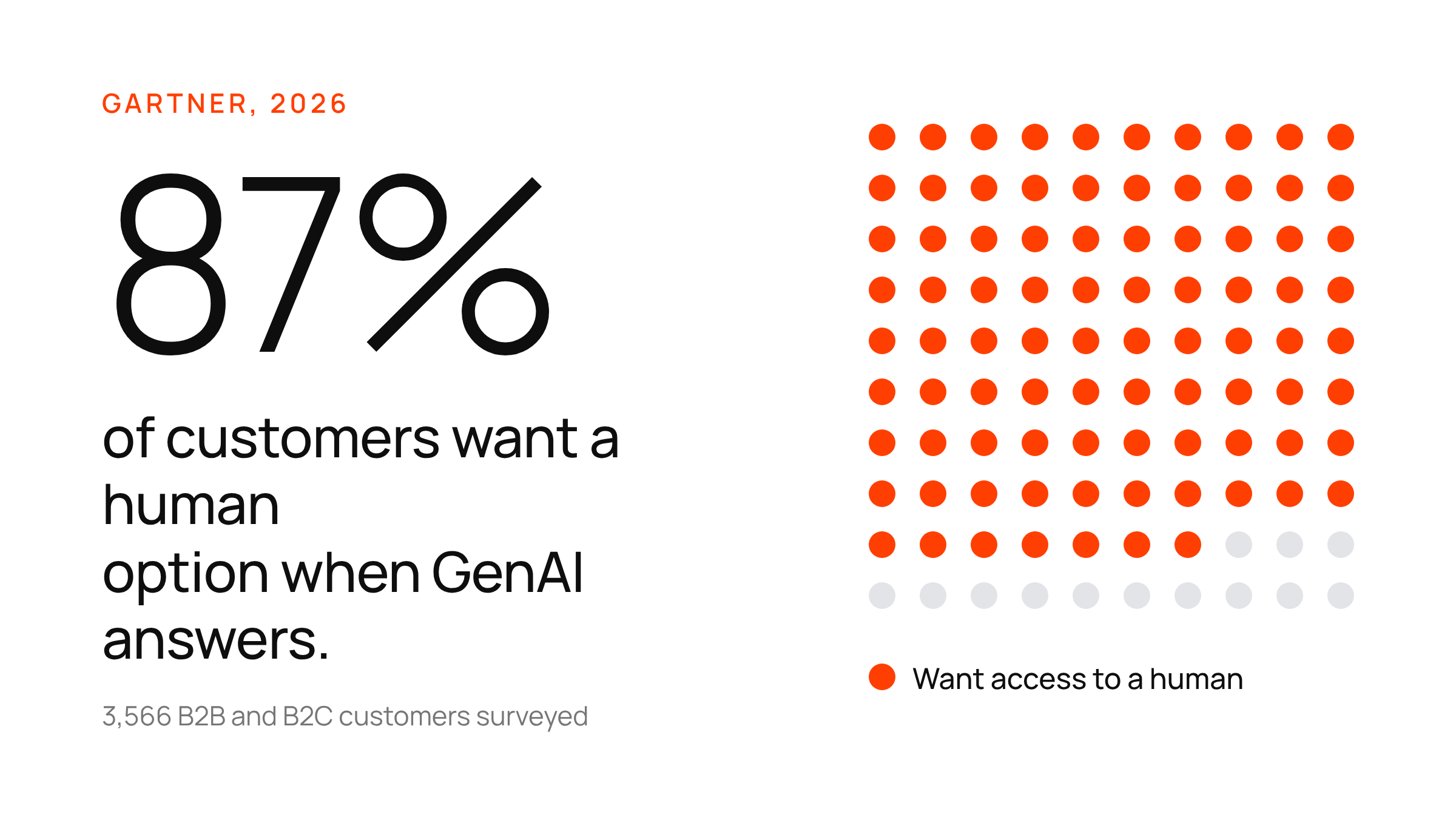
Customers expect a way out. In a 2026 Gartner survey of 3,566 customers, 87% said companies using GenAI for customer service must provide access to a human agent (Gartner, 2026). A bot optimized for containment works against that.
Measure what you’d measure for a person: was the issue resolved, how hard was it, and did the customer have to call again?
What should an AI voice agent scorecard include?
The same core items as your human QA scorecard, plus three checks only an AI needs.
| Dimension | Type | AI agent | Human agent | Why |
|---|---|---|---|---|
| Call reason | Category | ✓ | ✓ | Everything else is compared within a reason |
| Resolved on this call | Yes / no | ✓ | ✓ | The outcome that matters to the customer |
| Customer effort | Score 1 to 5 | ✓ | ✓ | Loops and repeats show up here first |
| Commitment logged (payment date, callback) | Yes / no | ✓ | ✓ | In collections, the promise is the outcome |
| Required disclosures given | Yes / no | ✓ | ✓ | Same rules apply to both |
| Handed over when it should have | Yes / no | ✓ | n/a | Disputes, hardship, explicit requests for a person |
| Handover passed the reason on | Yes / no | ✓ | ✓ | So the customer doesn’t repeat themselves |
| Invented an answer | Yes / no | ✓ | n/a | A confident wrong answer is the costliest AI error |
| Looped (asked the same thing twice or more) | Yes / no | ✓ | n/a | A common cause of frustrated callers |
All of it is visible in the transcript. You don’t need the bot’s internal logs to score it, which also means you can score any voice bot, not only your own. How the scoring works is in AI call analysis.
How do you compare an AI agent with your human team fairly?
By call reason, never overall. A bot that takes address changes and balance questions will beat your team’s overall resolution rate, because your team takes the hard calls. Compare like with like:
| Call reason | AI resolved | Human resolved | AI effort | Human effort | Read |
|---|---|---|---|---|---|
| Address change | High | High | Low | Medium | Keep with the AI |
| Invoice already paid | High | High | Low | Low | Keep with the AI |
| Payment plan request | Medium | High | Medium | Medium | AI collects details, hands over to decide |
| Dispute or complaint | Low | Medium | High | Medium | Route to a person |
This table is illustrative, not data from a client. Your own version, filled in from every call, is what should decide routing. Then re-run it monthly as you change the bot’s scripts.
Compare effort too. AI agents often win on effort for simple calls because there’s no queue and no hold. They lose when they loop. A rising effort score for one call reason is the earliest sign a bot shouldn’t own it. See customer effort score.
What should you check before trusting AI agent metrics?
Three things trip teams up.
- Different definitions. If the bot vendor’s “resolved” means “caller didn’t press 0,” you can’t compare it with your QA team’s “resolved.” Define each dimension once and score both from transcripts.
- Transcript quality. Speech recognition varies by language and line. Whisper, for example, scored a 17.6% word error rate on the CallHome telephone benchmark (Radford et al., 2022). Check a sample in each language you serve.
- Selection bias. If the bot only gets calls at night, or only one phone number, its mix differs from your team’s. Break down by reason and by time.
And keep scoring behavior, not feelings: in the EU, AI that infers the emotions of people at work has been prohibited since 2 February 2025 (AI Act, Article 5). That limit covers your human agents, not your bot, but a shared scorecard should stick to what was said and done.
How do you use the scorecard to grow the AI agent’s share?
- Start the bot on two or three reasons where your human team already resolves well and effort is low. Those are the safest to automate.
- Score every call for four weeks on the shared scorecard.
- Read the failures. Open every unresolved or looped bot call for one reason. The fix is usually a script, a missing data lookup or a handover rule.
- Expand by reason, not by volume. Add the next call reason only when the current ones match or beat your team.
- Keep a clean exit. Track handovers and how they went. A good handover is a success, not a failure.
It’s the approach we recommend for rolling out Sono’s AI phone agent or AI collection calls: reason by reason, with the numbers in front of everyone.
How Sono helps
Sonolytics gives you one scorecard for all AI and human calls. It reads every call, fills in the same dimensions for both (call reason, resolved, effort, handover, anything you define), and shows them side by side by reason, agent and week. You can ask “which call reasons does the AI agent resolve better than the team?” and get the answer with the calls behind it. It works with Sono’s voice agents and with recordings from other voice bots and contact centers. It’s in early access.
Measure your bot like a member of the team, and it’ll earn the calls it should take.
Useful links and sources
- Gartner: Agentic AI will autonomously resolve 80% of common customer service issues by 2029 (2025)
- Gartner: 87% of customers say companies using GenAI must provide access to a human agent (2026)
- Radford et al.: Robust Speech Recognition via Large-Scale Weak Supervision (2022)
- EU AI Act, Article 5 (European Commission AI Act Service Desk)