
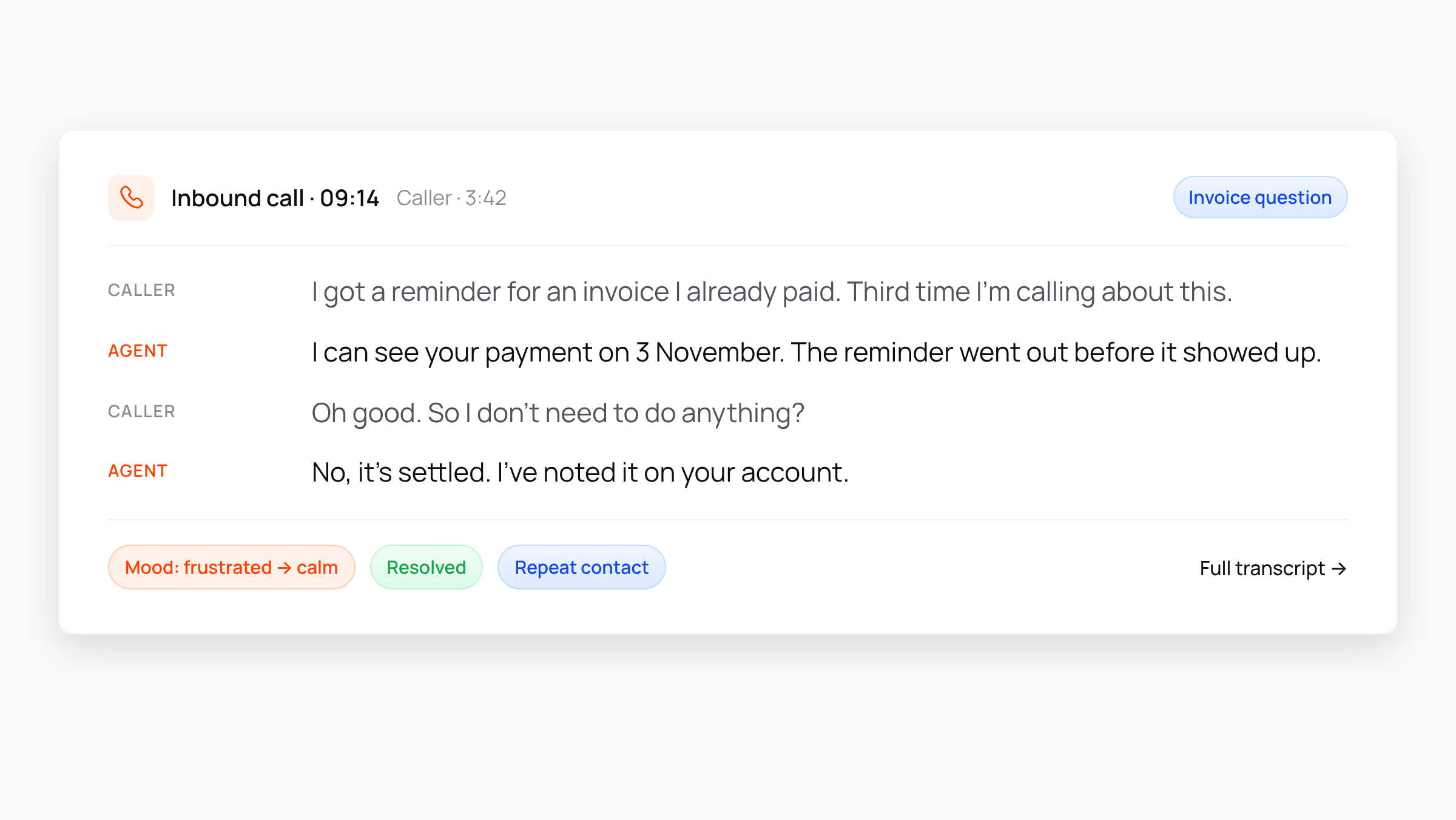
Call sentiment analysis is the use of AI to label how a caller feels during a phone call, typically as positive, neutral or negative. It reads what they say and sometimes how they say it. Call center sentiment analysis runs this across every call to spot trends, like a rise in frustrated callers after a price change. It’s useful, but less precise than vendor demos suggest: the best model on the SUPERB speech benchmark recognized four acted emotions with 67.6% accuracy (Yang et al., 2021). This guide explains what sentiment can tell you, where it fails, and the legal line to respect in the EU.
It’s one layer of call center analytics, which starts from a simpler problem: most calls are never heard by anyone.
How does call sentiment analysis work?
There are two approaches, and many tools mix them.
Text-based sentiment works on the transcript. A model reads what the caller said and scores it. “This is the third time I’m calling about this” reads as negative whatever the tone. It’s cheaper, works on any recording you can transcribe, and is easy to check because you can read the words.
Voice-based emotion recognition works on the audio: pitch, pace, volume. It can catch frustration that the words hide. It’s also harder to verify, more sensitive to line quality, and in the EU it sits closer to regulated “emotion recognition” (more below).
| Text-based sentiment | Voice-based emotion recognition | |
|---|---|---|
| Input | Transcript | Audio signal |
| Catches | What was said: complaints, threats to leave, thanks | How it was said: raised voice, tension |
| Misses | Sarcasm, polite anger | Context: a loud line, a naturally fast talker |
| Easy to check? | Yes, read the line | Harder, listen and judge |
| EU AI Act | Arguably outside “emotion recognition” (no biometric data), get advice | Emotion recognition based on biometric data: transparency rules; prohibited for employees at work |
How accurate is sentiment analysis on calls?
Good enough for trends, not good enough to judge a single call on its own. Three reasons.
First, emotion is ambiguous even for people. In the SUPERB benchmark, models classify speech into four emotions (neutral, happy, sad, angry) on acted recordings. The best model reached 67.6% accuracy (Yang et al., 2021). Real calls are messier than acted ones.
Second, sarcasm breaks text models. In the SemEval-2018 irony task, the best systems scored F1 0.71 on detecting irony and F1 0.51 on telling types of irony apart (Van Hee et al., 2018). Those results come from English tweets before today’s large language models, but “great, another reminder” still reads as positive to a naive model.
Third, transcripts aren’t perfect. Even a strong speech model like Whisper had a 17.6% word error rate on the CallHome telephone benchmark (Radford et al., 2022). A missed “not” flips the meaning.
None of that makes sentiment useless. Across thousands of calls, errors average out and the trend is real. It does mean you should never discipline an agent or flag a customer on a single sentiment label.
What is call sentiment analysis good for?
Four things, in order of value.
- Finding calls worth reading. Sort by “frustrated, not resolved” and read 20. That’s the fastest way to find a broken process.
- Trends after a change. A new invoice layout, a price change, a new bot script. Did frustrated calls go up for that call reason?
- Mood shift within a call. “Frustrated at the start, calm at the end” is a well-handled call. “Calm, then frustrated” points to something the agent or bot said.
- Comparing AI and human handling of the same reason. If frustration rises on bot calls for payment plans, that reason may belong with a person.
The pattern in all four: sentiment works next to call reason and outcome, not alone. A negative label without a reason is just a mood.
What does the EU AI Act say about emotion recognition?
Two rules matter for call analytics. Since 2 February 2025, the AI Act prohibits AI systems that infer people’s emotions at work and in education. The exception is medical or safety reasons (AI Act, Article 5). An automated “agent emotion” score in your QA program falls on the wrong side of that line in the EU.
For customers, emotion recognition isn’t prohibited, but deployers must inform the people exposed to it (AI Act, Article 50). Emotion recognition systems are listed as high-risk in Annex III (AI Act, Annex III). The Act defines emotion recognition by biometric data, so text-only sentiment on a transcript may sit outside these rules, while voice-based analysis likely sits inside. That distinction is a question for your lawyer, not for a blog. What’s clear: tell callers the call is recorded and why (EDPB), and keep agent emotion out of scoring.
Better signals than mood
Often the thing you want from sentiment is available more directly. Instead of “was the caller negative?”, score:
| Instead of | Score | Why it’s better |
|---|---|---|
| Negative sentiment | Repeat contact mentioned (yes/no) | Directly tied to a failure you can fix |
| Angry caller | Complaint or threat to leave (yes/no) | Clear, checkable, actionable |
| Mood score | Customer effort 1 to 5 | Predicts loyalty, see customer effort score |
| Agent tone | Next step clear to the customer (yes/no) | Scores behavior, not emotion |
These are all dimensions an AI can fill in from the transcript, with the line that justifies each answer. See AI call analysis.
How Sono helps
Sonolytics tracks caller mood next to call reason, outcome and effort on every AI and human call. It shows mood shifts within a call (“frustrated → calm”), lets you ask why frustration rose in a given week, and opens the calls behind the answer. You decide which dimensions to track, and the same definitions apply to your team and to Sono’s AI phone agent.
Use sentiment to find the calls that need you, then fix what the calls tell you.
Useful links and sources
- Yang et al.: SUPERB, Speech processing Universal PERformance Benchmark (2021)
- Van Hee et al.: SemEval-2018 Task 3, Irony detection in English tweets (2018)
- Radford et al.: Robust Speech Recognition via Large-Scale Weak Supervision (2022)
- EU AI Act, Article 5, Article 50 and Annex III (European Commission AI Act Service Desk)
- EDPB: Data protection guide for small business, recording calls