Call center quality assurance (QA) is the process of reviewing customer calls against a scorecard to keep service consistent, catch compliance risks and coach agents. In most contact centers it still means a supervisor listening to two to four calls per agent per month, which covers less than 2% of interactions (McKinsey, 2022). This guide explains why that sample can’t carry the weight put on it, what a scorecard should contain, and how to run QA on every call, AI and human.
QA is part of the wider problem of not knowing what happens on your calls. The overview is in call center analytics.
Why is quality assurance important in a call center?
Because the phone is where customers decide whether you’re easy to deal with. QA protects three things. First, consistency: customers should get the same answer whoever picks up. Second, compliance: required disclosures, identity checks and, in collections, rules on what can be said. Third, improvement: agents get better with specific feedback on real calls.
The trouble is that QA is asked to do all three with a tiny sample. A coach who reviews four to six calls out of the five or six hundred an agent handles each month (McKinsey, 2018) can coach. That coach can’t vouch for compliance or explain why customers are calling.
What’s wrong with sampling a few calls per agent?
Four things, and they compound.
- The sample is too small to find rare problems. A compliance miss on 1 call in 200 won’t show up in three reviewed calls, most months.
- The sample isn’t random. Reviewers pick calls that are short enough to listen to, or long enough to look interesting. Either way, the sample leans.
- Scores drift between reviewers. McKinsey estimates manual scoring at 70 to 80% accuracy, against more than 90% for automated QA (McKinsey, 2024). Those are McKinsey’s estimates, but anyone who has run calibration sessions knows the spread.
- It measures agents, not the business. A QA form asks “did the agent verify identity?” It doesn’t ask “why did this customer have to call at all?”
ContactBabel’s survey work points the same way: for most businesses, fewer than 5% of interactions are used in QA (ContactBabel, 2021).
What should a call center QA scorecard include?
Fewer items than you think. Long forms make reviewers skim and make automated scoring vague. Keep five to eight items, and make each one answerable from the call itself, without guessing what the agent was thinking.
Here’s a scorecard template that works for both service and collections calls:
| # | Item | Type | Pass looks like |
|---|---|---|---|
| 1 | Call reason captured | Category | One reason from your list, e.g. invoice question, payment plan, address change |
| 2 | Identity verified before account details | Yes / no | Required check done before any account data is shared |
| 3 | Issue resolved on this call | Yes / no | No callback needed, nothing left open |
| 4 | Customer effort | Score 1 to 5 | 1 = one ask, no transfer; 5 = repeated explanation, transfer, still open |
| 5 | Commitment made and logged | Yes / no | Any promised callback, payment date or follow-up is stated with a date |
| 6 | Required disclosures given | Yes / no | E.g. recording notice; in US debt collection, the required notices |
| 7 | Next step clear to the customer | Yes / no | The customer can repeat what happens next |
| 8 | Handed over correctly (if handed over) | Yes / no | Reason passed on, customer didn’t have to repeat it |
Notice what’s missing: “agent sounded friendly” and “agent showed empathy.” They matter, but they’re hard to score consistently. If you keep them, define what a reviewer should hear, word for word.
How do you score every call instead of a sample?
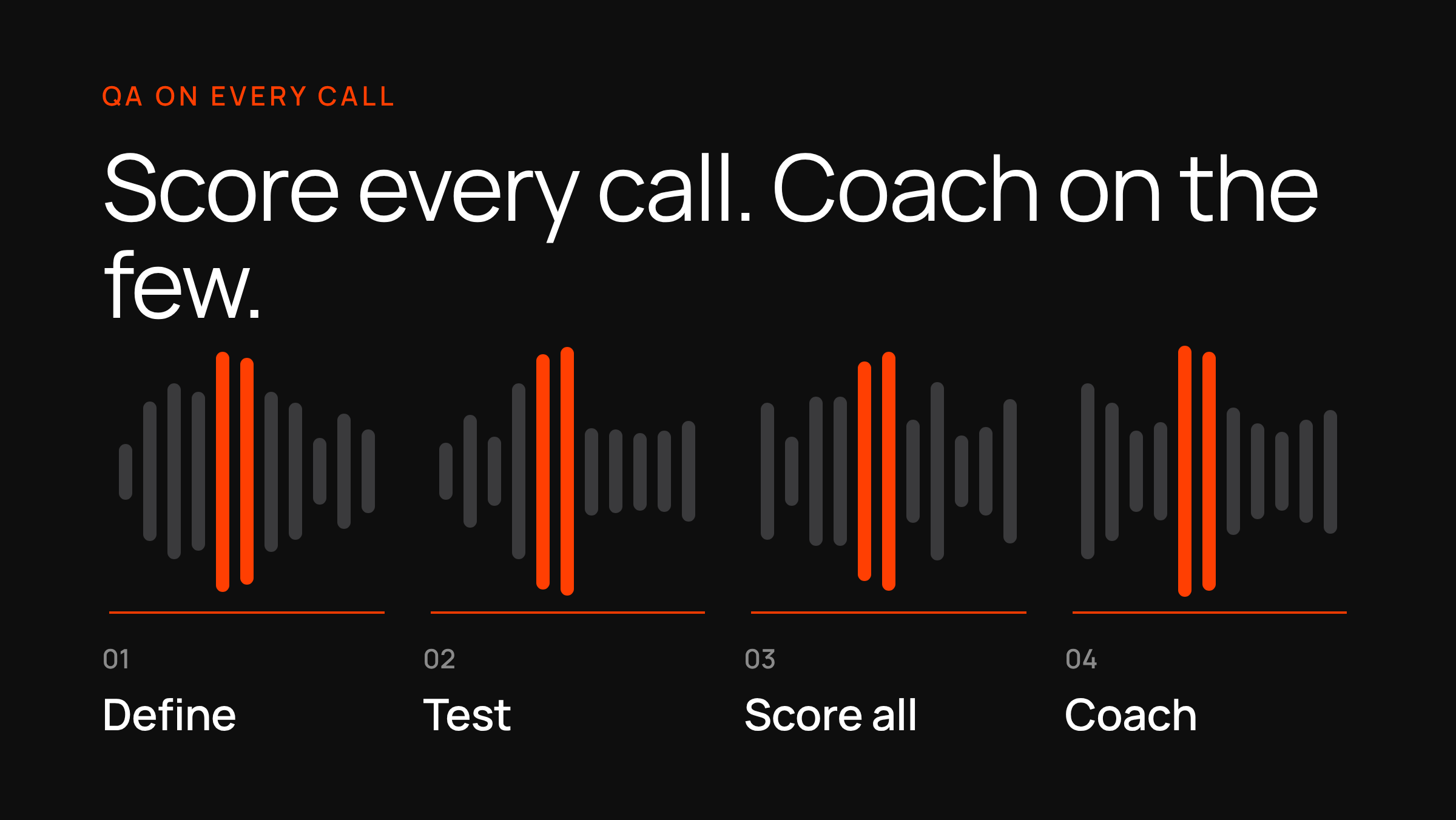
With AI call analysis. The call is transcribed, then a language model reads the transcript and fills in each scorecard item. You check its work on a sample, not the other way around. The steps:
- Write each item as a question with a definition. “Was identity verified before account details were shared? Yes means…”
- Run it on 200 past calls and read 30 of them yourself. Fix the definitions where you and the model disagree.
- Turn it on for every call. Look at scores by agent, by call reason and by week.
- Use people for coaching, not listening. Supervisors open the calls behind a low score and coach on those.
- Recalibrate monthly. Read a fresh sample, compare, adjust.
McKinsey reports more than 50% savings in QA costs from automated QA (McKinsey, 2024). The bigger gain is that your QA results finally describe the whole operation. More on how the analysis works in AI call analysis.
Should AI agents and human agents share one QA scorecard?
Yes. If a voice bot takes part of your calls, score it on the same items. Then you can compare resolution, effort and compliance by call reason and decide which calls each should take. A bot that resolves 90% of address changes but 40% of payment-plan calls should keep the first and hand over the second. Separate scorecards hide that.
For AI agents, add two items: “handed over when it should have” and “didn’t invent an answer.” Both are visible in the transcript. More in how to measure an AI voice agent.
What QA can’t score (and shouldn’t)
In the EU, AI that infers the emotions of people in the workplace has been prohibited since 2 February 2025, apart from medical or safety reasons (AI Act, Article 5). An automated “agent emotion” score is the kind of feature to leave out of EU QA programs. Scoring what was said and done (identity checked, issue resolved) is a different thing. Get legal advice for your own setup.
Customers must also be told that calls are recorded and why (EDPB). In the US, check consent rules in every state you call: about 11 states primarily require all parties to consent (RCFP).
How Sono helps
Sonolytics runs your QA scorecard on every call. You define the dimensions once (category, yes/no, score or percentage), and it fills them in for each AI and human call. You can ask questions in plain language, open the calls behind any number, and track a new dimension when something changes. If you also run Sono’s AI phone agent or collection calls, those calls land on the same scorecard as your team’s.
QA doesn’t have to be a monthly listening chore. Score everything, read what matters, and coach on that.